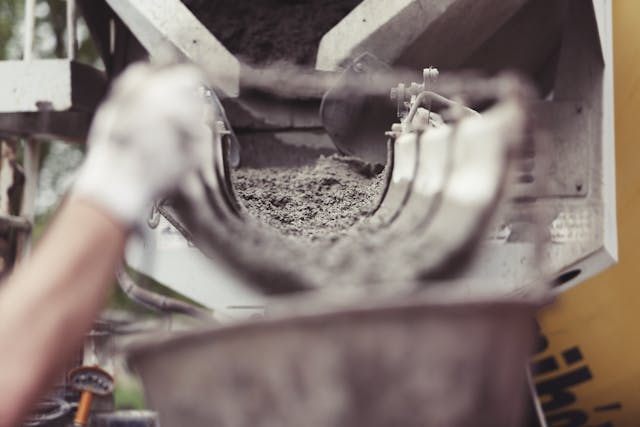
Are you afraid of seeing your foundations crumble or your slabs crack due to an approximate mix? This article details the foolproof method of 350 kg concrete dosing with sand and gravel mix, a master formula to guarantee unbeatable structural strength. By mastering this expert ratio and the water-to-cement ratio, you will transform your aggregates into an artificial rock of exemplary durability, worthy of the greatest builders.
📍 My experience: When creating my terrace last June, I rented a mixer to ensure the homogeneity of the mix. I paid about 45 euros per day, but the result is nothing like a manual mix with a shovel. The lesson is simple: for perfect 350 concrete, the consistency of mixing is as important as the precision of dosing.
- Understanding the strength of 350 concrete dosing for your projects
- The exact proportions for 100 liters of successful concrete
- Dosing by bucket or shovel without error
- The art of perfect mixing and professional finishing
Understanding the strength of 350 concrete dosing for your projects
After choosing your project, you need to tackle the heart of the matter: structural strength through dosing at 350 kg.
The technical definition of the 350 kg mix
The 350 kg concrete dosing with sand and gravel mix corresponds to the mass of cement per cubic meter. It is the standard for the structure. We are not talking about the total weight, but the concentration of the binder.
⚠️ Common misconception
It is often thought that adding more water makes the work easier, but this is a serious mistake. Too much water dilutes the cement and reduces the final strength of the concrete by up to 30% by creating pores during evaporation.
Cement acts as a hydraulic glue binding the sand and gravel. This reaction creates a solid artificial rock. It ensures maximum longevity for your outdoor works.
To go deeper, I recommend checking out my review on the concrete mixer which complements this topic well. The article on how to make a screed also provides useful insights. And to go further, this guide on how to sand concrete offers interesting perspectives for your finishes.
Why choose this mix for your slabs and foundations?

This mix outperforms 300 kg concrete in compression. It is essential for driveable slabs or house foundations. Without this density, the risk of cracks increases. It is a safety measure for your structures.
- Support columns, lintels.
- Garage slabs, footings.
🌍 Did you know?
Concrete mixed at 350 kg has a compressive strength of about 25 MPa after 28 days of curing, which is equivalent to supporting 250 kg on each square millimeter of surface!
Distinguishing reinforced concrete from non-reinforced concrete
Reinforced concrete incorporates steel to resist tension. The 350 kg mix is ideal here. It perfectly coats the metal to prevent any early internal corrosion.
Non-reinforced concrete is used for simple masses. However, for a slab, reinforcement remains the standard. This rich mix then guarantees maximum adhesion on the mesh.
Exact proportions for 100 liters of successful concrete
Once the theory is understood, let’s move on to the concrete numbers to prepare your first batch of 100 liters.
Balance between cement, sand, and standard gravel
For 100 liters, mix 35 kg of cement with 50 liters of sand and 80 liters of gravel. This ratio follows the simplified 1-2-3 rule. The sand fills the gaps between the large stones to densify the whole.
Granulometry is crucial for texture. Clean sand and crushed gravel offer better grip. It is this combination that gives concrete its final strength.
| Component | Quantity for 100L |
|---|---|
| Cement | 35 kg |
| Sand / Gravel | 55L / 73L |
Mastering the water-to-cement ratio and moisture
Water is the enemy of concrete if in excess. Surplus weakens the structure. Aim for about 17 liters of water for 35 kg of cement. This is the secret to a dense and strong concrete.
If it has rained, reduce your water input. Damp sand can contain several liters of invisible liquid. Be vigilant during mixing for your 350 kg concrete mix with sand and gravel.
🧊 Optimal storage
Always store your cement bags on pallets 15 cm off the ground. Protected from moisture, a bag remains usable for about 6 months before it starts to harden into blocks.
Calculate the total volume to avoid waste
Multiply length, width, and height to obtain the required volume. This is a simple step but often overlooked by rushed beginners.
Always add a 10% safety margin. Concrete settles during placement. It’s better to have a slight surplus than a catastrophic shortage.
Measuring with a bucket or shovel without mistakes
But on site, no one weighs every kilo; here’s how to turn these numbers into simple actions.
Proportions for a 35 kg or 25 kg bag
👍 Strengths
- Guaranteed structural solidity
- Increased natural waterproofing
- Excellent durability
🔻 Limitations
- Higher cement cost
- Heavier mix to stir
For a 35 kg bag, count on 10 buckets of 10 liters. This includes sand and gravel. It’s the most reliable method for consistent dosing.
| Cement bag | Sand volume (10L) | Gravel volume (10L) | Approximate water |
|---|---|---|---|
| 35 kg bag | 4 buckets | 6 buckets | 17L |
| 25 kg bag | 3 buckets | 4 buckets | 12L |
If you use a 25 kg bag, adjust your buckets. The ratio remains the same but the volumes decrease proportionally.
Calibrate your measuring tools like a pro
Never change buckets halfway through. Use only one 10-liter model for the entire job. Precision is the key to a homogeneous slab.
Mark your buckets with a felt-tip line. This prevents errors when fatigue sets in. A poorly filled bucket totally skews the strength of your final concrete. It’s a very effective old mason’s trick.
Also check your shovels. A rounded shovel holds more than a flat shovel. Stay consistent.
The art of the perfect mix and professional finishes
The dosing is ready, now just mix properly to obtain a smooth and solid paste.
Order of adding components into the drum
Turn on the mixer and pour in half the water. Then add the gravel. They will clean the walls and help with the mixing of the finer elements.
Pour in the cement, then the sand and the rest of the water. Let it run for a few minutes. You should get a uniform gray color without any lumps.
Common mistakes to avoid during preparation
Respecting the concrete dosage of 350 kg with a sand and gravel mix requires constant vigilance on hydration. Here is a golden rule during mixing:
Too liquid concrete is dead concrete; the strength drops by half if you flood your mix for convenience.
Watch the bulking of the sand. If it is damp, it takes up more space in the bucket. Tamp it down slightly to avoid under-dosing your mix in actual aggregates.
Curing time and equipment maintenance after use
Concrete takes 28 days to reach its maximum strength. Do not drive on a slab before at least 3 days. Watering is necessary in summer to prevent drying out.
Clean your concrete mixer immediately with plenty of water. If the concrete dries on the blades, it will be impossible to remove without damaging the metal drum.
Mastering this 350 kg concrete dosage guarantees structural works of exemplary robustness, combining a perfect density between binder and aggregates to prevent any cracking. Prepare your buckets and concrete mixer now to transform these calculations into unshakable foundations. Build today a stone legacy that will calmly defy the passage of decades.
FAQ
What is concrete dosed at 350 kg and what is it used for?
The 350 kg dosage refers to the precise mass of cement incorporated to make one cubic meter of fresh concrete. A true standard of structural construction, this mix offers superior mechanical strength, turning into an artificial rock of exemplary robustness after hardening.
This dosage is the essential ally of stressed structures. It is primarily used to pour foundations, driveable slabs, posts, or lintels, thus guaranteeing durability and stability against the tests of time.
What are the proportions of sand and gravel for a 350 kg mix?
To achieve this perfect balance, the empirical “1-2-3” rule serves as a mason’s spiritual guide: one volume of cement to two volumes of sand and three volumes of gravel. For 100 liters of concrete, this represents about 35 kg of cement, 50 liters of sand, and 80 liters of well-graded gravel.
The sand poetically fills the gaps between the gravel, while the cement, like a hydraulic glue, binds everything together. This studied granulometry ensures maximum compactness, transforming disparate elements into a monolithic block of remarkable density.
How many buckets of mix should be planned for a 35 kg bag of cement?
When leaving the scale aside for the 10-liter bucket, precision remains essential not to betray the strength of the work. For a 35 kg bag, it is appropriate to use 4 buckets of sand and 6 buckets of gravel, creating an ideal weight harmony for your reinforced concrete work.
It is crucial to keep the same container throughout the site to ensure the homogeneity of the mixture. Marking your buckets with a felt-tip pen will avoid dangerous approximations, ensuring that each batch has the same soul and strength as the previous one.
How much water should be added for a successful 350 kg dosage?
Water is the spark that triggers the chemical reaction, but its excess is a tempting siren that must be ignored. For a 35 kg bag, about 17 liters of water are needed, maintaining a water/cement ratio close to 0.5 for optimal durability.
Special attention must be paid to the natural moisture of the sand, especially if it has been exposed to the whims of the weather. Rain-soaked sand already contains an invisible liquid reserve that must be deducted from your manual addition so as not to drown the strength of the mix.
In what order should the components be introduced into the concrete mixer?
The art of mixing follows a precise choreography: start by pouring half of the water, then add the gravel. The latter, through their abrasive action, clean the walls and prepare the ground for the arrival of the binder and finer elements.
Then add the cement, followed by the sand, before perfecting the consistency with the remaining water gradually. Mixing for 3 to 5 minutes is the secret to obtaining a smooth paste, of uniform gray, ready to be applied with flair.