The cypress catches the eye with its slender silhouette and evergreen foliage, but it is especially its root system, often overlooked, that plays a crucial role in the health of the tree, its interaction with the soil, and the surrounding constructions. Before planting or managing cypresses near your home, it is useful to clearly understand how their roots develop and what issues arise from this. The following points are based on my field experience and the in-depth analysis of numerous sites where this conifer was present.
My editorial analysis: In my opinion, the cypress is too often seen as a simple green wall when its true power (and greatest danger) lies underground. I consider the cypress root system a masterpiece of biological strategy: it does not only seek to anchor the tree, it colonizes the space with an aggressiveness that many gardeners underestimate when planting. My view is that one should not fear this tree, but respect an absolute safety distance from your foundations, because a cypress root will not hesitate to overcome any masonry obstacle to find the moisture it needs.
Components of the cypress root system
The cypress root system exhibits great anatomical diversity and remarkable adaptation to different soil types. Its structure includes surface roots and deep roots, each playing a specific role in the tree’s stability as well as in the absorption of water and nutrients. This complementarity ensures the balance between anchorage and nourishment of the tree.
We classically distinguish the surface roots, which meander just beneath the soil surface, and the deep roots capable of penetrating several meters depending on the nature of the terrain. The harmonious development of these elements ensures the vigor of the cypress, even in hostile contexts.
Extended root system and lateral extension
An adult cypress can deploy an extended root system whose lateral extension sometimes far exceeds the width of the canopy. The horizontal roots then occupy a large area, allowing the tree to draw water from rainfall while stabilizing itself against storms.
In some cases, especially when the soil is compact or rocky, these horizontal roots dominate over the deep roots, accentuating their peripheral elongation. This type of development offers a definite advantage in terms of drought resistance, since the tree captures residual moisture on the surface over a vast area.
Lignified roots and anchorage in the soil
The lignified roots of the cypress form a dense and solid network that strongly contributes to the tree’s solidity. They develop mainly in the upper layers of the soil, ensuring both mechanical support and the accumulation of nutrient reserves.
The depth of the roots gradually increases with the age of the tree, sometimes reaching two to three meters depending on the presence of rocks or a water table. This progression allows for remarkable anchorage, even against strong winds.
To limit the spread of roots towards your installations, it is sometimes necessary to clear congested areas using an angle grinder equipped with a suitable disc to cut small woody shoots. If you plan to build a low wall nearby, soil preparation with a concrete groover will create an effective root barrier in your foundations. Finally, for the regular maintenance of the aerial part of your hedges, using an electric pruner will provide the necessary power to tackle the densest branches without excessive effort.
Management of cypresses: proximity to buildings and landscaping
The impact of roots on constructions must be taken into account when choosing the location of a cypress. In my practice, I have observed structural damage related to poor placement, especially when the tree is planted too close to a slab or foundation wall.
Keeping this tree sufficiently away from homes, pools, or terraces greatly reduces risks to your infrastructure while preserving its remarkable ornamental qualities. Good preventive management avoids many long-term inconveniences.
Proximity of roots and risks to masonry works
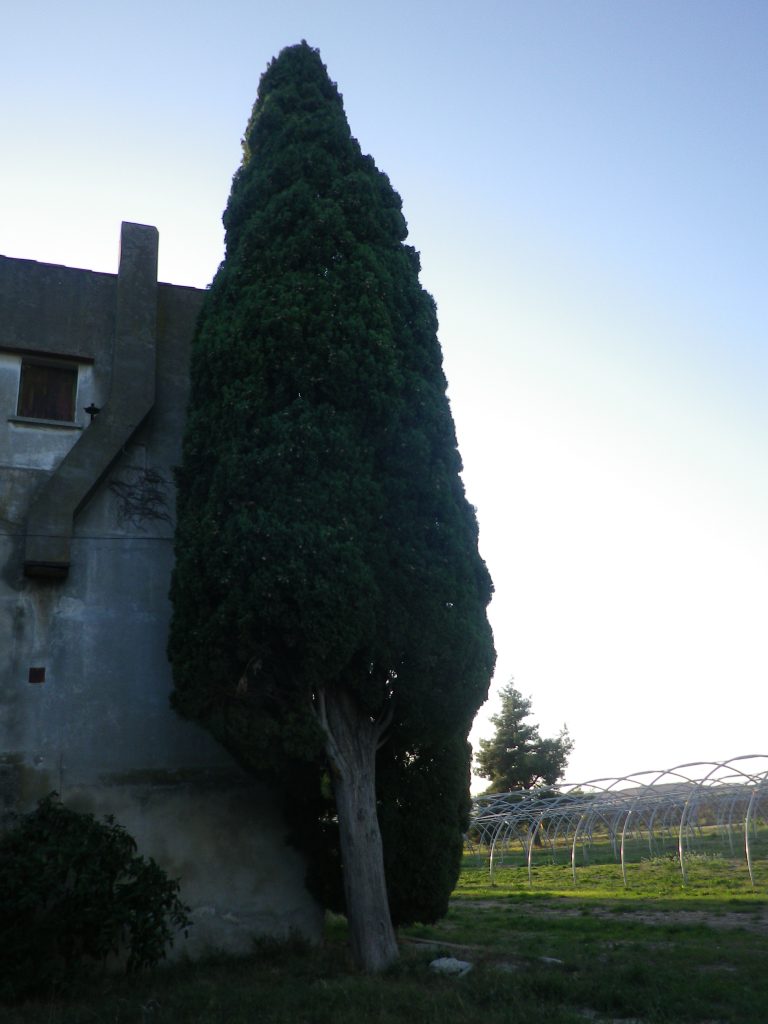
When planting a cypress less than three meters from a building, the surface roots sometimes exert pressure on technical trenches or foundations, which can cause cracks and lifting in extreme cases. The interaction is not due to brute force but rather to ground movements induced by water uptake and root growth.
In the absence of a protective curb or adapted foundations, the lateral extension of roots can lead to costly damage. To prevent this, it is advisable to allow sufficient space and install a root barrier, flexible or rigid, at the time of planting.
Impact of roots on buried installations
Over time, roots can detect the slightest water leak and invade pipes or porous drains in search of moisture and nutrients. I have observed this active moisture-seeking behavior through root invasion of technical conduits, especially if one of them leaks a few drops after a winter freeze or accidental shock.
To limit these inconveniences, choose quality pipes suitable for installation under tall vegetation, and ensure that joints are perfectly sealed, particularly in areas exposed to summer drought.
Comparison between surface and deep roots under different conditions
The behavior of roots varies according to soil texture and water availability. Under Mediterranean climate, where drought is frequent, there is generally a strengthening of surface roots, responsible for quickly capturing water during rare rainfalls.
When the soil benefits from regular water supply or has a good thickness of topsoil, deep roots develop more, allowing the cypress to endure dry periods without losing vigor. This explains its popularity as a hedge tree in many dry gardens.
- Heavy soil: roots mainly horizontal and superficial;
- Light and deep soil: roots mostly vertical and deep;
- Presence of rock or obstacle: the root system adapts by bypassing the obstacle and increasing lateral extension;
- Persistent water shortage: increased root development towards the surface.
| Soil type | Dominant development | Risks for buildings | Drought resistance |
|---|---|---|---|
| Clayey | Superficial | Medium to high | Low to medium |
| Sandy | Increased depth | Low to medium | Good |
| Stony | Strong lateral extension | Variable | Excellent |
I personally had a sudden awakening the day I wanted to install a simple garden border three meters from an old Provençal cypress hedge. Digging barely twenty centimeters, I came across a network of roots as dense as steel cables, literally “choking” the other plants in my flowerbed. This experience taught me that the cypress does not share its territory: it dries out the soil over a radius much wider than the canopy above. This is an essential reflection I share today: planting a cypress means accepting that nothing else will easily grow at its feet without a massive supply of water and fertilizer.
Frequently Asked Questions About Cypress Roots
What is the typical depth of cypress roots?
The depth of cypress roots depends greatly on the soil and environmental conditions. Generally, the roots do not exceed two to three meters in depth, but they can remain more superficial if the soil is poorly permeable or rocky.
They often favor lateral extension over long distances rather than strictly vertical rooting. This characteristic improves drought resistance in many French regions.
Can cypress roots damage buildings?
Yes, especially the surface roots when they extend too close to buildings. Their dynamic growth can disrupt light foundations or crack paving around the perimeter.
- Stay at least three meters away from buildings;
- Install an appropriate root barrier;
- Regularly monitor the condition of surroundings (paths, underground networks).
Should root growth under terraces and paved walkways be feared?
Horizontal roots can indeed lift light coverings, or even crack surfaces if they do not rest on a solid base. The problem mainly comes from soil movement caused by root growth, rather than a true mechanical push.
Choosing a sufficient planting distance and ensuring good substrate compaction limit these problems in the long term.
What benefits do cypress roots bring to the garden?
Thanks to their extensive root system, cypresses offer excellent wind stability and remarkable drought adaptation capacity. They also contribute to soil aeration through the network of fine roots.
- Stabilization of embankments or slopes;
- Creation of economical windbreaks;
- Successful adaptation to dry gardens regardless of the region.