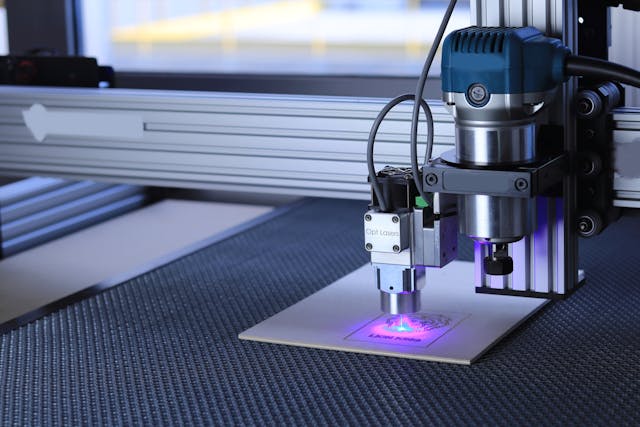
Like a welding machine, laser cutting machines are among the most used tools by professionals. They are used in countless applications, including laser welding or engraving, cutting sheets, tubes, plates, and many others.
Besides multiple functionalities, several laser cutting advantages can be distinguished. Thanks to the high-intensity laser beam, the equipment efficiently heats the material to burn, vaporize, or melt the target parts. This technology allows for great laser cutting precision.
If you are considering making a purchase, it is important to choose a good laser cutter for metal, wood, aluminum, acrylic, cork, leather, and more. We therefore suggest you take your time and consult this article summarizing the essentials to know about the laser cutting machine.
The essentials in a few words: In my opinion, laser cutting has completely revolutionized the world of prototyping and personalized creation. I find it fascinating to see how a simple idea drawn on a screen can transform into a physical object with millimetric precision in just a few seconds. My point of view is that this technology, once reserved for heavy industry, is becoming the best ally of the demanding individual: it allows for clean finishes without any mechanical effort, opening the way to limitless creativity on materials as varied as wood, acrylic, or leather.
What are the main materials compatible with laser cutting, and what are their cutting specificities?

If you think that DIY devices like cordless drills are the only versatile equipment, you are mistaken. Similarly, several different uses can be made of devices like laser cutting machines. This tool is used to cut a whole range of materials.
Among the most processed elements, wood is cut using low-intensity lasers. The goal is, for example, to make jewelry, ornaments, puzzles, or toys, just like with a wood lathe. A laser cutting machine can shape it into different forms and thicknesses according to your needs.
You can also use it with acrylic or plastic. They are among the most widely used synthetic materials with a laser machine. Regardless of their thickness, colors, or finishes, they can be cut by laser with a shiny surface and a smooth edge.
Otherwise, do not hesitate to use it with cardboard. Unlike most objects, the latter is the easiest to cut. Many work with laser-cut cardboard for model-making parts design. Fabric is also suitable for the laser cutting machine. Leather is of course a type of textile, but nylon, silk, polyester, as well as cotton are also options.
Regarding the metal laser cutter, this laser machine requires a more specific type of laser to cut this solid material. The same goes for glass. Due to its fragility, it cannot be cut with a standard laser beam. Many artisans use laser engraving cutting with this delicate material to create a variety of decorative accessories.
Apart from that, the laser cutting is used to work on rubber, aluminum, gold, brass, foams, cork, seals, films, labels, adhesives, and much more.
I tested laser cutting for the first time when I wanted to create complex ornaments for a modern marquetry project. The realization was immediate: where I would have spent entire days with a scroll saw for a sometimes approximate result, the machine completed the work in less than ten minutes with disconcerting perfection. That day, I realized that the tool did not replace the artisan’s talent but acted as a precision amplifier. This experience pushed me to rethink the way I design my objects, now incorporating graphic details that I previously forbade myself for fear of technical complexity.
Comparison of Laser Cutting Technologies
| Type of Laser | Preferred Materials | Line Precision | Typical Use |
| CO2 Laser | Wood, acrylic, glass, leather | Excellent | Craftsmanship and Signage |
| Fiber Laser | Metals (stainless steel, aluminum, steel) | Extreme | Industry and Jewelry |
| Diode Laser | Paper, cardboard, softwood | Fair | Beginners and Small DIY |
Which Laser Cutting Machine to Choose?
Whether you plan to buy a cardboard laser cutter, textile laser cutter, or metal laser cutter, finding the best model can take a lot of time. To help you in your search, here is a list of laser cutting machines that are among the most sought after by the general public:
GOWE Mini Laser Cutting Machine
No products found.
The GOWE mini CO2 laser cutting machine 40W is a compact device ideal for precision engraving and cutting on various materials such as wood, acrylic, or leather. Powered by 220 V, this CO2 laser machine offers a 40 W power suitable for creative and artisanal projects. Thanks to its USB support, it allows simple control from a computer, facilitating the creation of detailed and personalized designs.
In terms of features, this compact laser cutting machine combines precision and versatility with a stable structure and accessible control system. It is suitable for both amateurs and small workshops looking for an efficient solution for laser engraving. Its reduced size optimizes space while maintaining good performance.
ORTUR OLM3 Laser Engraver – 20W Output Power CNC Laser Engraving Machine
No products found.
This model stands out from others due to the presence of an air pump. With a 50 L capacity, it is equipped with an air outlet system blowing away the smoke produced by the material during work. As a result, the edge of the cut is not only smoother but also cleaner. That’s not all; it optimizes the machine’s efficiency and improves the quality of the cut.
Practical, this laser cutter comes with foldable legs. You can thus adjust its height relative to the laser. Equipped with a 20 W power, it can cut and engrave up to 40 different types of materials such as glass, wood, metal, acrylic, stainless steel, and more.
xTool S1 20W Laser Engraver Cutter with Work Panel and Air Assist
No products found.
With a working speed of 600 mm/s and a power of 20 W, this laser machine can cut and engrave many materials effortlessly and precisely. Thin or thick, leather, acrylic, stainless steel, wood, plastic, and other common objects can be more easily processed with this laser cutter to create perfect works.
Complete, it comes with innovative air assistance and a honeycomb work panel. Even better, it features multi-directional flame detection for safe use. Additionally, this laser cutting and engraving machine is equipped with a safety cover protecting your eyes. It is no surprise that it has a class 1 laser safety certification.
How does laser cutting technology work, and what are the main differences between CO2 lasers and fiber lasers?
Simply put, laser cutting is a type of treatment through thermal separation. The laser beam penetrates deeply into the surface of the object. Then it heats it to vaporize or melt it. Once it reaches a designated area, the laser cutting process truly begins.
The laser beam simply follows the indicated geometry. It cuts the material during the process. Depending on the application, different methods are used during laser cutting and engraving. There is the CO2 laser and the fiber laser.
As its name suggests, the first uses carbon dioxide to optimize the laser cutting process. As for the second, it uses fiber optic cables. These allow photons to be transported to create the beam through various elements such as erbium, thulium, neodymium, and more.
A metal laser cutting machine often employs fiber lasers. If your project involves processing organic materials such as cardboard, wood, or textiles, CO2 lasers will be the best choice.
What are the advantages of laser cutting compared to traditional cutting methods, such as mechanical cutting or water jet?
Of course, water jet and mechanical cutting are among the cutting methods used so far. But it is noticeable that the advantages of laser cutting are numerous, convincing many professionals.
They particularly appreciate the precision of laser cutting. The beam is able to carve geometries in the sharpest way, and in any shape. Once the laser-cut materials are separated, there is generally no post-processing such as sandblasting or sealing.
Laser engraving on textiles, laser cutting on cardboard or metal laser cutting, whatever the type of laser cutting machine, this device stands out for its high speed. The process is completely clean, causing neither cutting fluids nor residues.
The advantages of laser cutting also relate to the versatility of the equipment. It can process many different elements, regardless of their thickness or shape. Multifunctional, it is capable of engraving and cutting them.
The laser cutting process is also automated with minimal user intervention. Moreover, the process requires no additional support or working instruments, which limits tooling costs.
How do laser power and cutting speed influence the quality of the final cut?
Whether you plan to use a metal laser cutting machine or laser cutting on cardboard, know that the quality of the cut depends on the speed and power of the laser beam. This last point is a key factor, as it can define the speed and thickness of the cut.
If the laser power is high, you can process a material with a high cutting thickness. Laser cutting is also faster. For example, to cut a sheet with a thickness of 12 mm, you will need an output power of up to 1 kW. However, laser engraving cutting of 5 mm stainless steel only requires a power of 1 kW.
Highly efficient laser cutting machines are therefore capable of processing thicker materials, with a high cutting speed. However, caution is needed, as a high laser power may harm the quality of the cut. It can even damage the object being worked on.
Besides laser power, material thickness, and cutting speed, other parameters such as laser beam diameter, nozzle size and category, beam focus position, assist gas, and type of work are integral to the success of the laser cutting process. Together, they dictate the speed, efficiency, and especially the quality of the cut.
What safety precautions should be taken when using a laser cutting machine?
Compared to other technologies, laser engraving cutting has become a kind of advanced treatment in recent years. Due to the powerful laser beam used, a laser cutter can separate several different materials, regardless of their thickness.
Besides its speed and precision, many advantages of laser cutting can be discovered. Nevertheless, its few disadvantages should not be overlooked. Its handling presents certain risks. Therefore, it is imperative to adopt certain safety precautions throughout the laser cutting process.
Since the equipment uses a very powerful laser beam, the temperature rises very quickly once in contact with engraving elements. It easily burns flammable objects. To limit fire risks, please closely monitor the laser machine. Keep a fire extinguisher within reach.
If you have not yet used a laser cutter, it is recommended to be accompanied by an experienced operator. During handling, you must wear personal protective equipment.
Remember that the lasers of the laser cutting machine are high power. They can cause skin burns. Therefore, thick gloves and appropriate suits must be worn.
Similarly, as the cutter emits very intense light, avoid looking at it directly or from too close. Otherwise, you can obviously injure your eyes. Be sure to equip yourself with suitable protective glasses.

Toxic dust and fumes may also be present. It is essential to use air filtration and ventilation systems. They ensure your safety as well as that of those around you.
How to choose the right control software for a laser cutting machine based on production needs?
Whether you are a novice or a professional, a laser cutting machine offers the opportunity to realize countless creative ideas such as decorative wall accessories, keychains, or personalized glasses. To carry them out, it is necessary to use project design software.
Among the most popular, CorelDRAW, Adobe Illustrator, and Inkscape provide better results. They help you compose and then edit vector graphics. According to users, they are easier to use.
Apart from that, many people opt for Sketchup, a free 3D software. You have the option to use it to create 2D or 3D files. Once done, you export them in SVG format.
Unlike Sketchup, Lightburn is a paid graphic design software. Multifunctional, it is both an editing software and a control software for a laser machine. You can use it to monitor or configure the parameters of the laser cutter including its speed, the order of passes, its power, and more.
What are the costs associated with purchasing, maintaining, and operating a laser cutting machine?
Considering the many advantages of laser cutting, many want to acquire a new laser machine. If you are among them, it remains useful to inform yourself about the costs related to its acquisition, use, and maintenance.
First, know that its price varies depending on several factors such as the brand’s reputation, the equipment’s performance, its cutting quality, its various features, its cutting speed, and more.
Generally, a simple laser cutter costs between 100 euros and 500 euros. If you are looking for a professional model, plan between 2,000 and 80,000 euros. It should be noted that some agencies offer second-hand laser cutting machines. They are much cheaper than new models. If you plan to use it infrequently, you can get one.
Regarding maintenance costs, it should be known that a tool for laser cardboard cutting just like a metal laser cutter requires regular care. Like any industrial tool, the maintenance of a laser machine requires a substantial budget. It is advised to prepare an amount between 1,000 euros and 3,000 euros per year. This includes labor and spare parts.
For operating costs, laser cutting machines consume a lot of energy. The more powerful they are, the higher their consumption. For a laser cutter with 20 to 40 W power, it consumes up to 350 W, which is 0.1380 euro per hour. If you operate a 150 W laser machine, its consumption reaches up to 990 W or 0.3905 euro per hour.
How is laser cutting used in different industrial sectors, such as aerospace, automotive, or textiles?
Laser cutting technology can be deployed for countless different applications. Marking metals, cutting and engraving stainless steel, titanium, plastic, glass, or sheets are among them.
These works are common in numerous sectors such as automotive, aerospace, and textiles. The laser cutting process can also be used in the industrial cutting of wood, plastic, fabrics, ceramics, paper, and more.
Lasers allow cutting a wide range of metals, iron, brass, aluminum, or copper to produce various parts. Thanks to technological progress in laser cutting and engraving in recent years, laser cutting machines can cut materials up to 50 mm thick. This increases the application possibilities in multiple activity sectors.
Many models currently have high precision and high speed for laser cutting of thick tubes or panels. They are widely used in various fields such as the automotive or aerospace industry.
What are common challenges encountered when cutting reflective materials like aluminum or copper with a laser machine?
Whether it is aluminum alloy or copper, reflective elements are not easy to handle during laser engraving cutting. They can cause laser reflection that may affect the cutting quality or the efficiency of the laser machine. In the worst case, this phenomenon can even damage it.
To solve this problem, the solution to consider is to deploy specialized materials. These allow the laser to be absorbed, preventing damage to the laser cutter. Otherwise, you can adjust the settings. For example, you can increase the assist gas pressure or reduce the laser power.
Despite this, if you still do not get good results, it is safer to call a professional. They will surely find better solutions to cut reflective materials without risk.
Frequently Asked Questions about Laser Cutting: Precision and Applications
It is imperative to avoid all materials containing chlorine or toxic substances, such as PVC or vinyl, because their combustion releases chlorinated gases that are extremely corrosive to the machine and deadly to the user. Similarly, some plastics like polycarbonate tend to melt or catch fire rather than being cleanly cut. Always check the safety data sheet of your material before any production run.
The difference mainly lies in the power and speed of the beam execution. For cutting, the laser passes through the entire thickness of the material to separate two pieces. For engraving, the power is modulated (often reduced) and the movement is faster so as to only affect the surface layer of the material, thus creating a visual marking or relief without piercing the material.
Yes, safety is paramount. The use of protective glasses specific to the wavelength of your laser is mandatory to avoid irreversible damage to the retina. Furthermore, since laser cutting is a combustion process, a smoke extraction and filtration system is essential to evacuate fine particles and odors, while preventing fire risks inside the work enclosure.