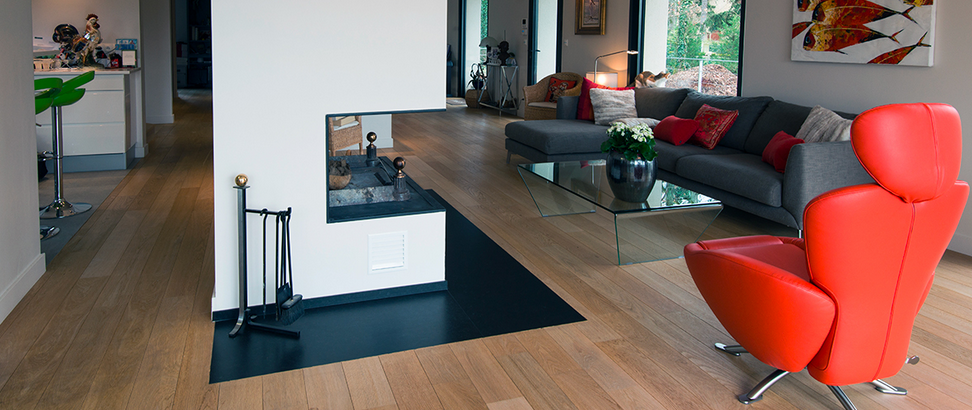
To bring a fresh touch to the house, some renovation work is necessary. Many questions deserve answers: what paint color for a living room? How to modernize a staircase? Otherwise, which furniture to choose for your home?
Many households sometimes neglect the floor covering. Yet, it contributes to the success of the overall decoration of the room. Parquet flooring is one of the best options. Whether it is solid oak parquet, parquet-effect tile, floating parquet, laminated parquet or engineered parquet, this material combines elegance, practicality, and durability.
To install it, you do not need to call a professional. However, it is important to know the direction of parquet installation. This article provides details on the subject.
The key takeaway: I consider the installation direction as the simplest architectural tool to correct the proportional defects of a room. In my opinion, natural light should be your compass: laying the planks in the direction of the main light source helps to erase joints and fluidify the space. I find that the most common mistake is to always want to align with the longest wall without considering perspective. In my view, this is a strategic choice that defines whether your room will appear wider, longer, or more harmonious at first glance.
Which direction for parquet planks?
Before asking yourself what decoration with dark parquet or which type of parquet to choose for your kitchen, first focus on the parquet installation.
The first step is to create the layout plan. This representative drawing is obviously useful to help you define the true direction for floating or glued parquet installation.
| Direction of plank installation | Desired effect / Recommended use |
|---|---|
| Parallel to the light source | Highlights natural light, ideal in rooms with windows |
| Parallel to the shortest side | Visually enlarges the room, recommended for narrow spaces |
| Parallel to the longest side | Lengthens the room, suitable for corridors or long rooms |
| Direction of walking | Practical in corridors, facilitates movement and visual coherence |
| Diagonal installation | Energizes the space, elegant effect, but requires more cutting and technique |
| Patterned installation (herringbone, broken sticks) | Sophisticated aesthetic, requires a professional for precise installation |
It also allows you to know the number of parquet planks needed and prevents miscalculations in cutting. The choice of parquet installation direction generally depends on the location of the main light source enhancing the volume of a room.
The parquet planks can be laid perpendicular to the window. This direction of parquet plank installation also provides better exposure. For a rectangular room, the lengthwise installation is recommended, but these parquet direction tips do not apply to a room that is too narrow.
In truth, there are always exceptions. The general rule is to install the parquet planks in the widthwise direction to widen the room. If you want to visually lengthen it, choose the lengthwise installation.
During the renovation of a very narrow and dark hallway, I initially thought that the planks should be laid in the direction of walking to “stretch” the passage. The realization was radical when doing a dry run: the tunnel effect was so oppressive that the hallway seemed endless and even more cramped. That day, I decided to break the rules by laying the parquet perpendicular to the long walls. The effect was immediate: the walls seemed to widen and the hallway regained a human proportion. This experience taught me that in decoration, sometimes you have to go against your first intuition to restore the balance of a complex volume.
Direction for laying floating parquet
Floating parquet installation is not only quick but also easy. Before starting the work, it is necessary to define the direction for floating parquet.
Generally, this is done according to the direction of the main light source in the room. The parquet planks must be oriented following the sources of natural light. Thus, the floating parquet should be laid perpendicular to the opening or window.
If the room is rectangular, the laying of the floating parquet planks is done along the length of the wall. You should start installing the first row from the back of the room.
Before the next row, place expansion spacers between the wall and the parquet planks of the first row. Since wood contracts or expands depending on temperature and humidity, make sure it does not touch the wall.
That said, lay the following rows. Cutting the floating parquet planks lengthwise is essential for the last row.
How to choose the direction for laying parquet?
Solid oak parquet, laminate flooring, or engineered parquet, this type of floor covering offers many advantages.
Besides its insulating quality and durability, it gives a warm effect to the room. For better finishes, the parquet installation in the room is not done randomly.
To know how to define the direction for laying parquet, it is crucial to consider a few criteria. First, make your choice based on the size and shape of the room.
For a rectangular room, carry out the solid oak parquet installation along the length direction. This laying gives a depth effect. If your living space is limited, a diagonal installation is an excellent idea to enlarge the room.
Also, decide on the direction for laying parquet according to the room’s light source. The basic rule is to always lay the parquet planks perpendicular to the window. For optimal exposure, adapt to the direction of natural light.
Besides that, the solid oak parquet or laminate installation is chosen based on your expectations and the desired effect. For example, the parquet direction is not the same for widening the space and for balancing the volume of the room.
Decision aid table: Which direction to choose?
| Room Configuration | Recommended Laying Direction | Visual Effect Achieved |
| Narrow and Long Room | Perpendicular to the long side | Widening of the space |
| Small Room (studio) | Parallel to the light | Feeling of volume and brightness |
| Dark Corridor | Transverse (perpendicular) | Breaks the “tunnel” effect |
| Square Room | Diagonal (45°) | Brings dynamism and luxury |
| Large Volumes | In the direction of passage | Fluidity of circulation |
What are the different ways to lay parquet flooring?
- Lengthwise parquet laying: For the classic parquet laying direction, you have the choice between lengthwise and widthwise laying. The first is to lay the parquet planks parallel to the longest wall. This technique is not only faster but also simpler.
- Widthwise parquet laying: As for the second, the parquet should be laid perpendicular to the long wall. This laying direction reduces the length effect. To do this, you place the parquet following the width of the wall.
- Alternative parquet laying: Besides the traditional solution, there is the alternative parquet laying direction which gives more character to the wooden flooring.
- Diagonal parquet laying: Diagonal parquet laying adds an elegant touch to your living space. It is suitable for small rooms such as an office, a bedroom, or a living room.
- Patterned parquet laying: For a more original and chic look, patterned parquet laying is a good option. These parquets come in many styles such as French parquet, English parquet, herringbone parquet, chevron parquet, and many other patterns.
What is the recommended parquet laying direction for a corridor?
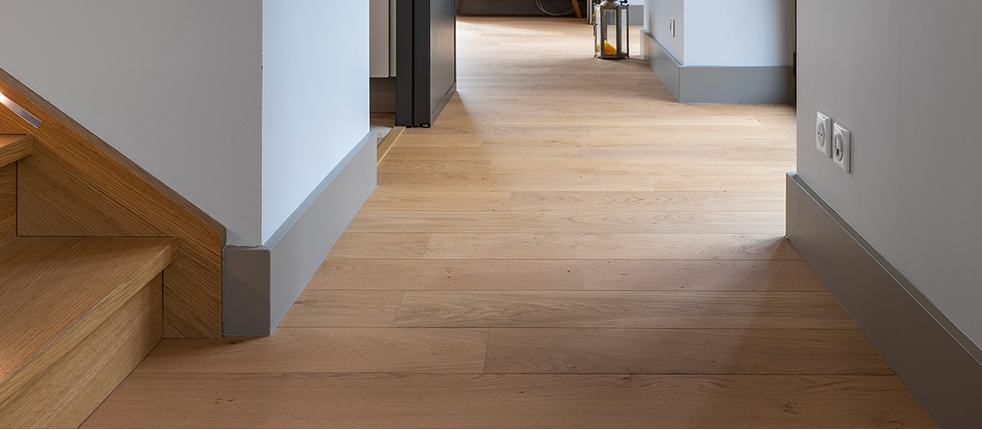
Just like in the kitchen or living room, the plank laying direction greatly affects the overall look of a corridor. Almost all methods used allow you to visually lengthen or widen the surface, ensuring balance in its volumes.
The most common parquet laying direction is the lengthwise laying. This style offers a sense of spaciousness. While it gives good results in a straight corridor, this is not the case with an L-shaped corridor.
Many households want to break the routine and decide to add a touch of originality to the passage area. If you are one of them, favor the herringbone parquet laying and diagonal laying.
Since the installation is difficult to accomplish, it is advisable to consult a specialist.
What is the recommended parquet laying direction for a bedroom?
The parquet laying direction for the room can be chosen based on the configuration and dimensions of the room. If it is small in size, it is recommended to favor parquet planks laid parallel to the shortest side of the space. This method offers an elongating effect.
If your bedroom appears rectangular, it is more practical to install the parquet along the wall. It is simpler to follow the room’s configuration.
To stand out from the ordinary, patterned parquet flooring provides an original and aesthetic touch to your interior. Whether it is in herringbone or broken stick patterns, the important thing is to create harmony throughout.
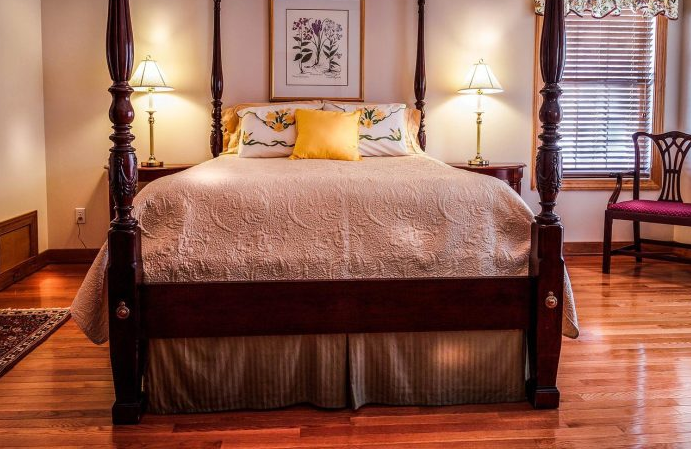
What direction to lay laminate flooring?
To give your interior a new style, laminate floating flooring is the ideal choice. To achieve the desired result, the flooring direction must be carefully analyzed.
Specialists recommend laying flooring in the direction of the main light source. The laminate floorboards should be parallel to the direction of the light.
If the space has several windows, you just need to favor the direction of the light source that makes the installation easier.
What direction to lay flooring in a rectangular room?
If you have a rectangular room, solid oak flooring installation is often done lengthwise. To do this, simply start from one wall and install the floorboards parallel to the length.
Thanks to this technique, the wooden covering visually lengthens the room. Many also use it to achieve a sense of depth.
It should be noted that this flooring direction is the least suitable for a narrow bedroom. Even if it is rectangular, it is better to favor the width direction to widen the surface.
What direction to lay flooring to enlarge a room?
The lengthwise installation is preferred to lengthen the room. To do this, position the floorboards parallel to the longest wall.
More and more households favor this installation direction, as it is not only simple to carry out but also economical. Unlike other techniques, this flooring direction requires little cutting. Yet, it is an effective solution to enlarge a room.
If you are looking for a method that gives the impression of widening the bedroom, you can favor installation in the width direction. It is also suitable for a narrow room.
Flooring direction and sunlight
The direction of natural light contributes to the success of solid oak flooring or floating flooring installation. It is important to follow the orientation of the room’s light source during flooring installation. In this sense, the floorboards should be installed perpendicular to the window. If there are multiple openings, choose the one that lets in the most light.
If you wonder why this flooring direction follows the light, the goal is to highlight the volumes of the room. That’s not all; the technique allows optimal exposure to the sun.
To carry it out successfully, the installation orientation is done parallel to the main light source. If your goal is to enlarge the room, opt for installation in the lengthwise direction.
In which direction to lay herringbone parquet?
Known as Hungarian point parquet, the chevron parquet can be installed with either engineered parquet or solid oak parquet.
To know the direction of parquet installation, it will be determined by the lengthwise direction of the room and the main light source. For a uniform look, you can lay the chevron parquet planks facing the light. Otherwise, place them parallel to the natural light creating a contrast between them.
The chevron parquet is part of high-end finishes. If you plan to cover your home’s floor with this material, expect a significant budget.
What direction to install click laminate flooring?
Also called laminate flooring or laminate floor, click laminate flooring is not really real parquet. While the latter is made of solid wood, it is instead a composite material covered with resin.
Thanks to this finish, it offers a better quality-price ratio. Although it is less expensive, it stands out for its strong resistance to shocks, scratches, and stains.
The laminate flooring also has another major advantage compared to solid wood parquet. Due to the integrated new technology, its installation is child’s play.
The click parquet planks system offers a quick and easy application. There is no need to hire a professional to install the floor. Once you have the necessary materials and tools, you can do it yourself.
As for the room parquet direction, the installation is done in the direction of the light. You can place the planks perpendicular to the wall with the main opening.
What direction to install parquet in the bathroom
With its wood finish, a standard parquet gradually deteriorates due to the humidity of the bathroom. To avoid this situation, manufacturers offer a special laminate bathroom parquet called waterproof parquet.
The planks are most often laid lengthwise. Their placement is parallel to the threshold bar. If your bathroom is small but long, choose an installation opposite to the entrance, that is, perpendicular to the threshold bar.
Thanks to this parquet installation direction, the flooring creates an enlarging effect for your small bathroom. In any case, make sure to use parquets specially designed for humid rooms to ensure their longevity.
Everything you need to know about the direction of your parquet installation to enhance your interior
<!– wp:yoast/faq-block {"questions":[{"id":"faq-question-1668638487061","question":"Why is there a direction for laying parquet?","answer":"The way to lay parquet planks influences the overall appearance of the floor covering. The parquet direction in the room depends on the room’s light source, the shape of the room, and the desired effect.”,”images”:[],”jsonQuestion”:”Why is there a direction for laying parquet?”,”jsonAnswer”:”The way to lay parquet planks influences the overall appearance of the floor covering. The parquet direction in the room depends on the room’s light source, the shape of the room, and the desired effect.”,”jsonImageSrc”:””},{“id”:”faq-question-1668638503051″,”question”:”How to find the right direction for laying parquet?”,”answer”:”To avoid making a mistake, it is recommended to follow the same direction as the sunlight source. You also identify the ideal orientation according to the desired look. Don’t forget to take into account everyone’s preferences when choosing the parquet laying direction.”,”images”:[],”jsonQuestion”:”How to find the right direction for laying parquet?”,”jsonAnswer”:”To avoid making a mistake, it is recommended to follow the same direction as the sunlight source. You also identify the ideal orientation according to the desired look. Don’t forget to take into account everyone’s preferences when choosing the parquet laying direction.”,”jsonImageSrc”:””},{“id”:”faq-question-1668638543899″,”question”:”What direction to lay the underlay and parquet?”,”answer”:”To choose the right laying direction, you must consider the use, shape, and surface of the room. Also, it is preferable to lay the underlay and the parquet planks in the direction of the main light source. “,”images”:[],”jsonQuestion”:”What direction to lay the underlay and parquet?”,”jsonAnswer”:”To choose the right laying direction, you must consider the use, shape, and surface of the room. Also, it is preferable to lay the underlay and the parquet planks in the direction of the main light source. “,”jsonImageSrc”:””}]} –>
The way to lay parquet planks influences the overall appearance of the floor covering. The parquet direction in the room depends on the room’s light source, the shape of the room, and the desired effect.
To avoid making a mistake, it is recommended to follow the same direction as the sunlight source. You also identify the ideal orientation according to the desired look. Don’t forget to take into account everyone’s preferences when choosing the parquet laying direction.
To choose the right laying direction, you must consider the use, shape, and surface of the room. Also, it is preferable to lay the underlay and the parquet planks in the direction of the main light source.