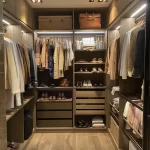
Many people tend to confuse a wardrobe, a closet, a wardrobe, a clothes rail, and a dressing room. However, each piece of furniture has its own particularities. Among these different options, the dressing room is one of the storage solutions that is both aesthetic and functional.
No one can deny that well-organized clothes, shoes, and accessories greatly simplify life and save you a lot of time in the morning. To make sorting no longer a chore, there is nothing like equipping yourself with a dressing room.
Whether you are a weekend handyman or an expert, you can very well make your own furniture. It is still feasible to design a custom-made dressing room work within everyone’s reach. To help you get started on this project, this article can serve as a guide. We provide you with clarifications on the subject.
What does a homemade dressing room bring to daily life?
Making your own dressing room is not just about optimizing space; it is also about creating a unique piece adapted to your lifestyle and needs. Here is what differentiates a self-designed dressing room:
- Simplified organization: every garment, accessory, or pair of shoes finds its place.
- Time-saving: no more endless searching in the morning.
- Custom-made: the furniture perfectly fits the dimensions of the room, even under a slope.
- Budget savings: much cheaper than a dressing room ordered from a carpenter.
- Creative freedom: choice of materials, colors, finishes, and atmosphere according to your tastes.
- Home value enhancement: a well-thought-out dressing room adds charm to the interior.
What solutions exist according to size and budget?
A homemade dressing room can be minimalist or high-end, compact or XXL. The choice mainly depends on the available space and the materials used. Here is a simple comparison:
| Dressing configuration | Required space | Estimated average budget | Ideal for… |
|---|---|---|---|
| Linear dressing (in I) | 2 to 3 m² | €300 to €800 | Small bedrooms |
| L-shaped dressing | 4 to 6 m² | €500 to €1,200 | Medium rooms, corner optimization |
| U-shaped dressing | 6 to 8 m² | €1,000 to €2,500 | Large bedrooms or dedicated room |
| Dressing under slope | Depending on available height | €400 to €1,000 | Attics, atypical spaces |
| Dressing with island | From 10 m² | €1,500 to €5,000 | Luxury, storage + decorative space |
What are the advantages of building a homemade dressing room?
Whenever you have free time, you want to build a homemade dressing room. With some DIY knowledge, wood materials, and tools useful for this work, you can easily realize your project.
The first advantage of designing a homemade dressing room is having furniture that perfectly meets your requirements. The clothes rail can easily adapt to the available space in the room.
If you purchase a custom-made dressing room work from a carpenter, it might not fit its intended location. Consequently, there is nothing like making a homemade dressing room yourself.
That’s not all, it allows you to customize the furniture to your tastes. It becomes your personal space, giving you a feeling of tranquility and privacy. Thus, each preparation will be a more pleasant moment without anyone disturbing you.
With a homemade dressing plan, you have the possibility to use wooden materials of your choice. Feel free to favor colors, lighting, decorative accessories, and textures that suit your tastes as well as your personality. It’s an opportunity to create a space that truly reflects you.
Regarding price, a homemade dressing helps you save money. You only need to acquire the raw materials yourself and you can start the custom dressing creation.
If you call on a professional, know that labor costs can be expensive, not to mention the price of materials. Moreover, designing a homemade dressing allows for unforeseen changes, for example adding another shelf even at the last moment.
What materials are recommended for building a homemade dressing?
Compared to a simple wardrobe, a homemade dressing is a real stylish and practical storage space. It allows you to organize your clothes, shoes, accessories more neatly.
To succeed in custom dressing fabrication, you need wood materials. This is a key element that is both noble, natural, and timeless. Several hardwood species are distinguished for all homemade dressing pieces, whether it is a corner dressing, XXL dressing, or sloped dressing.
Ash is one of them. Flexible yet hard, it is widely used in the construction of solid parquet flooring, carpentry, and furniture. Many also use it for custom dressing creation. Generally, this type of wood is white in color, but it can be customized according to your tastes to obtain a stylish storage space.
Oak also finds its place on our list for effective dressing arrangement tips. Versatile, it fits into all atmospheres. This hardwood is distinguished by its light shade, medium grain, and linear veining. Many use it to create closet doors.
Besides that, you can use homemade dressing pieces with acacia. Of course, this type of wood is most often used outdoors. But it can also help you in the making of a homemade dressing.
Besides hardwood, more and more DIYers opt for softwood to create this storage space. Fir is included in this classification of wood materials. With its warm tones and honey shade, it brings a fresh note to the interior of the house.
Otherwise, you can use wood derivatives such as plywood and melamine wood. Although sometimes criticized for their lack of solidity, they offer excellent value for money in custom dressing fabrication.

How much does it cost on average to make a homemade dressing?
If you plan to save money, nothing beats building a homemade wardrobe yourself. The price of custom wardrobe making can rise due to labor costs. This typically ranges from 500 to 3000 euros. Thus, designing a homemade wardrobe is an excellent idea to save money.
Generally, organizing a wardrobe with effective tips involves creating the furniture for shoes, closets, hanging space, and accessories yourself. You just need to gather the necessary tools for the job as well as all the supplies and follow your wardrobe plan.
To make wooden storage, budget between 5 to 10 euros per square meter. This concerns acquiring a water-resistant or particleboard wood panel. Regarding the door, you should expect about 10 to 30 euros on average.
In total, designing a homemade wardrobe can cost between 500 to 1500 euros. However, if you use the services of a professional, their fees range from 1000 up to 5000 euros. You can thus see for yourself that building a homemade wardrobe is worthwhile as it saves you a significant amount of money.
In any case, it should be noted that the price can vary depending on countless parameters such as the wardrobe size including its length and width, the quality of the wood material, slope issues of the wardrobe, the different components it includes, the shape of the wardrobe, and more.
What tools are necessary to build a homemade wardrobe?
We have already seen in the previous paragraphs the advantages of a homemade wardrobe as well as the budget to plan for. Now, it is appropriate to list the tools useful for this project.
You primarily need the different parts that make up the structure. They are similar to those of a wardrobe. So be sure to gather many boards cut to the desired dimensions. Likewise, wooden battens are among the essential materials for custom wardrobe making.
To ensure their fixation, don’t forget to include in your list the racks, dowels, screws, dowels, and many other fastening pieces.
Besides that, you must equip yourself with a number of tools to build a homemade wardrobe. To take measurements and markings, you need a tape measure, a pencil, a mason’s ruler, and a level.
To drive in nails, a hammer is your best ally. You also need a screwdriver and a drill driver for various screwing operations. And like any DIY project, no one can do without a cordless drill. It allows you to drill many supports.
A sufficiently powerful and sturdy saw helps you cut the wooden boards. By the way, our previous article explains the difference between a reciprocating saw or a jigsaw in case this topic interests you.
Back to our subject, custom wardrobe making or homemade wardrobe also requires the use of a router which is especially useful for grooves. Some tools like framing nails, fixing brackets, or drywall screws may be necessary.
Don’t forget to wear safety equipment such as protective glasses or gloves to help you work safely.
What are the design and planning steps for a homemade wardrobe?
Before installing the homemade dressing, first ask yourself whether the furniture is intended for a single person, a couple, or a family. This helps you define the dressing size. Choose its location carefully. Once done, draw the dressing plan.
Among its essential elements, the room must be equipped with a space for various shelves, another for the wardrobe, and an arrangement for accessories. These must find their place in the plan.
After selecting the wood materials, determine your budgets. These vary mainly according to the dressing size and the quality of the material. To arrange dressing tips most effectively, you need to work step by step.
Start by cutting the boards according to the desired length and width. Take your drill and make holes in the wall ensuring the dressing location. Once this step is finished, now create the partitioning. Make the compartments and install the shelves. Then assemble the drawers and fix the wardrobe rod.
For your homemade dressing to be more functional, give priority to lighting. Currently, the LED option is both trendy, practical, and cheaper. Ceiling spotlights are very popular. The same goes for lights with automatic detection.
The final step of the custom dressing manufacturing as well as homemade dressing relates to its overall decoration.
It is advisable to favor finishes that match the style of the room. Moreover, this storage space comes in many models that can suit all themes, including modern, Scandinavian, industrial, retro, or classic. If you like a closed dressing, using curtains is trendy. They give it a chic bohemian touch.
How to maximize storage space in a homemade dressing?
The custom dressing creation or homemade dressing is sometimes not a difficult task, but the problem usually lies in space issues.
To save space, simple but effective arrange dressing tips concern optimizing vertical space. To achieve this, consider multiplying shelves in height. You can store there your items that are, for example, out of season or rarely used.
We also often tend to fold clothes flat. However, this risks taking up space in the homemade dressing. To solve this problem, try vertical folding. Clothes take up less space this way, helping you maximize storage.
With the same goal, it is advisable to iron your clothes. Once they are perfectly wrinkle-free, they lose volume. You can clearly see the difference compared to bulky outfits.
Organization is equally crucial in arranging a sloped dressing, XXL dressing, or corner dressing. To do this, it is more practical to store your underwear or socks in boxes so they do not scatter.
To maximize storage in the homemade dressing, sort out clothes that are no longer worn. This frees up space to receive new items. If you do not know how to store coats that are rarely used, you can place them in vacuum bags.
What are the most popular styles of homemade dressings?
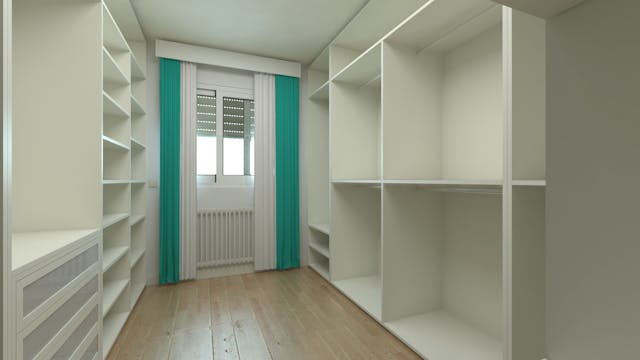
To express one’s tastes and assert one’s personality, it is crucial to carefully take care of the decoration of the homemade dressing room. More and more new styles are appearing on the internet or in magazines.
Among the trendiest, the chic but compact dressing room is gaining popularity. Often configured in an L shape, it combines a wardrobe and shelves while taking advantage of the ceiling height. Multiple rods are attached to the door holding a large collection of high heels.
If you have more space, you have the chance to build a spacious and rustic homemade dressing room. With a wooden appearance, it can accommodate a number of clothes, shoes, accessories with its several compartments and drawers. A dark wood dressing room is pleasant to look at.
For a modern and clean look, opt for a custom-made dressing room with a dominance of white color. Whether it is the walls or the doors, prefer a light shade that brightens the room. This choice perfectly matches the natural wood shelves. The whole provides a note of originality and warmth to your custom-made work dressing room.
Besides that, many dressing room styles are in fashion, for example a Scandinavian look dressing room, a dressing-living room, an island dressing room, a dressing room with the look of a fashion boutique, and more. Before making your choice, please consider the available space in the room so that the dressing room finds its corner without any trouble.
How to integrate effective lighting into a homemade dressing room?
When planning to design a homemade dressing room, the choice of the furniture configuration, the number of shelves or drawers, and the height of the wardrobe are most often prioritized. However, many tend to neglect the lighting.
Yet, the latter is not only functional but also affects your mood every time you use your corner dressing room or sloped dressing room. To fully benefit from it, make sure to choose the lighting that fills this storage space with light.
To properly arrange practical dressing room tips, favor LED strips. They are among the most used options to beautifully and effectively illuminate this room. Available in many sizes, they easily hang on shelves or on the wall. Likewise, you can suspend them from the ceiling.
To light the closet, profiles with LED tape offer powerful yet economical lighting. Otherwise, you can use recessed LED spots. Being part of a great classic for homemade dressing rooms, these promise brightness, modernity, and elegance to your storage space.
What are the common challenges when building a homemade dressing room and how to overcome them?
When planning to design a homemade dressing room, the most frequent challenge to overcome relates to space issues. In this situation, it is essential to carefully develop the dressing room plan.
Generally, it occupies an area of 4 to 6 m2. If you have enough space, you have a wide choice of closed dressing room configurations, including I, L, and U shapes.
The first is intended for small rooms while the second is for a deep bedroom with little width. Regarding the last one, it is especially suitable for large rooms allowing you to maximize the arrangement of your homemade dressing room.
If the space dedicated to storage is less than 4 m2, you can opt for an open dressing room directly in a room. In this case, please optimize every available corner. You have the option to build a custom dressing room with impeccable work and a hidden part. To do this, consider accompanying it with curtains or sliding doors.
The choice of wood material is also among the challenges to overcome during the custom dressing room or homemade dressing room fabrication. When you are not an expert in the field, you may end up with a poor element that does not guarantee the solidity of the piece.
Favor oak or ash dressing rooms. If your budget is limited, prefer melamine. It is an economical option but offers resistance and durability.
The last challenge, but not least, concerns the custom dressing room under a slope. For it to combine functionality and comfort of use, the space must be airy and warm. If the area under a staircase or attic is where water pipes run, your belongings risk retaining bad odors or humidity. Thus, find another well-ventilated place.
Make sure the sloped dressing room has enough space to accommodate your clothes. Shirts and suits require a surface of at least 1.20 m. Dresses, on the other hand, need 1.60 m in height.
How to personalize a homemade dressing room to meet specific needs?
The major advantage of the homemade dressing room is the possibility to personalize the room according to your own tastes. To give it some pep, why not accompany it with a brightly colored wall? You can highlight it with a structureless dressing room. The latter is equipped with shelves and bars without hiding the masonry in turquoise blue, pink, or even yellow.
To make your dressing room unique, dare to design a room that stands out from the ordinary. If clothes are usually hung on hangers, try this time with your boots. They will no longer wear out prematurely like those in shoeboxes.
A vertical rotating shelf is also trendy. You can store your shoes there. Thanks to its pivoting design, this magnificent rack immediately attracts attention. Consider equipping it with transparent drawers to make your dressing room original.
Yes, in most cases. Materials cost less than professional labor. However, the budget strongly depends on the finishes and the quality of the wood.
Not necessarily. Simple linear models or melamine kits remain accessible with basic tools. For a U-shaped or sloped wardrobe, a minimum of experience is better.
Yes, especially if the room lacks natural light. LED lighting integrated into the shelves or recessed spotlights help make the space practical and aesthetic.