If you regularly use a chainsaw, you know how crucial it is to maintain its chain to ensure optimal operation. Sharpening a chainsaw chain is not just a matter of performance, but also of safety. Proper sharpening helps reduce wear on your machine while increasing its efficiency. We will explore together how to sharpen a chainsaw chain methodically.
📋 The essentials at a glance: Personally, I consider a well-sharpened chain to be the first guarantee of safety: a dull chain forces you to exert more effort, which triples the risk of kickback. Did you know that regular sharpening extends your engine’s lifespan by 25% by limiting unnecessary strain? I recommend giving a light filing after each fuel refill to maintain a razor-sharp edge effortlessly.
Why is chain sharpening essential?
Sharpening a chainsaw chain maintains its cutting ability, which is fundamental for the chainsaw to function properly. A poorly maintained chain can cause uneven cuts and force the chainsaw to work harder, leading to premature engine wear.
Moreover, working with a dull chain increases the risk of kickback, making the chainsaw dangerous to use. To avoid these potentially hazardous situations, regular and thorough maintenance of the chain is indispensable.
📍 My experience: In 2025, during a session of cutting dry oak, I wanted to “save time” by continuing to cut despite producing fine dust instead of nice chips. Within 10 minutes, the guide bar overheated and the chain became irreparable because the metal had “blued.” The lesson learned is clear: as soon as the chainsaw no longer advances on its own, stop everything and take out your file; it will save you 50 euros in equipment.
Prerequisites before sharpening

Securing the chainsaw
Before starting sharpening, make sure your chainsaw is properly immobilized. Place it on a stable surface and disconnect the spark plug cable to prevent any accidental start. This step of securing the chainsaw is essential for working safely.
Cleaning the chain
Prior to sharpening, the chain should be cleaned. Remove all impurities, such as wood and grease residues, as these can hinder the sharpening process’s effectiveness. Use a wire brush for this task, giving you a clear view of the chain cutters that require precise sharpening.
To go deeper, I recommend consulting the guide to sharpening a chainsaw which complements this topic well. The article on adjusting the carburetor also offers useful tips. And to go further, knowing how to split logs provides interesting insight for your firewood.
The necessary tools for effective sharpening
Review the tools you need to successfully sharpen your chainsaw chain chainsaw. The choice of the right instruments greatly influences the final result.
Round file and sharpening gauge
| Chain pitch | Round file diameter | Sharpening angle | Type of wood |
|---|---|---|---|
| 1/4″ | 4.0 mm | 30° | Softwood |
| .325″ | 4.8 mm | 30° | Versatile |
| 3/8″ | 5.2 mm | 25° – 30° | Hardwood |
| .404″ | 5.5 mm | 25° | Professional felling |
The round file is undoubtedly the most fundamental tool for maintaining your blades. It comes in different diameters and should be chosen according to the specifics of your chain. Generally, the file diameter ranges from about 4 mm to 5.5 mm, but always check your chainsaw manual to select the correct size.
The sharpening gauge is used to ensure a correct sharpening angle, typically at 25° or 30°. This accessory reduces the risk of error and simplifies the process, especially for beginners. It is often sold in a sharpening kit which also includes a flat file and an ergonomic handle, useful tools for adjusting the depth of the cutters.
🔧 Tip
Use a permanent marker to mark the first tooth you sharpen. This will prevent you from going around the chain twice or, worse, forgetting a part, ensuring perfect balance.
Detailed procedure to sharpen a chain
Positioning and visibility
To properly perform sharpening, place the round file flat and hold it firmly. Adopt a comfortable position that will allow you to have a clear view of each tooth of the chain. Protective glasses are recommended to avoid the projection of metal particles during the operation.
Sharpening technique
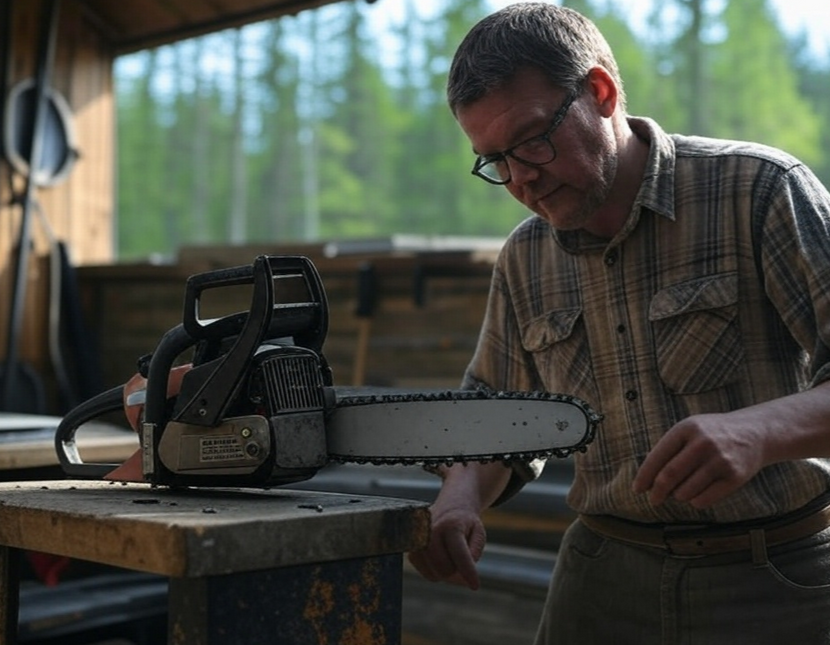
With the round file, start by deepening each chain cutter, making a steady forward motion. Do not apply excessive force, as this could unbalance the sharpening angle. You should work on each tooth two or three times until you achieve a sharp edge.
- Work from a fixed point on the chain to avoid missing any.
- Sharpen every other cutter to keep easy control of your progress.
- Then rotate the chain to work on the remaining teeth in the opposite direction.
⚠️ Common trap
A frequent mistake is filing with a back-and-forth motion. The round file only works when pushing. If you rub it back towards you, you destroy the fine teeth of the file and do not sharpen anything at all.
Checking the sharpening angle
One of the major challenges when sharpening is preserving the initial sharpening angle. This is where experience and the judicious use of the sharpening guide come into play. Take care to visually and tactilely assess the regularity of the sharpening after sharpening two or three teeth.
🌍 Did you know?
The standard sharpening angle is 30°, but for cutting frozen or extremely hard wood, a 25° angle is preferable because it makes the edge more resistant to repeated mechanical shocks.
Don’t forget to check out this comparison between manual and electric sharpening:
👍 Manual sharpening
- Removes very little metal
- Portable in the field
- Better cutting precision
⚡ Electric sharpening
- Time-saving on very damaged chains
- Risk of overheating the steel
Post-sharpening maintenance
Tension and lubrication
Once sharpening is complete, it is essential to ensure that the chain tension is correct. A chain that is too loose may jump, while a chain that is too tight accelerates wear and reduces cutting efficiency.
Finally, apply a special chainsaw oil to promote smooth sliding of the chain on the guide bar. This significantly extends the lifespan of your equipment.
Common mistakes to avoid when sharpening
Although sharpening a chainsaw chain may seem simple, some mistakes can compromise the effectiveness of the process.
Neglecting to check the file diameter
An inappropriate file diameter is a common mistake. If the file is too large or too small, it damages the blade rather than sharpening it. Carefully read the manufacturer’s recommendations to avoid this error.
Pace and uniformity
Uniformity is crucial. Do not rush: each tooth requires the same level of attention and care. Do not neglect any part of the chain. Each file stroke must maintain the same pace to ensure a consistent and regular operation.
Common questions about chainsaw chain sharpening
The frequency of sharpening depends on your usage. If you feel that your chainsaw is cutting less efficiently, it is usually a sign that sharpening is needed. With intensive use, resharpen after about every 2-3 hours of cutting.
Slower cutting, excessive sawdust production instead of chips, and increased effort to guide the chainsaw are clear indicators of a dull chain. A visual inspection may also reveal visible damage to the teeth.
A sharpening kit is often recommended for those who want to turn this task into an efficient routine. Composed of all the essential tools, it facilitates mastering the proper techniques by sometimes even providing a template to maintain a stable angle.
If a freshly sharpened chain still does not cut well, it could be due to a chain tension defect or advanced wear of the chain gauges. Check these points and consider replacing the chain if problems persist.