Compared to other flooring, concrete is not only robust and durable but also very aesthetic. To prepare the substrate, the sanding step is essential.
When you plan to sand a ceiling or a parquet floor to restore its shine, you must follow the proper process. The same applies to a concrete slab.
Many techniques deserve to be mastered to achieve better finishes. If you want to learn more, we invite you to read this article. Before getting to the heart of the matter, it is important to recap the purpose of sanding.
Technical overview: I consider sanding a concrete slab as the ultimate transformation of a raw floor into a noble and contemporary surface. In my view, it is not just a preparation step; it is the act that reveals the mineral texture and ensures perfect adhesion of future coatings. I find that the key to success lies in progression: skipping steps by using too fine a grit from the start is a classic mistake that leads to an uneven result. In my opinion, it is a work of patience where the machine must guide the movement to achieve perfect flatness, worthy of a professional industrial finish.
Why is sanding a concrete slab important?
This type of work is generally found on new construction or renovation sites. Sanding a concrete slab is necessary to improve and increase adhesion.
But that’s not all; this step also simplifies the application of a coating.
When the surface appears uneven, it must be polished to obtain a smooth substrate. This is not only pleasant to look at but also easy to work with.
Thanks to sanding, the flooring can be installed without difficulty, regardless of the direction of parquet installation, tiles, or laminate. It should be noted that this work can be done both indoors and outdoors and even on waxed concrete. In all cases, it is always recommended to polish a concrete substrate in a well-ventilated area.
If you plan to renovate your house or even build a new one, it is preferable to use a self-leveling screed. In this way, concrete sanding is no longer important.
I remember trying to sand my concrete terrace with a small orbital sander meant for indoor use, thinking that persistence would compensate for the lack of power. The realization was immediate: after an hour, I had barely scratched the surface and my machine was overheating. The day I rented a real concrete sander with diamond discs, I understood that the hardness of concrete is non-negotiable. Seeing the laitance disappear to reveal a smooth and uniform grain, I realized that the right tool transforms an exhausting chore into a satisfying and efficient process. This experience taught me that for concrete: the weight of the machine is your best ally to bite into the material.
What tools are necessary to sand a concrete slab?
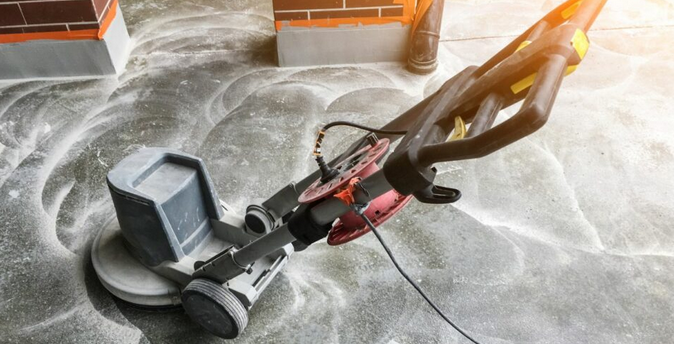
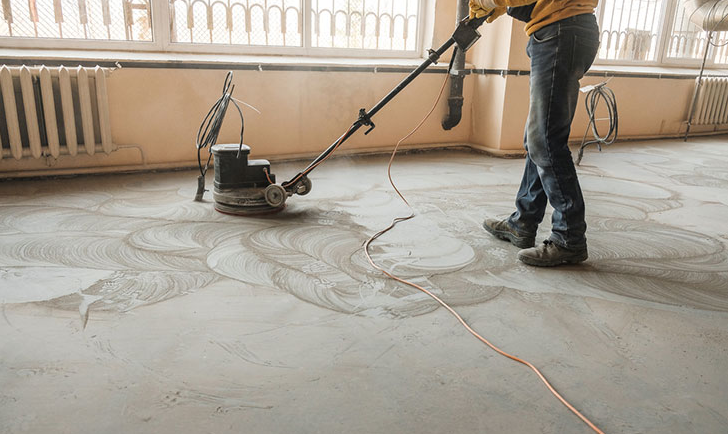
Even though sanding a slab is essential, you cannot accomplish it without the right equipment. A concrete sander is the ideal device to carry out this operation.
Also called a surface grinder, it is used to plane and polish hard materials like concrete. Due to its performance and practicality, it greatly facilitates your tasks.
Alternatively, you can use a sanding disc on an angle grinder or a cut-off grinder. You also need to have various discs on hand.
| Tool | Main function | Useful remarks |
|---|---|---|
| Concrete sander | Effectively sand the surface | Surface grinder type or diamond disc sander |
| Diamond abrasive discs | Abrasion of concrete according to the desired finish level | Coarse grit for roughing, fine grit for smoothing |
| Industrial vacuum cleaner | Vacuuming generated dust | Essential for dry sanding |
| Water sprayer (optional) | Dust reduction and disc cooling | Useful for wet sanding, requires good drainage |
| Protective goggles | Eye protection against splashes | Never neglect |
| Dust mask | Filtration of fine particles | Prefer FFP2 or FFP3 models |
| Work gloves | Hand protection | Choose gloves resistant to vibrations |
| Knee pads or floor mat | Comfort when working on the floor | Optional but useful for long sessions |
One version of abrasive disc is used for sanding as well as basic stripping. Another type, fine or medium, is used to remove imperfections. To finish sanding, use a very fine abrasive disc.
Since the sander is dangerous equipment, it is imperative to follow safety measures. Check the condition of the power cable before use. Also make sure to verify the condition of the disc.
Do not forget to wear a mask, goggles, and gloves. After sanding, you will need a vacuum cleaner to get rid of all the dust.
How to prepare the surface of the concrete slab before sanding it?
For a flawless finish, it is crucial to properly prepare the floor before sanding. To do this, start by inspecting the entire substrate to spot any irregularities in the concrete. If there are any, do not hesitate to repair them properly.
When you notice bumps often located on the corners, they must be removed without delay. You can use a cold chisel. This tool is designed to cut hard and thick materials like metal and concrete.
Once these imperfections are removed, clean the surface. It is always practical to polish on a clean substrate. To save time, use a vacuum cleaner. For those working indoors, the room must be well ventilated to protect the respiratory tract.
How to choose the right sandpaper for sanding the concrete slab?
The selection of sandpaper depends notably on the type of sanding to be done. If you plan to sand a basic slab, you can use sandpaper with a grit between 40 and 60.
If your goal is to remove small irregularities, a model with 80 to 120 grit will be perfect for you. For finishing work, use ultra-fine sandpaper with a grit ranging between 200 and 400. This will provide you with a perfect smoothing.
It is also possible to deploy diamond-type discs. These are especially suitable for the first pass. They are highly effective for roughing out the work before the finest sanding.
How to sand a concrete slab to achieve the best result?
- Preparation of the work area: Before starting the work, first prepare the area. As we all know, sanding concrete generates a lot of dust. So start by protecting all the surrounding elements, such as furniture.
- Ventilation and personal protection: If you are working inside the house, fully ventilate the room. And protect your lungs from inhaling fine dust by wearing a mask.
- Sanding at a steady pace: After this step, you can start the actual sanding. Make sure to keep the same rhythm by working along the length and then the width of the slab.
- Safe distance from walls: For added caution, it is best not to sand near the walls. Leave a 10 cm space from the baseboards, edges, and partitions. On each area, pass the sander multiple times to achieve a uniform result.
- Finishing edges and corners: That said, you can take care of the room’s edges and then the corners. Do not stop until you get the desired result.
- Final cleaning and smoothing: Once you finish sanding the floor, sweep the dust and clean the area by mopping. To ensure the surface is perfectly smooth, use an extra-fine sandpaper.
What are the tips to minimize dust when sanding a concrete slab?
Concrete sanding is an operation that causes a heavy accumulation of dust. Therefore, it is advised to remove all furniture before starting the work. If they cannot be moved, protect them with sheets or tarps.
Try to avoid spreading dust into other rooms. To achieve this, you must close all access points such as windows and doors. Also place cloths to seal the gap between the floor and the door.
It is also useful to turn off the ventilation system. Otherwise, it not only sucks in the concrete dust but also disperses it throughout the house.
Remember to vacuum the floor to remove debris. If the concrete has cracks, it is imperative to repair them before sanding. Keep the windows open throughout the sanding. Equip yourself with a mask and goggles for protection. This helps avoid breathing in a large amount of dust during the work.
What care should be given to the surface of the concrete slab after sanding?
After sanding, it remains essential to maintain the polished concrete to preserve its shine. To achieve this, clean stains very quickly before they are absorbed into the floor.
If you use a mop, it must be clean, as well as the water in the bucket. For large surfaces, it is better to use a non-abrasive pad from a floor filter or purifier to clean the concrete.
When dusting, to remove all dirt, do not hesitate to combine water with a neutral floor cleaner. This will not damage the concrete floor. After application, allow it time to work effectively before using a vacuum cleaner.
Everything you need to know about methods to successfully sand a concrete slab
You need a concrete grinder (surface grinder type or diamond disc grinder), suitable abrasive discs, an industrial vacuum for dust, and protective equipment (goggles, mask, gloves).
Start by cleaning the slab. Use the grinder with a coarse grit disc to roughen, then switch to a finer grit to smooth. Work in regular zones, without staying too long in the same spot to avoid hollows.
Not necessarily. Dry sanding is common but generates a lot of dust. Wet sanding limits dust and cools the discs but requires suitable equipment and good water drainage.