In the face of soaring energy bills, finding firewood at 40 euros per stere seems like an unexpected bargain, but this promise of a low price often hides disappointing realities. This article examines whether such a rate is a real opportunity or an economic mirage, while guiding you towards best practices to assess the quality and volume of your fuel. You will discover how to uncover the hidden defects of damp logs and the secrets of optimal storage to turn every euro invested into lasting and comforting heat.
- Firewood at 40 euros: miracle or economic mirage?
- Uncovering the hidden defects of fuel that is too cheap
- Mastering volumes and wood types to avoid being fooled
- Expert tips to heat your home without breaking the bank
🗣️ My experience: I myself was tempted by an ad on social media offering oak at 45 euros including delivery. Digging a little deeper, I realized that the seller required payment by PCS ticket before even unloading the wood. The lesson is clear: never pay a cent before seeing the wood in your yard and checking its moisture content with a tester, even if the offer seems irresistible.
Firewood at 40 euros: miracle or economic mirage?
🌟 Opportunity
- Unbeatable rates (woodlot rights)
- Certified local quality
- Support for short supply chains
🔻 Scam
- Advance payment required
- Quantities not respected
- Poor quality wood species
In the face of soaring bills, the announcement of a stere at 40 euros looks like a bargain. Yet, with a national average of 85 euros, this offer raises questions about its real viability.
Average: 85 €/stere. Gap: -50%. Risks: scam or damp wood.
The huge gap with current market prices
The price of 40 € stands out against the usual 85 €. This 50% gap seems suspicious for dry wood. We are bordering on a pure pricing anomaly.
For a professional, this price seems impossible. Between felling and taxes, the margin evaporates. Costs do not allow any profitability at this level.
A low price often hides an illegal origin. Receiving green or poor quality wood is likely. Caution is therefore advised.
The invisible impact of transport and handling fees
Logistics heavily weighs on the final delivered cost. Fuel and driving time are major variables. They burden the operator’s budget.
Some sellers attract with €40 but make up for it later. They charge high delivery fees to compensate. The bill then matches the usual prices.
Transport often represents 30% of the final price; wood that is too cheap often hides exorbitant delivery fees or a very small catchment area.
⚠️ Common misconception
The classic trap is to believe that a stere of 33 cm wood always occupies 1 m3. Once cut and stacked, a 33 cm stere represents only 0.7 m3. Do not trust the apparent volume of the pile unloaded in bulk!
To optimize your heating, I suggest you consult our guide on hemp pellets which constitute an ecological alternative. If you have doubts about your equipment, the article on the chimney sweep log provides interesting insight. Finally, to split your logs yourself, discover our advice on the wood splitter to save time.
Uncovering the hidden defects of an overly cheap fuel
Beyond the appeal of an aggressive price, it is the intrinsic quality of the fiber that determines the real profitability of your winter purchase.
The thermal and health danger of wet wood
Burning green wood causes massive fouling. This incomplete combustion quickly generates soot and sticky tar in your chimney flue.
Efficiency collapses because energy is spent evaporating internal water. Instead of heating your home, you waste precious and costly calories unnecessarily.
This practice also saturates your indoor air with fine particles. These harmful emissions degrade the occupants’ health and pollute the external environment in a lasting way.
🌍 Did you know?
Burning wet wood (more than 20% moisture) releases up to 10 times more fine particles into the atmosphere and halves the calorific efficiency of your stove.
Recognizing dry wood without being a forestry expert
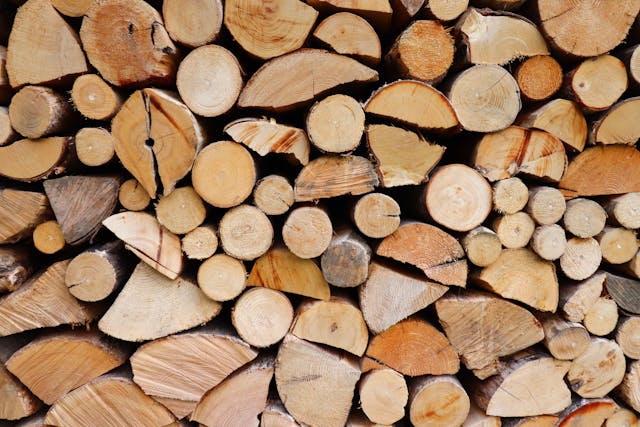
The lightness of a log often betrays its low moisture content. Ready-to-use wood sounds clear when struck and shows marked cracks.
- The sound must be dry and not dull
- The bark should come off easily
- The weight should be feather-light
- Complete absence of green moss
The hygrometer remains the essential tool to scientifically validate your stock. A rate below 20% remains the only reliable benchmark for your safety.
🔧 Tip
To test your wood without a device: knock two logs against each other. A dry and clear sound indicates well-dried wood. A dull and muffled sound betrays the presence of sap, a sign of green wood that should not be burned immediately.
Mastering volumes and wood types to avoid being cheated
Moving from the physical quality of the wood to the mathematical rigor of delivered volumes requires constant vigilance.
The subtle distinction between a stere and apparent cubic meter
The volume varies depending on the cut. The shorter the log, the more it compacts. A stere of 33 cm thus occupies less space.
Check your order upon delivery. Measure the pile of wood once stacked. Apply the conversion coefficient to confirm that the count is correct.
| Log length | Conversion coefficient | Actual volume in m3 |
|---|---|---|
| 100 cm | 1 | 1 |
| 50 cm | 1.25 | 0.8 |
| 33 cm | 1.43 | 0.7 |
| 25 cm | 1.67 | 0.6 |
Hardwoods versus softwoods: the performance match
Calorific density defines your comfort. Oak or beech burns for a long time. They produce a lasting ember and a constant heat in the hearth.
Softwoods ignite quickly but provide less lasting heat. They also have the drawback of clogging your flues. The resin leaves stubborn deposits everywhere.
Real profitability favors hardwoods. Paying more is often economical. You will consume less for the same comfort, far from the mirage of 40-euro-per-stere low-quality firewood.
Expert tips for heating your home without breaking the bank
Conclude with concrete solutions to optimize your expenses while ensuring sustainability.
The power of collective buying to reduce bills
Opt for group orders. By teaming up with neighbors, you drastically reduce transport costs. The truck is thus maximally cost-effective.
Favor PEFC or FSC labels. This guarantees wood from responsibly managed forests. It is an ethical and sustainable choice.
Negotiating in large volumes often allows you to obtain a significant discount on the unit price.
Optimize storage to preserve your brown gold
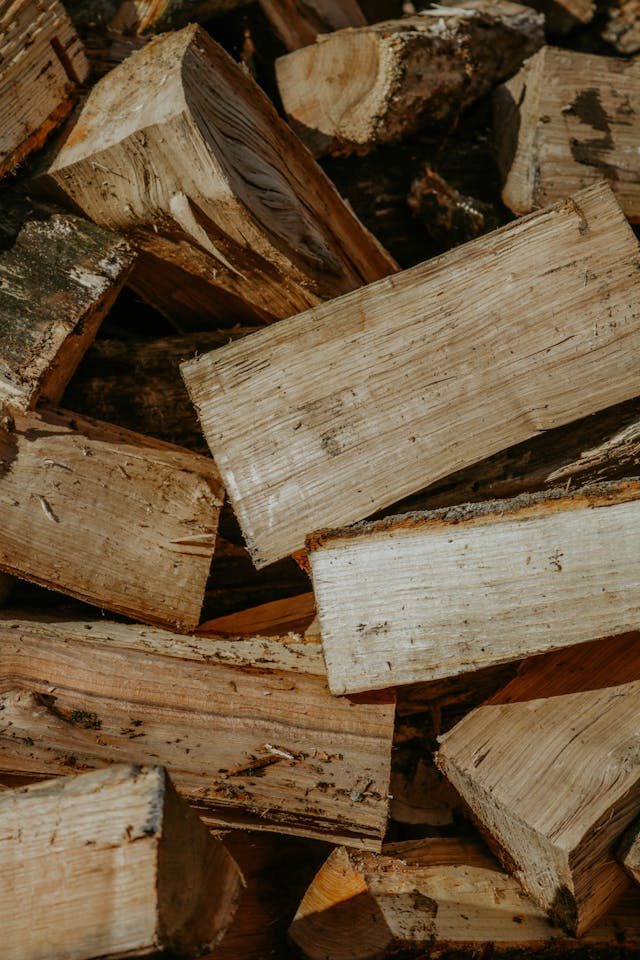
The wood must imperatively be elevated off the ground. A shelter ventilated on the sides is necessary. This prevents mold and rot.
Well-stored wood protects your appliance. You will avoid excessive chimney sweeping costs. It also limits costly breakdowns and clogging.
To not see your investment go up in smoke, keep this physical reality in mind:
Poorly stored wood loses 20% of its calorific value in a single wet season.
Even if one hopes to find firewood at 40 euros per stere, the quality of drying remains the real lever for savings.
In the face of inflation, finding firewood at 40 euros per stere requires absolute vigilance on moisture and the actual volume delivered. Favor group orders of hardwoods to guarantee optimal thermal efficiency. Secure now your winter comfort to enjoy the gentle warmth of an economical and efficient hearth.
FAQ
Is it really possible to find a stere of wood for only 40 euros?
Let’s be realistic: in the current energy landscape, such a price is more of a mirage than a good deal. While the national average vigorously ranges between 70 and 130 euros, an offer at 40 euros is well below the cost price of a professional, including felling, sawing, and rising taxes.
Such a low price often hides major flaws, whether it is “green” wood soaked with water, poor quality species, or, worse, an undeclared transaction. Vigilance is therefore necessary to avoid seeing your savings literally go up in smoke.
Why does the price of firewood vary so much depending on the region?
The wood market is a complex mosaic where geography dictates its law. The proximity of forest massifs and the abundance of noble species, such as oak or beech, directly influence prices. In Burgundy, for example, prices are historically lower than in Provence or Brittany, where the resource is scarcer and logistical flows more costly.
Let us not forget that transport is a central actor in the final cost, potentially representing up to 30% of your bill. Ordering locally is not only an ecological gesture, it is a formidable financial strategy to prevent delivery fees from making the price per stere skyrocket.
How to ensure the quality of economical firewood?
Cheap wood should never rhyme with wet wood. The legislation is clear: since 2022, wood sold must display a moisture content below 23%. A dry fuel, ideally below 20%, is recognized by its lightness, marked cracks, and the crystalline sound it produces when two logs are struck together.
Burning poorly dried wood is an economic nonsense. The energy from combustion is then wasted to evaporate the water instead of spreading comforting heat, while dangerously fouling your installation with tar and soot. Using a small hygrometer remains the infallible judge to validate your purchase.
What is the concrete difference between a stere and a cubic meter?
This is where geometry comes into play to challenge our certainties. While a stere initially corresponds to one cubic meter of logs one meter long, this apparent volume mechanically decreases as soon as the wood is cut shorter. Logs of 33 cm stack much better, leaving only 0.7 m³ of occupied volume for the same actual amount of wood.
To avoid being caught off guard during delivery, it is essential to refer to the conversion coefficient. Although the cubic meter is now the legal unit, the stere remains ingrained in habits; the important thing is to verify that the delivered volume corresponds well to the ordered cutting length.
What tips help reduce your firewood bill?
Unity is strength, even in front of the woodpile! Organizing a group order with neighbors allows you to maximize truck rotations and negotiate discounts on volume. Anticipating your purchase as early as spring, when demand is at its lowest, is also an excellent lever to obtain more competitive prices.
Finally, the performance of your “brown gold” depends on its storage. Elevated wood, protected from rain but generously ventilated, will retain all its calorific power. Remember that poorly stored fuel can lose up to 20% of its efficiency in a single damp season, turning your investment into a sterile expense.