The saw is among the best essential tools that every DIYer should have on their workbench. Japanese saw, double blade saw, or even circular saw, this cutting tool comes in many varieties. Each model is suited for certain specific uses. It also requires specific maintenance to extend its lifespan.
This time, we will focus on the reciprocating saw and the jigsaw. At first glance, these tools have many similarities. They actually belong to the same family. Regardless of their resemblance, each tool has its own functions. This article explains their differences. To clarify the subject better, start by discovering their definitions.
Summary of my expertise: For me, comparing these two tools is like comparing a scalpel and an axe: it all depends on the finesse of the patient. I consider that precision undoubtedly belongs to the jigsaw version, while raw power and versatility in demolition are the domain of the reciprocating saw. My view is that a well-rounded DIYer always ends up owning both, but if I had to choose only one to start with, I would opt for the maneuverability of the jigsaw, much more forgiving for creative indoor projects.
What are the reciprocating saw and jigsaw?
Also called the alternative saw, the reciprocating saw is used for multiple small renovation jobs, carpentry, but especially demolition. DIYers mainly use it to tear materials apart. Thanks to its power, it produces a lot of recoil and vibrations that facilitate and speed up crushing.
Like other saw models, this device can be battery-powered or corded. Most are equipped with a toothed blade. It is used to cut many objects such as wood, plastic, metal, copper, steel, brick, or PVC. Of course, you must use a blade adapted to the material to be cut.
As for the jigsaw, it is considered by most as an advanced version of the reciprocating saw. It is capable of making curved cuts as well as straight ones while remaining ultra precise. Due to its versatility, it is one of the essential tools for professionals. The device is available in two forms: corded and cordless models.
Like the reciprocating saw, it is equipped with a toothed blade allowing it to work on several materials such as wood, PVC, metal, tile, but also sheet metal and drywall. Since it can be connected to a vacuum hose, collecting sawdust becomes child’s play.
I remember my first renovation site where I tried to cut roof rafters with my usual little jigsaw. The blade kept wandering, heating up, and I ended up breaking the tool after only three cuts. This realization was radical: the tool was not bad, it was my use that was inappropriate. The next day, I bought my first reciprocating saw. It was a revelation: where I struggled painfully, it cut through wood and old rusty nails like butter. Since then, I never force a machine; if it struggles, it means I don’t have the right one in hand.
What is the difference between a jigsaw and a reciprocating saw?
As mentioned above, these two cutting tools are not only used for working wood but also for cutting various materials. They operate with a back-and-forth motion that simplifies cutting. Despite their similarity, we can discover their differences.
The jigsaw stands out for its great precision while the reciprocating saw is valued for its power. The first is the perfect tool for making bevel cuts. It is also undeniably useful for creating shapes.
The second, on the other hand, is used when precision is not highly sought after. It can help you when you need to break, tear, or demolish objects.
With a jigsaw, cuts should only be made flat. This position allows it to ensure sharpness. The material to be cut must be perfectly stable. This is not the case with a reciprocating saw, which can make cuts even at the most difficult angles. This all-purpose tool helps you demolish objects without precision. You can use it in almost any position.
The choice of your cutting tools closely depends on the nature of the materials to be processed in your workshop. If you work on fine woodworking projects, it is essential to know the best tools for working wood with precision. For specific cuts in composite materials, you might need to know how to cut plexiglass without cracking it. Finally, remember that the performance of your machines depends on maintenance, notably by learning how to sharpen a chainsaw chain or your saw blades.
Technical comparison of the two cutting tools
| Characteristic | Jigsaw | Reciprocating Saw |
| Main use | Curved and precise cuts | Demolition and rough cuts |
| Working position | Flat on the support | Freehand or overhead |
| Precision | High | Low |
| Thickness capacity | Moderate (up to 10 cm) | High (up to 30 cm) |
| Metal versatility | Yes (thin sheets) | Yes (tubes, thick profiles) |
What is the price difference between a jigsaw and a reciprocating saw?
The first criterion defining the cost of the saw concerns its mode of operation. Whether it is a jigsaw or reciprocating saw, these tools can be corded or battery-powered.
There are also pneumatic reciprocating saw models on the market offered by major manufacturers. Operating with an air compressor, they are mainly intended for bodywork specialists and construction professionals.
Aside from that, the price of the device depends on the integrated technologies, available options, quality of its finish, and especially the brand’s reputation.
In any case, it is observed that reciprocating saws are more expensive compared to jigsaws. Generally, they cost between 100 to 500 euros.
If you are looking for a battery-powered model, expect an amount between 250 to 600 euros. As for a pneumatic model, its price ranges between 200 to 350 euros.
For a jigsaw, it is accessible to almost all budgets. It usually costs between 50 to 100 euros. For those who prefer battery models, they can acquire one for around 200 euros.
What is the most versatile saw?
According to sawing enthusiasts, the jigsaw wins the title of the most versatile saw on the market. It helps you make many different cuts. Whether it is a curved or straight cut, it is capable of performing it with precision.
That’s not all, this tool has never let you down when cutting curves. Many use it to design various shapes. Thanks to its multiple functions, it is the best ally of skilled DIYers.
It also accepts several blades that correspond to different materials. That is why the jigsaw can handle not only wood but also laminate, metal, drywall, ceramic tiles, plastic, and many others.
Whatever the object to be cut, the cutting precision is always guaranteed. You just have to use it on a stable support and it can promise you quality work.
When to use a reciprocating saw and when to use a jigsaw?
If you need to cut an object without worrying about precision, a reciprocating saw will suit you perfectly. Due to its power, it can notch materials in an instant.
Unlike the jigsaw, it can be handled easily in difficult positions or inaccessible places.
Using the right blade, it promises satisfactory results, whether with wood, PVC, plastic, red bricks, aerated concrete, plaster, steel, or copper.
If you plan to buy a reciprocating saw, you can choose between the battery-powered, pneumatic, or corded version. The latter stands out for its lightness.
As for the cordless model, the built-in battery may make it heavier. However, it is extremely practical on sites where there is no electrical power. Moreover, it promises you freedom of movement with each use.
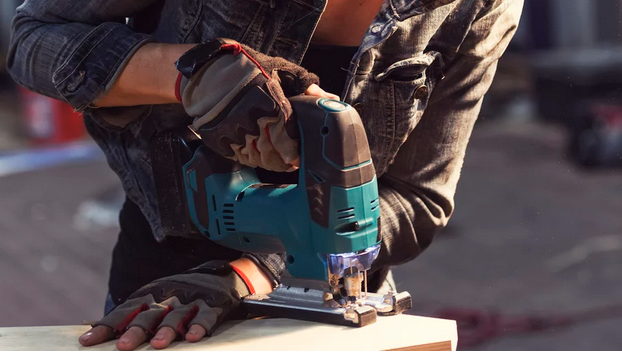
Now let’s talk about the jigsaw, which is mainly used for cuts that require precision. Generally, it is used to cut thin materials. Versatile, this device is suitable for cutting wood, aluminum, plywood, metal, ceramic, and much more. Its main function is to make ultra-precise straight cuts more quickly. But it also allows for curved and rounded cuts.
Some models are equipped with a laser beam. Others have an outlet that can be connected to a vacuum cleaner. There are also models with a removable guide that facilitates very straight cuts. Whatever product you choose, jigsaws come at a price accessible to everyone.
Which tool to cut wood with precision?
If you are demanding in terms of accuracy, there is nothing like using a jigsaw. After the drill driver, it is the most sought-after and best-selling power tool in the market. Whether you choose a corded or cordless model, the device allows you to make straight, curved, and rounded cuts with maximum precision. With its various settings, it can not only cut but also bevel up to 45 degrees.
For those who intend to create wooden toys, the scroll saw is also one of the highly favored tools by craftsmen. Thanks to its extremely thin blade, the sharpness of curved cuts is significant. It is the ideal tool for making beautiful wooden sculptures.
Advantages and disadvantages of a reciprocating saw and jigsaw
The main advantage of the reciprocating saw is that it can be deployed in any position. Unlike the jigsaw, it does not require the material to be worked on to be flat or on a workbench. This way, you have more freedom in handling it. It also gives you the opportunity to work in hard-to-reach areas. Its long shape greatly facilitates tasks.
As for its downside, it is rather criticized for its weight. It undoubtedly strains your arms when you have to use it with one hand. As for the jigsaw, it is particularly praised for its versatility. It helps you make several different cuts.
Even better, it is capable of performing more precise work. Narrower markings are quite feasible with this tool. Almost all DIYers greatly appreciate its practicality. Due to its small size and lightness, a jigsaw is easy to handle. Moreover, it takes up little space in your workshop.
Regarding its disadvantage, some usage rules must be respected. The object to be cut must be installed on a support with a part hanging in the air allowing the blade to pass through. Good support is required throughout the work.
A reciprocating saw is very helpful for small demolition projects without precision. The other is used when precision in cutting is sought.