In the 1990s, the container house first appeared in Asia. Initially, these were simple precarious dwellings made from recycled shipping containers. Since then, it has continued to gain popularity not only among individuals in Europe but also among architects.
Compared to the Phenix house, the floating house, the traditional house, or the condominium, the container house construction is the most economical solution.
It is also an ecological alternative with a low environmental impact. Modular, it can be stacked, nested, or arranged in many different ways.
Since the container is designed to withstand sea transport, container house construction is therefore particularly durable. Due to their finish, they are capable of supporting heavy loads. To delve deeper into the subject, this article reveals the essentials to know about container house construction.
What is a container house?
As its name clearly suggests, a container house is nothing other than a dwelling made from a container. The container house builder like JDK concept uses these metal boxes that were originally used to transport goods.
Shipping containers indeed allow the creation of true architectural works. They can be modified to build a contemporary home. This is why container houses have become trendy over the years.
They can be very luxurious depending on the owner’s tastes. With a good dose of creativity, the industrial look of the container house is no longer noticeable.
This construction is not only for residences but also for commercial and industrial premises. There are similarly restaurants, offices, data centers, student dormitories, and shops built with container house construction.
At the end of the 1990s, Asian countries, more precisely China, were among the pioneers of container house construction. Then the Netherlands also started manufacturing them in the 2000s.
Currently, self-building container houses are very common. You can find individual or collective container houses. Many people also decide to install them to create an extension or even a house extension.
For them to be habitable, significant improvements with beautiful interior and exterior finishes are necessary. Insulation is the most important task.
How much does a container house cost on average?
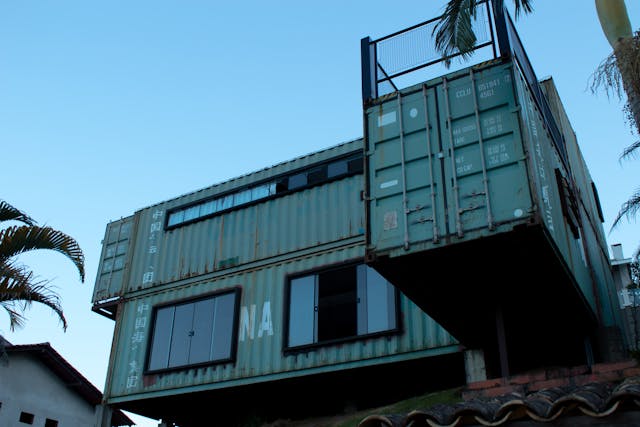
Before going into details, it should be noted that a container house price is half that of a traditional home. If you plan to embark on self-building a container house, don’t forget to consider the purchase price of the containers and the cost of their transportation.
For used shipping containers, they cost approximately 1,000 euros per unit. This price varies depending on the model and dimensions. If you opt for new containers, you should budget around 3,500 euros per container.
Regarding their transport, the costs mainly depend on the distance to be covered. In general, consider preparing an amount of around 10,000 euros. You can benefit from a container house price discount if you manage to negotiate the pricing with the responsible company.
For the container house construction price itself, the budget averages between 500 euros up to 1,500 euros per square meter. As for the interior layout including equipment and furniture, it costs between 400 and 1,000 euros per square meter.
To save money, many families opt for self-building a container house. However, it must be admitted that the work requires very specific skills.
To ensure the durability and robustness of the construction, nothing is safer than entrusting the installation to specialized companies. The container house price per square meter can vary depending on the complexity of the work.
To reduce costs, resorting to state subsidies is an excellent idea. Some schemes finance the use of certain devices such as photovoltaic solar panels.
Why are container houses so appealing?
Container houses are experiencing strong enthusiasm because they combine modernity, durability, and affordability. They attract both families and investors looking for an original dwelling.
- Reduced cost: a much cheaper alternative than a traditional house.
- Fast construction: only a few months delay, compared to over a year for classic builds.
- Ecology: recycling of maritime containers and reduction of environmental impact.
- Modularity: possibility of extension, stacking, or custom layout.
- Strength: metal structure designed to withstand weather and maritime shocks.
- Contemporary look: a modern industrial style that is increasingly popular.
What design options are available to you?
Depending on your needs, containers come in multiple configurations. Here is a comparison of the most common solutions:
| Type of configuration | Main advantage | Ideal for… |
|---|---|---|
| Simple container house | Accessible and quick to build | First purchase, secondary residence |
| Stacked containers | Gain in vertical space | Families, need for several rooms |
| Juxtaposed containers | Modularity and expanded space | Family houses |
| Container office/shop | Compact and functional | Remote work or professional space |
| Container extension | Practical complementary solution | Enlarging an existing house |
What are the advantages of a container house?
Unlike traditional houses, the advantages of container houses can be numerous. Whatever your project, a container house extension or an elevation, the installation promises you a long lifespan.
Container house or container studio, it can last for many decades, thanks to its exceptional durability. Since it is made with steel shipping containers, it has a robust and long-lasting frame.
Even better, these transport boxes are perfectly watertight. Your home is therefore able to withstand bad weather as well as extreme climatic conditions. Since they support a huge weight during maritime transport, your house also resists shocks and heavy loads.
As we already mentioned in the previous section, the container house construction price is affordable. Unlike a traditional house, the construction timelines are extremely shortened.
A classic construction takes a whole year before delivery. On the other hand, a container house advantages stands out by its very short construction period. On average, six months may be enough and your future container house is ready to shelter your family. The first two months generally concern the building permit application.
Besides that, the container house construction with foundations meeting standard norms perfectly meets the criteria of a sustainable and ecological habitat. By recycling shipping containers, it significantly limits material waste.
Moreover, this turnkey container house uses other recyclable objects. The transformation of containers into a house requires little energy. Environmentally friendly, it helps reduce on-site work.
What are the disadvantages of a container house?
Of course, many container house advantages can be cited. But regarding its drawbacks, they may seem few.
Firstly, the turnkey container house, regardless of its interior or exterior finishes, is not suited to all styles. If you like a Nordic wooden home or an old house made of natural stone, the container house construction cannot meet your tastes. It is more suitable for an industrial design with its metal structure.
Next, it is important to specify that its installation requires perfectly stable ground. To ensure its solidity, the installation of concrete piers or a thick concrete slab may be essential. Furthermore, it is crucial to set up foundations that comply with standard norms.
Of course, shipping containers are watertight materials. To ensure occupant comfort, it is always useful to optimize the acoustic and thermal insulation of the container house construction. Even if these works require financial investment, they are necessary to bring it up to standards.
Besides that, it must be said that its interior layout represents a huge challenge to overcome. It seems difficult to adapt your specific needs to the size of the shipping containers. Their dimensions limit the various possibilities for space arrangement.
If you plan to install a wooden mezzanine or stairs, the ceiling height may prevent you from doing so. If you wish, you can entrust all your constraints to JDK concept container house builder. As a professional, he can find solutions to every problem.
What is the lifespan of a container house?
Among the container house advantages, its superior longevity continues to convince many individuals and professionals. Since it is made with the most robust and resistant material, it is no surprise that it can last for countless years.
Due to its foundations meeting standard norms and its solid steel structure, a container house construction can last up to 40 or even 50 years. Like any dwelling, its maintenance can be essential to extend its lifespan.
The main enemy of the steel in shipping containers is rust. Over time, this phenomenon can appear especially if you neglect the maintenance of the container house.
To avoid this, please take care of it regularly. Fortunately, this operation does not require any special skills. It just needs frequent cleaning with water and that’s it.
Similarly, try to apply a protective paint to fight against corrosion. This problem is reduced if you cover the house with cladding. To optimize its protection against sun and rain, it is possible to use a special roof for container houses.
At each maintenance, take the time to check the sealing joints. If they are in poor condition, do not hesitate to replace them for good.
What types of containers are used to build container houses?

Because of the affordable container house price and its very interesting lifespan, container house construction continues to attract more and more families. If this project interests you, know that it remains important to understand the different types of containers used in construction.
We can distinguish 3 categories of containers, including the open-top container, open-side, and Dry. The first is characterized by its opening on the top. It is particularly suitable for terraces. Due to its lower resistance compared to other shipping containers, it is preferable to install it above the structure.
Regarding the second model, it opens on the side faces. It is notable for the absence of a roof and has removable walls. A container house construction with this structure is still less common for the moment.
For the Dry container, it is the most used type of container for container house construction. A closed model, it often has a door fixed on its outer face.
Since it is originally intended to transport non-polluting goods, a container house made with this box poses no danger to the inhabitants. The walls are thus free of toxic products.
There are several sizes of shipping containers. If you prefer the largest models, they cover an area up to 20 to 30 m2. Their width is estimated at about 2.40 m. A spacious container has a width of 2.9 m. With this size, you have no problem arranging the interior of the container house.
What are the installation and fitting costs of a container house?
Made with recycled shipping containers, container house construction offers a reduced environmental impact. Inexpensive, the dwelling is also quick to build.
Whether fixed, removable, or preassembled, it is a practical solution for projects adding outbuildings or container house extensions. Its other advantage lies in its affordable price.
Generally, the installation cost varies depending on the container house builder. If you hire an architect, the quote may be higher compared to a simple construction company.
For an unfurnished container house construction, the former requires about 1,000 to 1,600 euros per square meter. If the dwelling is furnished, expect roughly 1,500 to 2,000 euros per square meter.
If you turn to a specialized company, their pricing ranges between 800 to 1,200 euros per square meter. If you entrust them with the interior layout, you should budget between 1,000 to 1,300 euros per square meter.
Whether you use the services of an architect or a container house builder, know that their involvement helps you save a lot of time. Especially since the container house is already pre-built, it requires no foundation.
Moreover, the professional can handle the interior layout in the factory. Thus, you save up to 70 or even 80% of the time compared to traditional construction.
Is it necessary to obtain building permits for a container house?
If you plan to proceed with the container house construction on a surface area of more than 20 square meters, it is mandatory to apply for a building permit from the urban planning department.
It should be noted that requirements may vary depending on the size of the construction project and the location. Therefore, take the time to inquire about local laws to ensure you comply smoothly with current regulations.
To meet all conditions, make sure to inform yourself about the PLU or Local Urban Plan. It is required to create foundations that meet standard norms, regardless of the geographical area.
Besides the building permit, many regions require special authorizations for container house construction.
For example, there are zoning rules as well as land use regulations. These serve to determine whether a plot is suitable for a container house construction or not. The installation of this green habitat requires flat land. Otherwise, significant soil leveling work is necessary.
Also ensure compliance with building codes that determine minimum safety standards for container house constructions. This may also concern standards related to electricity, insulation, ventilation, structure, plumbing, and many others.
As with any individual house construction project, that of a turnkey container house is subject to strict environmental criteria. Consider informing yourself to ensure the container house construction complies with regulations.
What are the structural and technical challenges related to building a container house?
Like any construction, container house construction presents countless challenges to overcome. First, you must find an ideal plot to install the dwelling. Then it is imperative to gather information on current rules to avoid foundation problems and ensure compliance with standard norms.
That said, insulation of the container house is one of the major technical challenges. These are related to the lack of wall thickness. Indeed, the walls combine strength and durability. But their shallow depth poses a real challenge for proper insulation.
There are several insulation solutions for a turnkey container house. Spray foam is one of the fastest options. If you prefer natural insulators, you can choose between cotton, cork, and sheep’s wool. The latter offers high-performance insulation capacity.
The other challenge to overcome during container house construction relates to interior layout. Since the space inside the container may seem narrow, you need to be creative and original in organizing it.
As soon as construction is underway, you must come up with practical and effective layout ideas, as there is no turning back.
What customization options are available for a container house?
Container houses can be customized in many ways according to the owner’s tastes. Since this dwelling is modular, it can be modified by assembling the containers, stacking them, or covering them.
Because this construction is trendy, architects and professionals in the field are full of creativity to enhance it. To personalize it, you can use cladding, facade covering, exterior thermal insulation, paint, and many other innovative ideas.
Among trendy colors, many prefer gray, highlighting the industrial design of the container house construction. Otherwise, you can choose white, beige, cream, or certain neutral shades.
Regarding cladding, there are several options to suit all tastes. Among the most popular, metal siding, wood cladding, and stone facing beautifully enhance the container house construction.
Finally, if you want to enjoy your container house for a very long time, do not take its maintenance lightly. Please clean the interior and exterior walls regularly to preserve its shine over time.
Likewise, pay special attention to its insulation and ventilation. These systems ensure your comfort inside the house.
Yes, as soon as the area exceeds 20 m², a building permit is mandatory. The rules depend on the PLU (Local Urban Plan) of each municipality.
By default, no: they require appropriate thermal and acoustic insulation. This can be done with natural insulators or modern techniques (sprayed foam, wood wool, etc.).
With proper maintenance (anti-corrosion paint, cladding, ventilation), a container house can last between 40 and 50 years, or even longer.