To improve your DIY skills, it is crucial to equip yourself properly. Whether it’s a creation project, decoration, partition installation, or furniture assembly, woodworking is essential.
With the right equipment, you cut, fix, shape, hammer, drill, polish, or smooth the material according to the rules of the craft. Using them allows you to work faster and achieve better finishes. If you want to know the right tools, check out this article. We summarize the essentials and provide details.
📋 The essentials at a glance: Personally, I believe that equipping yourself with the right tools is the first step towards excellence, because a quality blade reduces final sanding time by 40%. Whether you are a beginner or an expert, the precision of your markings and the quality of your cuts define the strength of your work. A thoughtful investment in a few durable basic tools is better than a complete low-end set.
What are the essential tools for woodworking?
To work precisely, it is necessary to measure the material well beforehand. For this, you need a compass, a marking gauge, and of course a tape measure.
Also, a square is undeniably useful. For cutting markings, use a carpenter’s square. To check right angles, a mason’s square is the ideal tool.
If you plan to cut wood, you need a saw. There are many types of saws. Operating with a back-and-forth motion, a reciprocating saw is suitable for small cutting, demolition, and carpentry jobs.
📍 My experience: During my first shelf-making in 2024, I used a cheap saw that deviated by 2 mm on each cut. I spent three hours fixing the angles with a plane. The lesson is simple: for 30 euros more on a quality Japanese saw, I would have saved an afternoon of work and achieved a perfect joint on the first try.
A circular saw, on the other hand, stands out for its multiple uses. It can perform complex cuts regardless of the material’s thickness. Besides that, you can handle a back saw, miter saw, hand saw, and many others.
For shaping projects, you cannot do without a plane. Manual or electric, this tool is mainly used to smooth a piece of wood.
If you plan to make precise notches, you need a wood chisel. Likewise, this tool helps you make adjustments. A set of gouges, a mortise chisel, and a jack plane are also among the necessary equipment for wood carving.
🌍 Did you know?
Unlike Western saws that cut by pushing, Japanese saws cut by pulling. This allows for a much thinner blade and therefore a cut with millimetric precision.
How to choose the right saw for cutting wood?
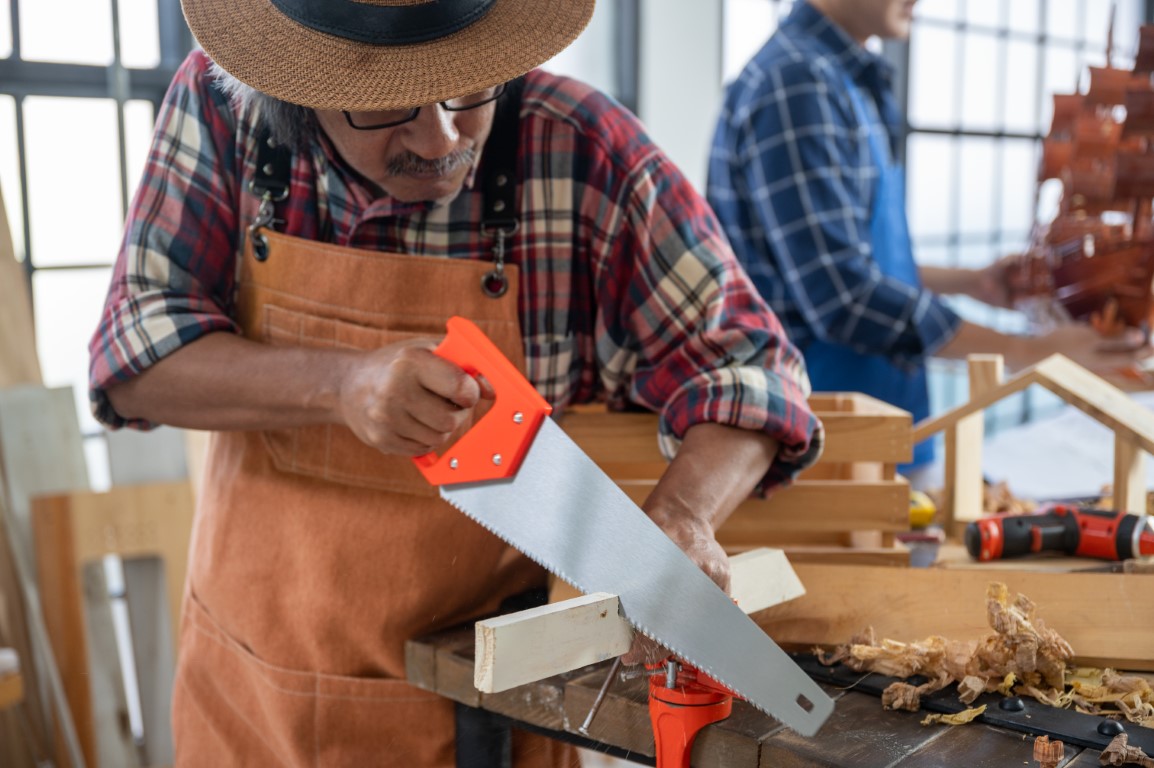
Despite the variety of saws on the market, they can be classified into two categories, namely hand saws and electric saws.
For occasional use, opt for the first model. Since it can operate without electricity, it has the ability to work anywhere you want.
Practical, it is easily portable and takes up little space. Its other advantage lies in its affordable price. It suits small budgets.
The hand saw is part of this category. It stands out for its great versatility. It comes with various tooth sizes that cater to several types of work.
The Japanese saw is also among the most used hand saws. It easily reaches difficult spots. As for the scroll saw, it follows curves with ease.
The flush-cut saw, as its name suggests, is suitable for flush cuts. For the log saw, it efficiently cuts large pieces of wood with its huge teeth.
Regarding electric saws, they offer better performance compared to manual versions.
Since the device operates using electric current, there is no need to exert physical effort. It takes care of all the work. Additionally, it demonstrates speed and power, helping you save time during cuts.
Besides the circular saw and the jigsaw, the miter saw is among the mechanical saws widely used by carpenters. Mounted on a table, it can make notches and cuts at regular angles.
Many confuse it with the radial arm saw. However, the latter is mounted on an arm. This allows it to cut wider pieces of wood.
The scroll saw, plunge saw, reciprocating saw, band saw, hole saw and table saw are included in the ranking of electric saws. Despite their diverse uses, their common point is their remarkable efficiency.
⚠️ Common misconception
It is often thought that a well-sharpened tool is more dangerous. It is the opposite: a dull tool requires more force, risks slipping, and causes much more serious injuries due to lack of control.
What is the difference between a jigsaw and a circular saw?
| Criterion | Jigsaw | Circular saw |
|---|---|---|
| Blade type | Thin, straight blade, mounted vertically | Round, toothed blade, mounted horizontally |
| Cutting motion | Back-and-forth (reciprocating) | Fast rotation (circular) |
| Precision | Good for curved or complex cuts | Excellent for straight and clean cuts |
| Cut type | Rounded cuts, angles, custom shapes | Straight, long, and deep cuts |
| Compatible materials | Wood, thin metal, plastic, plywood | Solid wood, panels, metal with appropriate blade |
| Handling | Lightweight, easy to handle, ideal for beginners | Heavier, requires a good grip |
| Recommended use | Finishing work, creative DIY, decorative cuts | Carpentry work, woodworking, cutting large pieces |
| Average price | Affordable, entry-level from €30–50 | Higher, high-performance models from €100–150 |
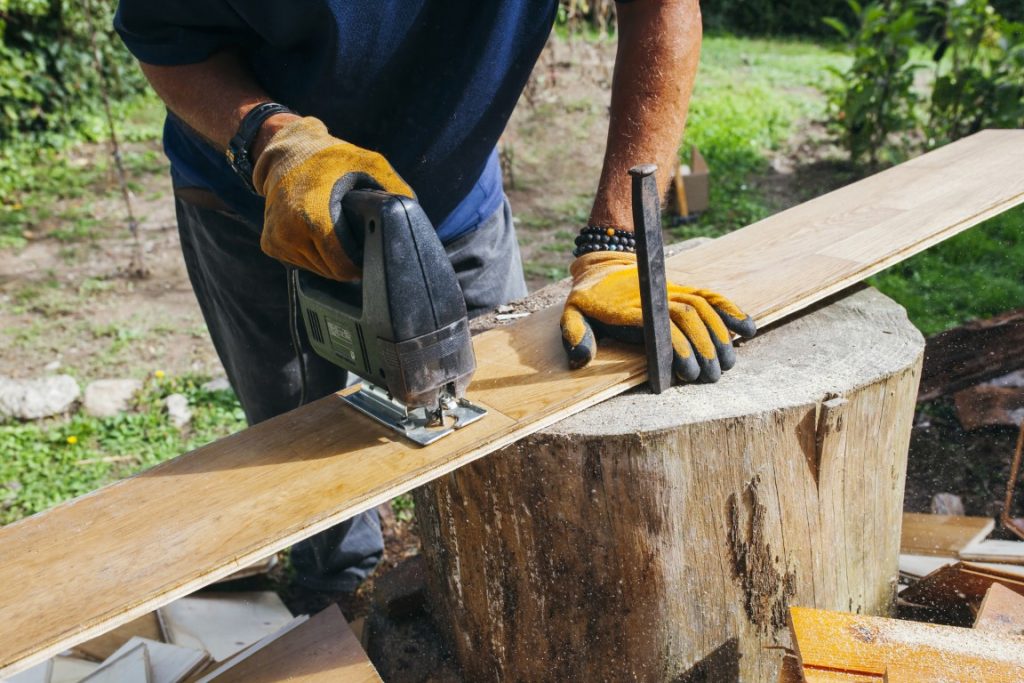
These cutting tools bear a strange resemblance. Nevertheless, they are two completely different pieces of equipment. The jigsaw is particularly suitable for woodworking. But it can also be used for cutting ceramic tiles or plastic.
It is not only used for making straight cuts, but also angled cuts and rounded cuts. Despite its many advantages, it does not seem as powerful as a circular saw.
Although the latter is not versatile, its performance impresses professional DIYers. It is perfect for making exclusively long straight cuts. Besides wood, it cuts plastic and even hard materials like metal.
In any case, it seems less maneuverable than a jigsaw due to its weight. To find the appropriate model, prefer the tool capable of carrying out the project you plan to do.
💡 Practical tip
For your markings, prefer the edge of a marking knife over a pencil line. This creates a micro-notch that physically guides your saw or chisel for surgical precision.
How to choose the right router bit for making cuts in wood?
There are countless router bits on the market, available in different sizes and materials. To find the perfect version for working wood, it is necessary to consider the hardness of the piece.
That said, you must take into account the shape of the cut you plan to make. For a finishing project, the type of bit is not the same as for a rough cut aimed at reducing volume.
For users demanding precision, carbide bits will not disappoint. But they seem more fragile than HSS bits. These do not break easily and withstand high temperatures.
What are the advantages and disadvantages of an orbital sander?
Advantages:
- Versatility of use: The orbital sander is intended for both DIY enthusiasts and professionals. It is used not only in woodworking but also in polishing, bodywork, and many other fields.
- Multiple functions: This handheld tool is essential for roughing, polishing, sanding, or buffing a surface. Versatile, it demonstrates power when working with wood, dried leather, and metal.
- Various applications: It is particularly favored for polishing parquet floors, polishing vehicle bodies, renovation, and furniture creation. It is primarily used for finishing projects.
- Technical efficiency: With a power range from 200 to 800 W and a rotation speed of 4,000 to 15,000 rpm, the orbital sander shows remarkable efficiency.
- Time-saving: Fast, it allows you to save time during the finishing of your woodworking projects. Thanks to an integrated telescopic arm, it can reach high areas.
Disadvantage:
- Usage limitation: However, its field of application is limited. If polishing is required at the corners, you cannot use it. Instead, opt for a vibrating sander or a belt sander.
How to choose the right planer to flatten wooden surfaces?
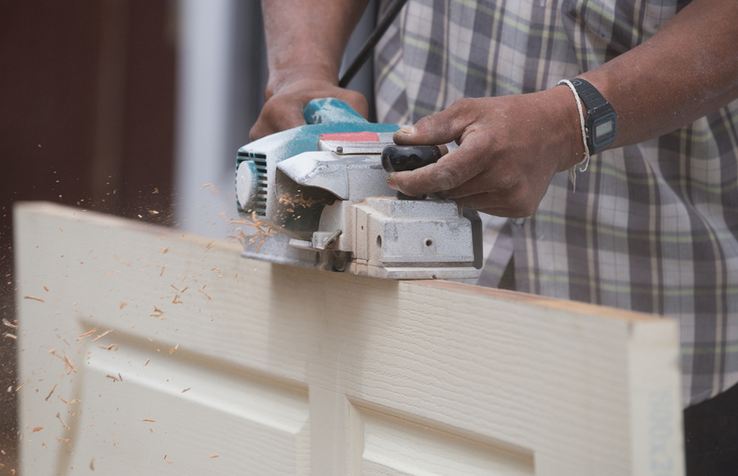
A planer is one of the very essential tools for woodworking. It is an excellent finishing and precision tool.
In most cases, it allows you to level a wooden support. That’s not all; it is used to join two pieces and to groove a wooden edge. If you want to find the suitable device, first determine its type of use.
Then define its frequency of use. For moderate application, a manual model will do. It is also suitable for planing small surfaces.
On the other hand, if you use it daily, prefer an electric model. Powerful and fast, it meets the requirements of both individuals and professionals.
To find a good planer, it is important to consider your budget. While a carpenter’s plane costs only 20 euros, the price of professional planes rises to 90 euros.
What tools are necessary to make wood joints?
There are many techniques to join pieces of wood. Some are both quick and simple to implement with basic tools. Others prove to be complex, requiring specialized equipment.
The most classic method involves screwing, gluing, and nailing. Otherwise, use dowels to join the wooden pieces.
It is also possible to accomplish this by overlapping. This process offers a strong joint. If the supports have the same thickness, you can combine them with a rebate joint. With some experience, mortise and tenon joints are also reliable.
Whatever method is used, you need a wood chisel, a mortise chisel, a marking gauge, a drill, a screwdriver, wood glue, a back saw, wood screws, nails, a mallet, and much more. To finish, take the time to read an evaluation of the benefits of sharpening tools for working
Frequently Asked Questions
To maintain the effectiveness of your cutting tools over time, make sure to sharpen their blades regularly. To do this, you can use either a sharpening stone or a file. Regardless of your choice, start from the inside towards the outside.
Besides the wood lathe, you can use the roughing gouge, the hollowing gouge, the profiling gouge, the plane, the chisel, the parting tool, the scraping chisel, and other sculptor or carpenter tools.
To be able to use them for a very long time, each tool requires regular maintenance. This operation varies depending on its type. If the tool is made of wood, remember to grease it with linseed oil to waterproof it.