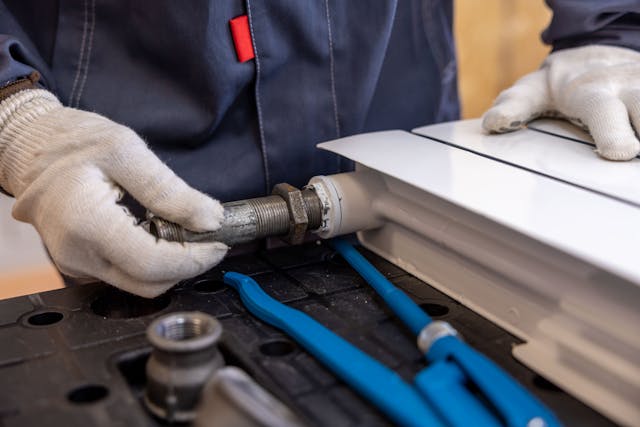
Plumbing leaks quickly drive up water bills. If left unchecked, this phenomenon can cause humidity problems in the house. In the worst cases, it eventually leads to serious damage to the foundation.
Before replacing the piping network and repairing a water leak, it is necessary to check the tightness of the pipe fittings. Sometimes, there is no need for extreme measures, as simply renewing the seals is enough.
Among the various sealing methods, plumbing hemp fiber offers surprising results. If you want to learn more about the subject, take your time and read this article.
Essential: I consider hemp fiber the “real” secret of professional plumbers. Although Teflon tape is more popular among beginners, I find that the combination of hemp fiber and joint paste offers far superior security, especially for installations subject to vibrations or large temperature variations. In my opinion, it is the only method that allows a slight rollback (adjustment of the fitting) without sacrificing immediate tightness. To me, it is a traditional know-how that remains unmatched in 2026 to ensure the longevity of a hydraulic circuit.
What is plumbing hemp fiber and what is it used for?
Hemp fiber is generally made from natural fibers derived from hemp. It is mostly used as a filling material when there are gaps between two pieces of pipe or conduit. Likewise, it is widely used in plumbing work to seal tubes connected by threading.
Also called hemp thread or linen thread, this seal is very useful when installing conduit fittings, simplifying the tightening and screwing process. To optimize its effectiveness, it must be combined with a special joint paste and wrapped in many turns. In this way, it can fill the grooves of the male threading for excellent sealing of the fittings.
It should be noted that plumbing hemp fiber is only used on fittings containing male and female threading. It is distinguished by its ability to expand when in contact with water to seal the gaps between pipe threads and prevent leaks.
In case of humidity problems in a room or water leaks, plumbers use it to prevent water from penetrating the gaps present in walls, slabs, or floors. It is also used as an insulating material for electrical devices, protecting the casing against moisture.
I remember trying to repair a leak on an old radiator fitting using only Teflon tape: I had to redo it three times because the seal always ended up seeping after a few heating cycles. A craftsman neighbor then showed me how to prepare the threading with a hacksaw before wrapping it with linen hemp fiber soaked in paste. The realization was immediate: when tightening, I felt a “greasy” and firm resistance that plastic never gave me. Since that day, I understood that for large diameters or heating, natural materials remain the best ally for the handyman.
What are the advantages of hemp fiber compared to other sealing methods?
Compared to the rubber gasket, teflon tape, and joint paste, hemp fiber offers countless interesting advantages. It guarantees optimal sealing of plumbing fittings, compression fittings, threaded fittings, mechanical fittings, and much more.
Versatile, it is not only used for large-scale projects such as pipe repair or building wiring. It can also be used in small plumbing tasks when screwing and tightening a pipe fitting. When it expands upon contact with water, it effectively fills the threading between the conduits, preventing water leaks.
The hemp fiber joint also has better resistance to corrosion, mold, solvents, acids, and bacteria. Even better, it withstands heat and pressure. This sealing element is suitable for both sanitary circuits and heating circuits.
Unlike other materials, it stands the test of time. It does not have an expiration date. Thanks to its natural fiber composition, plumbing hemp fiber has better water absorption, enhancing its tolerance to humidity. Versatile, it is compatible with several types of pipes, for example, those made of steel, copper, or plastic.
Comparison of sealing methods for plumbing
Several sealing techniques can be distinguished. While teflon tape is easier to use, the rubber gasket can be applied quickly. If you choose joint paste, it offers good sealing but is less flexible than the hemp fiber joint. The latter outperforms its competitors due to its effectiveness in sealing plumbing fittings. To learn more, see the table below:
| Method | Material used | Advantages | Disadvantages |
|---|---|---|---|
| Hemp fiber and joint paste | Linen hemp fiber + joint paste | Very resistant, durable | Application requires expertise |
| Teflon tape | Teflon | Easy to use | Less resistant in the long term |
| Rubber gasket | Rubber | Quick application | Can degrade over time |
| Joint paste alone | Sealing paste | Good sealing | Less flexible than with hemp fiber |
How to prepare and apply hemp fiber on a plumbing fitting?
Hemp fiber is much better than joint paste or a teflon joint. It is mainly applied on a metal fitting equipped with threading. Its installation is not reserved only for a qualified plumber. If you have some technical knowledge, you can very well apply this traditional joint on a plumbing fitting.
If you wrap it correctly, the material offers optimal protection against leaks throughout the lifespan of the piping. To do this properly, first prepare the threading. It must be well cleaned. After drying, gently score it using a hacksaw along the entire threaded part. This arrangement allows the hemp fiber joint to stay in position, ensuring the long-term sealing of the fitting.
The next step is to wrap the hemp fiber all around the fitting. To do this, proceed clockwise. The same direction applies for tightening. Make sure the threading is covered with the hemp fiber without overloading the fitting, of course.
Once finished, now apply the joint paste around the filasse joint. In a jar or tube, this paste is spread with the fingertips around the filasse. All that remains is to tighten the fitting. To do this, simply insert the male thread into the female one.
To finish, turn on the water and check the tightness of the fitting. If water continues to flow, the process must be repeated. The plumbing joint is therefore not properly installed. Otherwise, it is overloaded with filasse or joint paste.

Steps for installing plumbing filasse
The table below summarizes the different phases of installing the filasse joint. To achieve good results, please use all the necessary tools and materials.
| Step | Description | Necessary tools |
|---|---|---|
| Thread preparation | Clean and scrape the thread | Wire brush, cloth |
| Wrapping the filasse | Wrap the filasse in the direction of the thread | Flax filasse, joint paste |
| Applying the paste | Apply a layer of joint paste | Brush or finger |
| Tightening the fitting | Screw the fitting | Adjustable wrench |
Which types of fittings require the use of filasse?
There are several plumbing fittings including olive fittings or double-cone fittings, fittings with a loose nut, and fittings equipped with a fixed thread. If you want to use a filasse joint, know that it is only done on fittings with a female thread and a fixed male thread.
In the case of olive fittings or loose nuts, the female nut can rotate to tighten the joint creating the seal. If you intend to make a filasse joint with these fittings, it can be counterproductive. The filasse may prevent the correct compression of the assembly.
Even though Teflon also allows for a good seal, filasse surpasses it due to its long-term resistance. If the former requires a gentle tightening, the latter is necessary for a rigid tightening. Therefore, filasse can be chosen for a harder tightening.
What are common mistakes when using filasse in plumbing?
The first mistake is selecting a poor-quality material. If you come across cheap filasse, it may not provide you with the benefits of a quality filasse joint. Please prioritize top-grade models. Moreover, their price difference is not that significant.
People also often make mistakes when they do not properly follow the steps of installing filasse on a plumbing fitting. Either they wrap it in the wrong direction or they tighten the fitting too much. As a result, the joint is not made according to best practices and water leaks despite its installation. The joint thus fails to perform its roles because it cannot prevent leaks.
When you also use too much hemp fiber or joint paste, know that the fitting can be overloaded, which affects its sealing. Some people also tend to neglect the thread preparation. And even if the seal is properly placed, it fails to prevent moisture from entering the plumbing system. Let’s recap the most common mistakes in the use of plumbing hemp fiber:
- Wrapping the hemp fiber in the wrong direction
- Using too much or too little joint paste
- Not properly preparing the threading
- Choosing the wrong material
Can hemp fiber be used for all types of materials (PVC, copper, etc.)?
During plumbing work, it is necessary to be well equipped with the required materials such as pipes. But if their fittings are not watertight, water leaks cannot be avoided. To ensure their impermeability, the hemp fiber joint proves to be very effective.
Unlike other sealing solutions, it has the particularity of being versatile. It is suitable for plastic, copper, and steel pipes alike. But it is noted that it especially guarantees better sealing for a metal fitting, most often made of brass.
Plumbing hemp fiber is especially recommended for flat joints in heavy piping such as metal ones. Generally made of flax, it is particularly effective for fittings that require good resistance to aggressive chemical products or high temperatures. In a word, it ensures long-lasting sealing of the plumbing fitting.
What are the essential tools to correctly apply hemp fiber?
To make the plumbing hemp fiber joint, take the time to find the best flax hemp fiber. Generally, it is obtained from flax waste. Its main ingredient is untreated jute which is dry, strong, and free of oil, capable of absorbing a significant amount of chemical products. The fiber can prevent possible water leaks at the pipes by soaking up excess water in the flax.
For it to effectively ensure the fitting’s impermeability, it must be combined with an appropriate joint paste. This is therefore also included in the list of necessary materials for making a hemp fiber joint.
When tightening the fitting, you can use an adjustable wrench. It is the ideal tool to insert the male fitting into the female fitting. If you do not have one in your toolbox, do not hesitate to replace it with an English wrench, open-end wrench, Swedish wrench, or simply a slip-joint plier.
Once the hemp fiber joint is made, please clean the threading with a wire brush. During tightening, excess sealing paste may come out. You can wipe it off, for example, with your index finger all around the fitting. Here is a list of the necessary tools for the job:
- Quality hemp fiber (flax)
- Appropriate sealing paste
- Adjustable wrench
- Wire brush to clean the threading
What is the lifespan of a hemp fiber fitting compared to other solutions?
By making some comparisons with most sealing materials, the filasse joint offers quite a few remarkable advantages. Besides its excellent waterproofing and resistance to corrosion, mold, extreme temperature, and chemicals, it also has good longevity.
If you install it on the fitting properly by combining it with an appropriate sealing paste, your plumbing fitting can last between 10 to 20 years.
As we mentioned in the paragraph above, filasse does not have an expiration date, which indicates its long lifespan. Moreover, it requires no complex maintenance. Even though it costs a bit more compared to other plumbing joints, its price is worth it. You can enjoy it for about ten years.
What is the average cost of using filasse in a plumbing project in 2024?
Even though filasse in plumbing offers you many advantages, know that it is available at a reasonable cost. Its price can vary depending on its manufacturing quality and the brand’s reputation. Generally, you should expect between 6 to 10 euros. If you opt for high-quality flax filasse, it is usually available between 10 to 15 euros.
Making a filasse joint is not a difficult task at all. You are not obliged to hire a plumber. But if you want quality work, you can entrust these small plumbing jobs to a technician. They will charge you between 10 to 15 euros for improving the waterproofing of your plumbing fitting.
Cost comparison for different types of joints
According to the table below, filasse with sealing paste is more expensive compared to other solutions. But choosing it is worth the money, thanks to its significant lifespan. A fitting with a filasse joint can last up to 20 years.
| Type of fitting | Estimated cost (€/unit) | Estimated lifespan | Installation difficulty |
|---|---|---|---|
| Filasse + sealing paste | 5 to 15 €/fitting | 10 to 20 years | Medium (requires experience) |
| Teflon tape | 2 to 5 €/fitting | 5 to 10 years | Easy |
| Rubber joint | 1 to 3 €/fitting | 5 to 8 years | Very easy |
What are the alternatives to filasse in plumbing and when to use them?
Teflon is an interesting alternative to filasse, thanks to its multiple advantages. First, it is easier to apply. No special tools are needed during installation. You just have to wrap it flat in the direction of the threading. During screwing, the joint will be perfectly compressed on your fitting and that’s it.
Next, teflon is a material that is both flexible and malleable. Like filasse, it is highly praised for its excellent waterproofing and resistance to corrosion as well as abrasion. Its versatility is also one of its assets. It is compatible with multiple pipe models including those made of cast iron and ceramic.
Besides teflon tapes, you can also replace the filasse joint with sealing paste. It can work alone ensuring the waterproofing of the fitting. This sealing solution combines the advantages of teflon and filasse by offering good waterproofing.
Finally, it is especially recommended for fittings under pressure. Many appreciate its effectiveness for sealing a water leak in a pipe. It is widely used during leak repair work.
FAQ: How to use plumber’s hemp for watertight fittings?
No: the use of plumber’s hemp is strictly reserved for metal threads (steel, brass, copper). Plumber’s hemp tends to swell slightly when in contact with moisture, which creates internal pressure capable of cracking plastic threads. For PVC, Teflon tape or specific joint pastes are the only safe options.
Scratching the thread with a hacksaw blade creates micro-notches that prevent the hemp from slipping during screwing. Without this preparation, the hemp may accumulate in a ball at the fitting entrance instead of penetrating the threads, which would completely compromise the joint’s watertightness.
Joint paste is not used to fill holes: it is used to lubricate the flax fibers and prevent them from rotting over time. A small amount is enough: it should be spread evenly in the direction of the thread over the hemp. Excessive application will not improve watertightness and may clog your faucet filters or radiator valves.