During the front yard landscaping, the garden is the most favored space in the project. When considering the installation of fence post footings, drying racks, benches, using no-mix concrete greatly simplifies the tasks.
As its name suggests, it requires no mixing, unlike other types of concrete. In this respect, it combines speed and ease of use.
Besides that, this construction and renovation material has many advantages. Before going into details, it is important to provide you with the definition of no-mix bagged concrete to better understand our ideas.
📋 The essentials at a glance: Personally, I consider no-mix concrete to be the revolution for the busy DIYer, allowing you to set a post in less than 5 minutes without a cement mixer. Did you know this special mix hardens in just 15 minutes upon contact with water? I recommend this solution for all small garden footings, as it guarantees immediate strength without any manual mixing effort.
What is no-mix concrete and how is it used in construction?
As mentioned in the introduction, this concrete requires no mixing step. Generally, all concrete needs this before being used properly.
This no-mix bag product is a blend composed of aggregates, cement, and a well-dosed setting accelerator additive, just like fast-setting concrete or express concrete.
📍 My experience: In 2025, I had to set six fence posts on a Saturday afternoon. Usually exhausted by mixing in a bucket, I tried the ready-to-use no-mix concrete: I poured the powder, sprinkled water, and the job was done in 40 minutes flat. The lesson learned is valuable: for precision work where speed is king, the extra cost of the bag is more than compensated by the savings in fatigue and cleanup time.
This material is already mixed at the factory. That is why many call it ready-to-use concrete. Due to the absence of mixing, its main advantage lies in its quick use and ease of application.
There is no need to be a building professional to use it properly. In most cases, it is widely used in installing fence post footings, drying racks, benches, supports, mailboxes, panels.
To fix, for example, fence posts, you first need to dig a hole in your garden with an electric auger or a suitable tool. The next step is soaking the bottom of the hole and placing the object.

Once done, pour the no-mix bagged concrete and then the water. Your footing then becomes high quality and more durable.
What are the main advantages of no-mix concrete compared to traditional concrete?
When we talk about it, its first strong point is its preparation without mixing. In this respect, it offers quick application and ease of use. That’s not all, it provides you with a significant time saving.
With traditional concrete, you have to do the mixing, which can take time, especially for beginners. This is not the case with bagged no-mix concrete without equipment.
The product is already ready to use. You just have to pour the powder into the pre-dug hole and no one is required to do the mixing or measuring. It thus constitutes the ideal concrete for concreting projects requiring immediate intervention. Waste can also be avoided, as the product is already precisely measured.
With the addition of a setting accelerator additive, there is no need to wait, as the concrete hardens more quickly. Despite the accelerated process, the sealing of mailbox supports and signage panels appears both robust and reliable.
🌍 Did you know?
No-mix concrete uses ultra-powerful hydro-active additives. Unlike traditional concrete, its exothermic reaction is faster, which explains why it can harden even in cold weather, where standard concrete would take hours.
Besides that, bagged no-mix concrete has many different uses. It is mostly used for sealing fence posts, clotheslines, benches, mailbox supports, and signage panels. Whatever the use, this construction and renovation material promises optimal resistance guaranteeing the solidity of the work.
What are the main advantages of no-mix concrete?
No-mix concrete is increasingly appealing to both individuals and professionals due to its ease of use. Unlike traditional concrete, it requires no specific equipment or mixing, making it a practical and quick option for many jobs. Here are its essential advantages:
- No complicated preparation: ready to use, just add water.
- Time-saving: quick setting thanks to the integrated additive.
- Reliable and consistent dosing: optimized proportions at the factory.
- Versatile use: ideal for sealing posts, mailboxes, fences, etc.
- Guaranteed durability: progressive strength reaching up to 30 MPa.
- Suitable for small projects: perfect for quick and occasional jobs.
How is the quality and strength of no-mix concrete ensured?
Unlike other concretes on the market, bagged no-mix concrete stands out for its consistent quality. Since the mix is already done at the factory, the concrete quality complies with current standards.
Still at the factory, the dosing is studied and perfectly balanced. The concrete thus presents a good proportion of aggregates, water, cement, and setting accelerator additive guaranteeing higher strength.
Thanks to this characteristic, it provides great durability and increased solidity to structures such as mailbox supports, signage panels, fence post sealings, clotheslines, benches, supports, and more.
During the first month after pouring, no-mix concrete used for sealings gradually strengthens until it reaches a strength of 30 MPa or 4000 PSI. In this sense, it becomes more robust than most concretes used in house foundations.
⚠️ Classic trap
The mistake is to pour all the water at once. If you drown the powder too quickly, the water will not penetrate to the bottom of the hole, leaving a pocket of dry sand at the core of the sealing. Always sprinkle in a fine rain and in successive stages.
Can unmixed concrete be used for load-bearing structures?
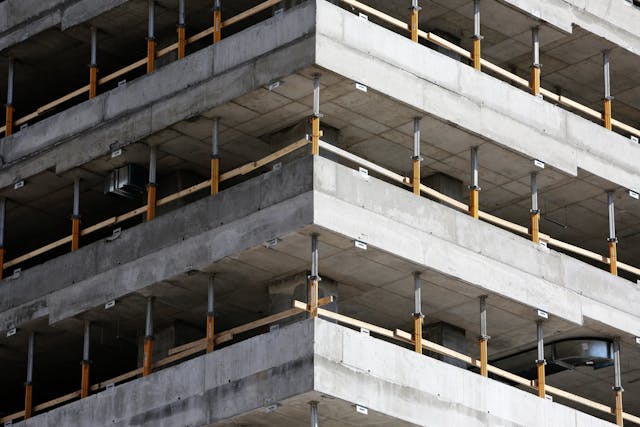
In general, concrete that does not require bag mixing is used without inconvenience for making fence post sealings, clotheslines, benches, supports, mailboxes, and signage panels. Apart from sealing work, it is used for installing anchor bolts for windows, doors, and any other type of carpentry.
During a renovation project, it is very helpful to conceal imperfections on interior walls and the facade. Outdoors, it allows you to make roughcast. To achieve this, please use aerial lime when composing the concrete.
Thus, it is uncommon to use unmixed concrete for making load-bearing structures or frameworks. This does not mean it lacks strength. Rather, it is intended for small construction, renovation, or emergency ornamental work.
To ensure the solidity of load-bearing structures, professionals often prefer to use reinforced concrete. Otherwise, they choose fiber-reinforced concrete or high-performance concrete. Due to their high quality, their price is generally higher than that of conventional concretes.
How does unmixed concrete compare to traditional concrete?
🍀 Advantages
- No mixing tools required
- Clean site (no splashes)
- Considerable time saving
🔻 Limitations
- Higher price per bag
- Use limited to small volumes
Before choosing unmixed concrete for your work, it is interesting to compare it with classic concrete. The table below summarizes the main differences:
| Criterion | Unmixed Concrete | Traditional Concrete |
|---|---|---|
| Preparation | Ready to use, no mixing necessary | Must be mixed (mixer, shovel, trough…) |
| Dosage | Already balanced at the factory | Depends on manual preparation |
| Application time | Very fast (pour, add water) | Longer (measuring, mixing, adjustments) |
| Setting | Fast thanks to additives | Classic setting, slower |
| Applications | Sealings, small jobs, repairs | Structures, foundations, slabs, major works |
| Final strength | Up to 30 MPa (suitable for sealings) | Variable depending on dosage and use |
| Price | Higher (10 to 35 € per bag) | Cheaper (5 to 15 € per bag) |
What are the limitations of using unmixed concrete in construction projects?
When planning to carry out the installation of fence post anchors, clotheslines, benches, supports, mailboxes, panels, nothing beats using no-mix bag concrete.
While the preparation of traditional concrete requires mixers and shovels, the preparation of no-mix concrete requires no equipment. It is already well measured and composed at the factory. All you have to do is pour it into the hole in your garden, for example.
This product therefore offers you simplicity and speed of use. That’s not all, it allows you to save time in your anchoring work.
Despite its many advantages, it must be admitted that bagged no-mix concrete has application limits. If you intend to carry out concreting and anchoring of structural elements according to the NF EN 206/CN standard, it is better to find other concretes. The no-mix bag concrete is not the right material.
Similarly, it cannot provide better results for anchoring steel reinforcement bars. If you plan to use it for foundation footings, you are mistaken. It is not designed for this operation.
No-mix concrete cannot be used on sloping ground either. Before applying it, please properly prepare the ground that will receive it. In any case, do not hesitate to use it for small anchoring jobs. And even if you do not have masonry equipment, it is always ready to serve you.
How does no-mix concrete contribute to durability and ecology in the construction sector?
Due to its quality composition, bagged no-mix concrete increases the durability of the construction. It must be acknowledged that its long lifespan has an environmental impact. Moreover, its production requires the addition of a setting accelerator additive. This product raises doubts for most about its aggressive components.
To address these concerns, manufacturers compete in ingenuity and creativity to offer eco-friendly concretes. To retain the no-mix description while preserving the environment, their components must be reliable without threatening the ecosystem.
To achieve these goals, more and more builders reduce energy use in the production of no-mix concrete in practice. They also exclude the use of steel and limit the amount of cement so that the work is more ecological.
What is the average cost of no-mix concrete compared to traditional concrete?
Unlike traditional concrete, it can be noted that concrete not requiring bag mixing without delivery is expensive to purchase. However, this price difference can be understandable considering its many interesting advantages.
If you buy a 25 kg cement bag to make traditional concrete, it costs only 5 to 15 euros. On the other hand, a 25 kg bag of no-mix concrete costs on average from 10 euros up to 35 euros.
Its price can vary depending on many factors such as the quality of its composition and the brand’s reputation. Each distributor can also set the price according to their requirements.
For example, you can find a no-mix concrete bag of 25 kg at 11.90 euros at Castorama. On the other hand, Amazon offers you concrete of a similar category at 36.97 euros.
To find the best price, take the time to make a comparison. And do not hesitate to gather the necessary information on each product that interests you.
How is no-mix concrete delivered and applied on a construction site?
In most cases, no-mix concrete for making seals is distributed in bags. You can purchase it at any hardware store or specialized shop of your choice. It is also convenient to obtain it online. Many websites offer you a complete collection of models at a competitive price.
Regarding its application, the operation is a real child’s play, unlike the preparation of traditional concrete. You do not have to worry about the dosage or its quality since it is ready to use.
You sometimes need it to erect supports, mailboxes, and signposts. It is also the perfect material for making seals for stakes, fences, clotheslines, and benches.
Before using it, it is useful to make a hole to position the post. Once this step is finished, add the no-mix concrete bag into the hole, then pour the water according to the necessary quantity. For a 25 kg bag, you can mix it with 4 liters of water.
💡 Practical tip
Use a magnetic spirit level fixed on your post before pouring the concrete. Since the setting is very quick (less than 10 minutes), you will have only a few moments to adjust the perfect plumb before the structure is fixed.
The drying time depends on countless factors such as humidity and ambient temperature. Because of the setting accelerator additive, the no-mix bagged concrete can harden in a short time. However, it is necessary to wait weeks for it to reach its maximum strength.
What precautions should be taken when implementing no-mix concrete?
Although this category of concrete is suitable for all temperatures, it is always necessary to take measures to limit any inconvenience.
It is important to emphasize that ice is a major factor damaging the texture of no-mix concrete.
To avoid ruining the work, it is advisable to use the material during the hottest times of the day to speed up its drying.
Sun rays optimize its rapid drying. However, it is imperative to remain vigilant, because the concrete may be hard only on the outside, but not inside. To avoid this situation, it is better to spread covers on top to reduce the sun’s effect.
What recent innovations have been developed in the field of no-mix concrete?
Faced with fierce competition among manufacturers of no-mix bagged concrete, each brand continuously deploys the latest modern technologies to distinguish its products. To achieve this, they compete in innovation and development to present eco-friendly concretes.
Thanks to these, it is possible that the making of seals, stakes, fences, clotheslines, benches, and mailbox supports does not pollute the environment. The concrete used must be made of ecological elements.
It is thus necessary to limit the use of cement and other environmentally harmful products. During the material composition process, energy consumption is considerably reduced. The goal is to make no-mix concrete less polluting.
According to reliable sources, traditional concrete is responsible for 6 to 7% of greenhouse gas emissions worldwide. To address this problem, it is imperative to reduce the environmental impact of preparing no-mix concrete for making seals.
Frequently Asked Questions
No, it is intended for small sealing jobs and not for load-bearing structures. For solid foundations, it is better to opt for reinforced or high-performance concrete.
The price ranges from €10 to €35 for a 25 kg bag depending on the brand and distributor, compared to €5 to €15 for a bag of regular cement.
Yes, it gradually reaches significant strength (up to 30 MPa), which guarantees solidity and longevity for sealing and small jobs.