Just like the concrete slab, the metal structure, the new wood, the cinder block or the brick, drywall plasterboard is one of the most commonly used construction materials by both individuals and professionals.
Distributed by the Saint-Gobain group, it offers countless different uses. It is an ideal solution for interior fittings to create walls, partitions, and ceilings. The plasterboards are both a superior finishing and renovation element.
Their installation does not require significant masonry work. Moreover, drywall comes at an affordable cost. If you plan to use it but are still hesitant, this article provides essential information on the subject.
What is drywall plasterboard and what is it made of?
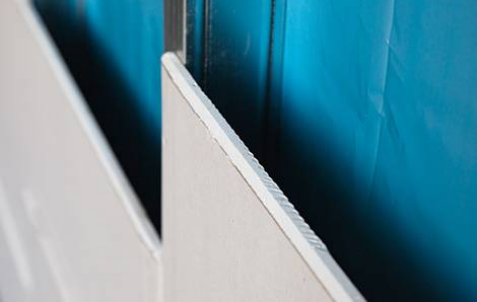
Drywall plasterboard is nothing other than a brand created by the Saint-Gobain group. It specializes in the manufacture of plasterboards and uses this term to indicate its brand of drywall or plasterboards.
Over time, the term drywall plasterboard has become increasingly popular in everyday construction language.
It is a material composed of molded plaster installed between two ultra-thin layers of cardboard. The mixture of plaster and cardboard forms the plasterboard with tapered edges for various types of work.
Many models can be found, each with its own particularities. For example, there is water-resistant drywall for wet rooms, acoustic drywall for sound insulation, and the type fire-resistant drywall.
Besides that, the plasterboard or Saint-Gobain drywall comes in many sizes. Apart from the standard drywall or BA13, there are BA10, BA15, BA18, and BA25. They differ in size and thickness. As for their width, it ranges between 60 to 120 cm.
Whatever the dimensions, the plasterboard with tapered edges of different types is installed by screwing using a drywall screwdriver. The material is fixed onto metal studs or rails. In some cases, it can be glued with a specialized mortar.
Main uses in your projects
Drywall plasterboard is now indispensable in interior design. Its variety of applications makes it a valuable ally for renovating, insulating, or structuring a space. Here are the most common uses:
- Creation of interior partitions to separate or reorganize spaces.
- Covering existing walls to obtain a smooth surface ready to be decorated.
- Construction of suspended ceilings to integrate lighting or improve acoustic insulation.
- Thermal insulation from the inside in combination with insulating materials.
- Attic conversion thanks to its lightness and ease of cutting.
- Installation of technical partition walls allowing cables and circuits to pass without heavy work.
What are the advantages of using plasterboard in construction?
Compared to most materials, water-resistant plasterboard for rooms or acoustic plasterboard insulation stands out for its lightness. As such, it is not only easy to install but also easy to work with.
No one needs to do major work to ensure its installation. You just need to be a good DIYer and equip yourself with the necessary tools, and you’re good to go.
Its other major asset lies in its multiple uses. It is an ideal option for interior fittings to finish ceilings or walls.
The plasterboard France is also the best material for mounting shelves, partitions, false walls, faux pillars, and panels that do not require any load-bearing wall.
If you want to build an efficient partition, using acoustic plasterboard insulation is not necessarily enough.
You can place a layer of glass wool between the two plasterboard sheets. In any case, the Saint-Gobain group can offer you a variety of professional quality models.
That said, plasterboard manufacturing is increasingly attracting people due to its affordable cost. Although it has many advantages, it is offered at a price within everyone’s reach.
Even better, it is praised for its hygrometric qualities. This allows it to effectively regulate humidity inside the home. The insulating plasterboard or standard prevents the appearance of fungi and mold.
How to choose the right type of plasterboard for my project (water-resistant, fire-resistant, acoustic, etc.)?
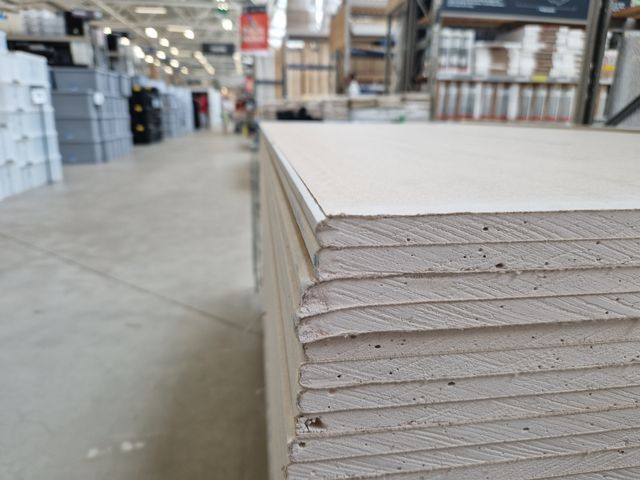
Between acoustic plasterboard sheets, fire-resistant plasterboard, water-resistant plasterboard for wet rooms, an endless variety of plasterboard France models are available on the market. If you have trouble making your choice, it is important to consider the type of your project.
If you plan to renovate the walls, partitions, or ceilings of your kitchen, the fire-resistant model is an excellent option. Pink in color, it has high fire resistance.
Since the kitchen is the area most exposed to fire, this category of plasterboard France can withstand fire for about 2 hours.
For a bathroom renovation, it is advisable to opt for water-resistant plasterboard for wet rooms. Green in color, it is designed to withstand humidity. Apart from the bathroom, this plasterboard is suitable for other rooms where this condition is present.
Many households prefer to create a comfortable atmosphere at home. To reduce noise, acoustic plasterboard insulation delivers good results. It is recognized by its purple or blue shade.
Some plasterboards guarantee thermal insulation in the room.
Besides this insulating plasterboard, there are models on the market capable of purifying the air.
Others demonstrate remarkable versatility to suit any hard-to-reach room or those with curves. This flexibility allows them to meet all expectations.
How to install plasterboard? What tools are necessary?
Whether it is acoustic plasterboard for sound insulation, thermal insulating plasterboard, or water-resistant plasterboard for wet rooms, installation by a professional generally costs between €25 and €50 per square meter.
However, if you have good tools and some DIY knowledge, you can very well do the job without any problem.
To do this, some tools and materials may be necessary, including metal studs and tracks, a mason’s ruler, a screwdriver, insulating materials, a drywall panel lifter, drywall screws, an electric screwdriver, joint compound, sandpaper, and paint.
Before installing the drywall panels, you must first install the tracks on the floor and ceiling to secure them. Once done, you can install the studs. To enhance the insulation of walls, partitions, and ceilings, you have the option to add insulation.
Once this is in place, install the plasterboard panel with tapered edges into the metal framework. Make sure it is perfectly straight. Then, you can secure it with an electric screwdriver.
The final step is to apply the joints. To make the results visually pleasing, conceal the joint tape with a layer of special joint compound.
As for finishing, sand the surface with sandpaper. The goal is to remove roughness and make the surface smooth. Once this step is finished, remove the dust with a vacuum cleaner. You can then paint the wall or apply a covering of your choice.
What is the difference between plasterboard and other interior finishing materials?
There are many elements contributing to the finishing of an interior partition. Apart from plasterboard, there are terracotta bricks, aerated concrete, and glass.
If you prioritize robustness, bricks will not disappoint you. They also have the ability to regulate room humidity and ensure thermal comfort during the hot season since they are breathable materials.
However, due to their weight, installation is not an easy task at all. On the other hand, Saint-Gobain plasterboard is prized for its lightness. Plasterboard is easy to work with.
Regarding aerated concrete, many prefer it and use it for their partitions because of its versatility. It is suitable for both humid and dry rooms. Its drawback lies in its high cost. If you have a limited budget, know that the plasterboard price is affordable for everyone.
As for glass, it comes in two categories, including glass partitions and glass bricks. If you consider using it in living rooms or bathrooms, its transparency provides an unmatched aesthetic note.
During installation, it is preferable to entrust it to a professional. Since glass is a fragile material, its handling is rather reserved for an expert. Conversely, plasterboard manufacturing can be installed by simple DIYers.
Technical characteristics of Plasterboard to know
Beyond its uses, plasterboard has important technical properties that guide the choices of DIYers and professionals. These characteristics influence the performance and durability of the material.
| Characteristic | Details | Why is it important? |
|---|---|---|
| Standard thickness | 6 to 25 mm (most common: 13 mm) | Determines rigidity and ease of installation |
| Board width | Generally 120 cm | Allows quick coverage of large surfaces |
| Weight per m² | About 8 to 10 kg (standard BA13) | Affects handling and installation |
| Thermal conductivity | λ ≈ 0.25 W/m.K | Influences the effectiveness of associated insulation |
| Mechanical resistance | Varies depending on type (standard, reinforced hardness, etc.) | Guarantees longevity and strength |
| Specific variants | BA13 hydro, acoustic, fire… | Adaptation to specific needs and rooms |
How to repair a hole or crack in a plasterboard wall?
To create partitions, the plasterboard with tapered edges of the work type is ideal for interior fittings. Not only is it easy to install, but it also offers excellent sound and thermal insulation.
Over the years, a crack or hole may appear inside the wall. You can repair it using a filling paste. Smoothing compound tubes are also available on the market.
In the case of a medium-sized breach, it is better to use a powdered filler. Its preparation is child’s play. You can mix it with water. Then stir the material until the paste becomes thick and homogeneous.
For a large hole, you need to act differently, as the previously mentioned methods cannot seal it. Start by cutting the damaged part with a saw blade.
Use a plasterboard as a repair piece. Cut it according to the size of the breach. Once it is well fixed, apply a special plasterboard compound to conceal the surface. After the product dries, sand the area using 120-grit sandpaper.
Is it possible to install shelves or hanging furniture on a plasterboard wall?
Of course, it is possible to fix a wall cabinet on a plasterboard partition. But before you start, it is important to determine the load the material can support. High-quality plasterboards can accommodate a heavy shelf.
With the variety of offers from the Saint-Gobain plasterboard group, it is easy to find a model with high resistance.
Some plasterboard panels also have a specific treatment to support an object up to 30 kg or more. This reinforced plasterboard guarantees a reliably secure installation of hanging furniture.
For this mounting to be solid, the plasterboard must also be firmly fixed with a high-quality anchor. The MZK plastic model and the metal Molly are among the most effective.
For a screwed or glued wall doubling, favor a NP type anchor if the loads exceed more than 30 kg. The anchor must be driven into the wall to a depth of at least 5 cm.
How to soundproof or thermally insulate a wall with plasterboard?
If you want to limit noise pollution, many manufacturers like the Saint-Gobain plasterboard company offer improved versions of plasterboards. This type of plasterboard provides better thermal and acoustic insulation.
Just like traditional models, it features easy installation. The soundproof plasterboard insulation is capable of reducing sound intensity by up to 50%. It therefore makes the atmosphere in the room pleasant.
Due to the presence of gypsum, it is both a healthy and ecological material. Besides being an acoustic insulating plasterboard, some versions are moisture-resistant. They can be installed in damp rooms.
To optimize results, it is entirely possible to use other methods to reduce noise transmission. For example, you can add a soundproof underlay made of rubber before installing the plasterboard. Alternatively, a special soundproof coating is another option.
To ensure the surface is perfectly even, it is required to apply a special plasterboard undercoat before painting. It helps the paint adhere. Even better, it covers plaster marks and any stains after the work.
When working on plasterboard gypsum board, it often generates dust, especially since cutting is required. It is therefore necessary to wear protective equipment such as a mask.