During energy renovation work, the ceiling is among the parts of a house to insulate as a priority. Heat loss sometimes occurs from above, especially in homes equipped with unfinished attics. It is therefore essential to insulate a ceiling to limit energy loss.
A better thermal insulator serves to create a barrier against cold and strong summer heat from outside. Besides the thermal comfort obtained, ceiling insulation helps reduce the use of air conditioning and heating. It is therefore a way to lighten electricity bills. A well-insulated ceiling is indeed capable of maintaining a stable temperature, avoiding energy consumption. This can become profitable in the long term, making your home less energy-consuming.
Summary: I remain convinced that insulating a ceiling is the most cost-effective action to stop the “cold wall” effect in a dwelling. In 2026, I consider that the best approach is no longer just to choose the maximum thickness, but to prioritize the continuity of the insulation. In my view, creating a suspended false ceiling with an airtight membrane remains the king method: it allows housing high-performance bio-sourced materials while offering a flawless finish that immediately enhances your property.
What are the most effective options for insulating a ceiling?
Several techniques for ceiling insulation can be distinguished. The use of the best insulating materials is part of this. Rock wool and glass wool are among the most used. They stand out for their increased thermal insulating power. The choice of insulation mainly depends on specific needs. In any case, please prioritize a certified product with optimal performance.
To insulate a ceiling, installing a false ceiling is also an excellent idea. The goal is to place insulating materials between this false ceiling and the real ceiling. This type of ceiling is not only used to improve acoustic and thermal insulation. It also enhances the room by giving it an unmatched aesthetic touch. It should be noted that the false ceiling is only suitable for areas with a high ceiling height.
Many people also insulate a ceiling using a thin insulation. Thanks to its low thickness, installation can be both quick and easy. Moreover, this significantly minimizes space loss. To do this, simply staple or glue the element directly to the ceiling. Then, you need to drill it to simplify the passage of ducts. For finishing, you can cover it with a facing.
Even though it is a thin material, it consists of many layers of insulation such as cotton wool, felt, plastic foam, polyurethane, and wood fiber. To enhance performance, please combine it with classic insulating panels such as glass wool. Together, they perfectly insulate the ceiling, meeting both acoustic and thermal requirements.
| Insulation Method | Recommended Materials | Thermal Gain | Work Complexity |
| Suspended False Ceiling | Wood wool or rock wool | Very high | Moderate to high |
| Glued Cork Boards | Natural expanded cork | Medium (ideal for renovation) | Simple |
| Injection in Box | Cellulose wadding or cotton wool | Excellent (zero thermal bridge) | Professional required |
| Polystyrene Tiles | High-density EPS | Low to medium | Very simple |
During the renovation of my old workshop, I had neglected ceiling insulation, thinking the walls would be enough. One windy evening, I realized the extent of the problem when I saw the smoke from my cup of tea literally being sucked upwards by air leaks at the joists. By installing rock wool panels myself under a rail structure, I immediately felt a difference: not only did the heat stop escaping, but the silence became profound. It was a true lesson in applied physics: the comfort of a room depends above all on what happens above our heads.
Which materials to use for optimal ceiling insulation?
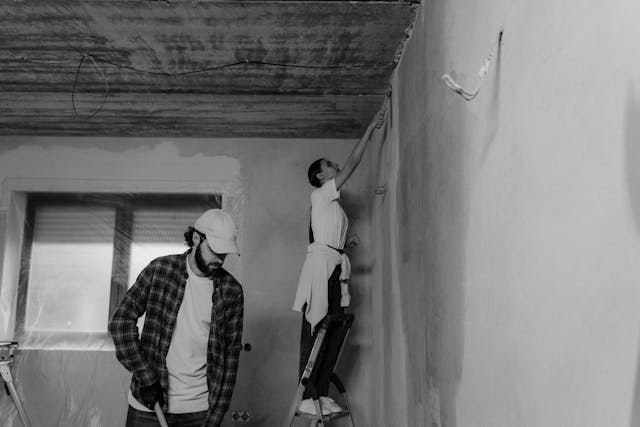
Before looking into the various aids for insulating your home, first take the time to choose the insulation to install. There are several types of materials to insulate a ceiling. Mineral thermal insulators are among the most popular. They stand out for their good thermal performance. Between cellular glass, rock wool, and glass wool, the latter is not only a better sound insulator but also thermal.
If you prefer synthetic thermal insulators, they are loved for their lightness. They are therefore easy to install. You can choose between polyurethane, expanded polystyrene, and extruded polystyrene. Most of these are not only used to insulate a ceiling but also the garage, basement, and cellar.
Natural thermal insulators are also gaining popularity. As their name suggests so well, their natural property is one of their major assets. Moreover, many favor them due to their renewable nature and low environmental impact. Examples include cellulose wadding, sheep wool, cork, wood wool, hemp wool, wood fiber, and many others.
Insulation materials for ceilings
As we have just seen in the paragraph above, it is difficult to choose insulating materials because of their variety. To make things easier for you, we suggest consulting this table summarizing the best ceiling insulators:
| Insulation material | Average thickness (mm) | Thermal performance (λ in W/m.K) | Advantages | Disadvantages |
|---|---|---|---|---|
| Glass wool | 100 to 200 mm | 0.030 to 0.040 | Good thermal and acoustic insulation, economical | Requires significant thickness |
| Extruded polystyrene | 20 to 50 mm | 0.029 to 0.036 | Lightweight, easy to install | Less effective acoustically |
| Thin insulating panels | 20 to 50 mm | 0.030 to 0.040 | Space-saving | Less effective than wool |
| Wood wool | 50 to 150 mm | 0.038 to 0.042 | Eco-friendly, good acoustic insulation | More expensive |
How to insulate a ceiling without reducing ceiling height?
Ceiling insulation is an interesting solution to save energy and improve the interior comfort of a home. However, it must be admitted that such work often results in a loss of space for rooms with low ceiling height. To remedy this situation, it is recommended to favor an ultra-thin insulation material.
Several types of low-thickness insulations are available on the market. If you prefer traditional materials, synthetic and mineral insulations provide good results. For the latest options, nothing beats choosing vacuum insulation panels.
With a thickness of 3 cm, this material significantly minimizes volume loss during ceiling insulation. Moreover, it offers better thermal performance with a thermal resistance of about 5 m².K/W and a thermal conductivity of 0.006 W/m. It thus promises optimal comfort while preserving space. To acquire one, a significant budget is required due to its high cost.
To maintain ceiling height during ceiling insulation, external insulation also proves to be a better idea. This involves installing the insulating material on the roof before the covering is installed. Besides providing good insulation without reducing space, this technique protects the roof from weather damage.
What is the most suitable ceiling insulation method for an old house?
If you have just inherited an old building, its insulation is one of the priorities to consider. Generally, homes built before 1975 are energy sieves. They exhibit significant heat loss, increasing the energy bill.
Before starting insulation work, it is first necessary to have the home inspected by a specialist. They will analyze the existing insulation, preliminary work, effective measures, and especially the right insulation technique to use.
Since heat rises, ceiling insulation is a crucial step in insulating the entire home. Depending on the budget and situation, you have a choice between two insulation methods:
First, you can apply internal insulation. The condition is to have a roof covering in good condition. This approach is also not suitable for flat roofs. If you meet these requirements, do not hesitate to opt for this technique. To do so, simply fix the insulation under the roof or more precisely between the rafters.
The second method is external insulation. It is the ideal solution for roofs in poor condition. The roofer first installs the insulating panels on the framework. Once done, he covers them with a new roof. It is important to emphasize that this insulation technique is suitable for both pitched and flat roofs of an old house.
What are the advantages of acoustic insulation for a ceiling?
Just like thermal insulation, acoustic insulation is of paramount importance. According to reliable information, noise pollution is among the sources of neighborhood conflicts. Up to 40 % of French people complain about the disturbances caused by these nuisances. To reduce them, it is essential to strengthen the acoustic insulation of the home.
People living in urban environments are the primary victims of an aggressive sound environment. By undertaking soundproofing of the house, they have the opportunity to live comfortably without suffering the disturbances caused by noise pollution. To achieve this, they do not hesitate to carry out ceiling soundproofing.
These works not only optimize the acoustic performance of the dwelling but also reduce the perception of all external impacts. By using better insulating materials, they are able to limit resonance and the internal propagation of noise until it becomes imperceptible. As a result, the occupants can live comfortably.
Besides that, the advantage of soundproofing is also to increase the value of the house. If you plan to sell it, a well-insulated property is an excellent selling point that attracts buyers’ interest. This is particularly relevant for homes located near train stations, busy streets, or major roadways. Since these areas are very noisy, it is essential to insulate houses in these regions to make them pleasant to live in.
Comparison of types of acoustic insulation for ceilings
Among the different ceiling insulators, rock wool is highly recommended due to its high acoustic efficiency. Otherwise, you can choose between glass wool, acoustic panels, and acoustic foams.
| Type of acoustic insulator | Acoustic efficiency | Recommended thickness (mm) | Ideal applications | Durability |
|---|---|---|---|---|
| Rock wool | Very good | 100 to 200 mm | Suspended ceilings, false ceilings | Good fire resistance |
| Acoustic panels | Good | 20 to 50 mm | Apartments, offices | Easy installation, aesthetic |
| Glass wool | Good | 100 to 200 mm | Old houses, attics | Less durable in humid environments |
| Acoustic foams | Average | 10 to 30 mm | Music studios, specific rooms | Low thermal resistance |
What are the costs of ceiling insulation?
If many people decide to insulate the ceiling of their homes, it is because these energy renovation works offer several advantages. Among the best known, they are eligible for multiple financial aids that reduce costs.
Moreover, this project is an idea to make energy savings. If you plan to insulate the ceiling by installing a false ceiling, it also allows hiding the electrical network. There are many benefits of ceiling insulation, but these are just a few examples among many others.
Regarding the price of ceiling insulation, this includes the purchase of insulation materials and labor. That is why the amounts can vary depending on several parameters, namely the type and quality of the insulation, the artisan’s rates, as well as the model and surface area of the ceiling.
In any case, the installation price includes about 15 euros per square meter for thin insulations. If you choose to install a false ceiling with thick insulation, expect roughly 70 euros per square meter. Don’t forget to add the purchase price of the insulation to these costs, and on average you get 50 euros per square meter for insulating your ceiling.
Is it possible to insulate a ceiling without major work?
Of course, it is entirely possible to proceed with ceiling insulation without doing major work. To carry it out successfully, it is recommended to install a thin insulation directly on the ceiling. This insulation technique is the quickest and easiest to perform. You simply glue the material or staple it, and that’s it. Despite the simplicity of the work, it must be said that the effectiveness of the method seems limited.
To avoid major work, applying insulating paint on the ceiling is also an interesting idea. Like thin insulating panels, it is easy to use. Even better, it is offered at a price accessible to everyone. This paint helps increase the thermal insulation of the ceiling. But for better performance, it is preferable to combine it with renovation work providing sufficient thermal and acoustic insulation.
Among the most popular methods, it is advised to prioritize the installation of a false ceiling. This technique allows effective insulation of the existing ceiling. Although its installation may reduce the ceiling height, it guarantees good sound and acoustic insulation of the dwelling. Additionally, it allows you to use a thick insulation known for its exceptional thermal performance.
Insulation solutions without major work for ceilings
If you have difficulty choosing the most practical insulation methods without major work, do not hesitate to consult this table. It presents a comparison of insulation techniques with their advantages and limitations.
| Insulation solution | Description | Approximate cost (€/m²) | Advantages | Disadvantages |
|---|---|---|---|---|
| Glued insulating panels | Panels directly glued to the ceiling | 10 to 30 €/m² | Easy to install | Less effective for major heat loss |
| Insulating false ceiling | Installation of an insulated false ceiling | 30 to 60 €/m² | Good thermal and sound insulation | Reduction of ceiling height |
| Thermal insulating paint | Paint with insulating microbeads | 8 to 15 €/m² | Simple to apply, low cost | Limited thermal efficiency |
What are the current regulations for ceiling insulation?
Carrying out insulation work requires following certain standards. They are becoming increasingly stringent to limit greenhouse gas emissions related to construction. The regulation RT2012 is replaced by RT2020, aiming to reduce greenhouse gas emissions and energy consumption of new housing.
This current law applies to countless buildings including individual houses, offices, collective housing, and educational establishments. The goal is to ensure energy sobriety, reduce carbon impact, and also improve comfort especially during heatwave periods.
The thermal regulation by element is still valid up to now even though it was implemented in 2017. The insulation used must meet the thresholds of thermal resistance allowing effective insulation. The thermal resistance of an attic ceiling must, for example, be approximately 7 m2. K/W at minimum.
What are the tax benefits for insulating a ceiling in 2025?
When it comes to tax benefits, one immediately thinks of the major change in the MaPrimeRénov’ 2025 scheme. From January 1, 2025, the subsidy ceilings will be increased, reducing the costs of energy renovation work. This aims to encourage households to undertake this project.
For those who are part of low-income households, the decree plans to increase the cap up to 100%. For middle-income households, the cap is increased to 60 to 80%. Even higher-income households also have their share with a capping rate of 40 to 60%.
Starting from January 2025, MaPrimeRénov’ can be combined with the Zero Interest Loan or PTZ scheme. This reduces the costs of renovation work, further encouraging households to embark on this project.
Besides this, there are other financial aids such as the Prime Effy, the reduced VAT at 5.5%, as well as many local and regional subsidies. They allow you to carry out the insulation of your house at a lower cost. To be certain about your eligibility, please obtain the necessary information on the subject from the responsible authorities.
Best method to insulate a ceiling in 2026: The practical guide
If you lack ceiling height: polyurethane panels or vacuum insulation panels (VIP) are the most effective. They offer exceptional thermal resistance for a reduced thickness: which allows you to preserve maximum living space while meeting current energy standards.
The installation of a vapor barrier or hygro-variable membrane is imperative in most cases. It prevents moisture generated inside the house from migrating into the insulation: which avoids internal condensation, loss of thermal performance, and especially premature deterioration of your framework or plasterboards.
To block footstep noises coming from the upper floor: it is preferable to use anti-vibration acoustic hangers. By combining a fibrous structured insulation (such as hemp or wood wool) with a high-density acoustic plasterboard: you will create a formidable “mass-spring-mass” system against noise pollution.