

If you love gardening, it is hard for you to resist the art of the Chinese garden. Whether it is classical Chinese gardens, imperial gardens, temple gardens, or the humble administrator’s garden in Suzhou, this green space demonstrates great originality and creativity.
Just like the contemporary garden, it continues to enjoy tremendous success. Its reputation extends to all corners of the globe. Chinese gardens stand out because of the elements that compose them, their history, and their symbolism.
To learn more about this subject, there are many sources that can help you, such as the books by Che Bing Chiu or Michel Baridon Jardins. Feel free also to consult our article providing essential information on Chinese gardens.
What is a Chinese garden?
The design of Chinese gardens differs from that of Japanese gardens, French or English gardens. They disrupt Western conventions by prioritizing quality and respecting the Feng Shui principle which states: less is more.
The art of the Chinese garden recreates nature in miniature. It sets up a natural landscape in an artificially arranged place. This type of gardening adopts plants, mountains, rocks, and lakes as decor or expressive elements.
It arranges a vast, yet limited, virgin space to establish a symbolized and refined nature. The goal is to poetically represent the natural order of the garden without leaving traces.
We often speak of Chinese gardens as a quest for paradise on earth. The place guarantees a feeling of well-being, thanks to the calm it provides. It is later defined as a place of meditation and refuge helping you to relax peacefully.
Regarding the history of classical Chinese gardens, it dates back to the Zhou and Shang dynasties. Nobles arranged forests spanning hundreds of square kilometers for hunting.
Then the Han dynasty brought changes by integrating animals and residential quarters. In this sense, Chinese gardens as a quest for earthly paradise allowed people not only to hunt there but also to relax.
But the true architecture of traditional Chinese gardens dates back to the Tang dynasty. Artisans built for the first time a beautiful creation with fountains, ponds, and artificial hills in a limited space.
The design of Chinese gardens has continued to evolve until it became a unique natural space. It is not only considered a place of entertainment.
It can also host formal ceremonies. It can even be arranged so that people can practice their worship.
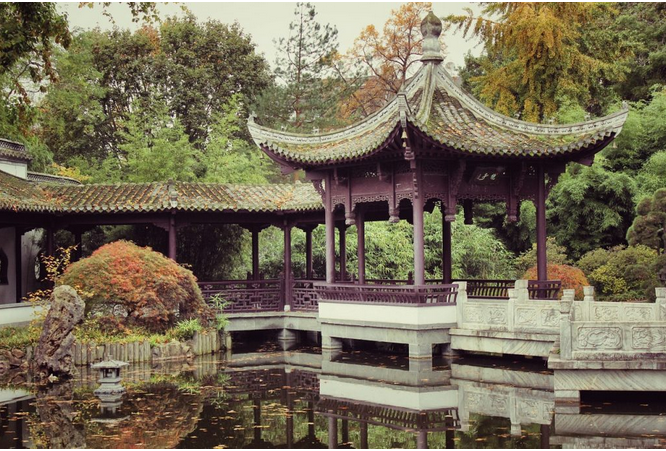
History and symbolism of a millenary art
The Chinese garden is much more than a simple green space: it is conceived as a miniature representation of the world, where each element carries meaning. Inherited from a long artistic and philosophical tradition, it blends harmony, contemplation, and natural balance. Here are the essential aspects:
- Purpose of the garden: to invite meditation, contemplation, and a spiritual relationship with nature.
- Ancient origins: appearing as early as the Han dynasty (2nd century BC), Chinese gardens were associated with Taoist philosophy and the art of living.
- Philosophy of balance: union of yin and yang, seeking harmony between man and nature.
- Architectural elements: pavilions, bridges, pagodas, and winding paths to encourage strolling.
- Symbolism of plants: pine for strength, bamboo for flexibility, lotus for purity.
- Play of contrasts: water and rock, shadow and light, curves and straight lines, creating a poetic balance
What is the philosophy behind the design of Chinese gardens?
Imperial gardens, humble administrator’s garden, classical Suzhou gardens or temple gardens, almost all Chinese gardens are inseparable from painting, poetry, sacred arts, and calligraphy.
This intensifies the poetic charm of the creation reflecting Chinese culture and its philosophical thought.
Moreover, one can notice that the design of traditional Chinese gardens is influenced by countless doctrines such as Buddhism, Confucianism, and Taoism. It is especially the latter that greatly influences this true haven of peace.
Taoist philosophy focuses on the connection between the cosmos and humanity. The precise goal is to develop perfect harmony between nature and man.
The majority of classical Suzhou gardens reveal a sometimes irregular geometric image represented by the lake, plants, stones, rivers, and many other elements.
Through Chinese garden art, artisans simulate the poetic splendor of nature. The Chinese paradise garden externally describes the inner strength of humanity. It is an embodiment of Yin and Yang balancing these two opposing forces in Chinese philosophy.
How are elements such as water, stones, and plants used in a Chinese garden?
Whether it concerns Chinese gardens seeking paradise on earth or the humble administrator’s garden in Suzhou, every Chinese garden requires water, rocks, and of course plants. They are defined as the basic elements of Chinese garden art.
You thus do not need to accompany it with modern decorative accessories such as a garden arbor, outdoor rug, or brazier for it to be complete. These elements alone can suffice to make it special.
Representing Yin, water is an essential symbol in Chinese philosophy. There are several ways to integrate it into classical Chinese gardens.
It can be a waterfall or a stream. It can also meander among different garden decorations. By means of bridges, dikes, or islands, its surface is divided into scenes of different aspects. Semi-circular bridges symbolizing the moon are often seen.
The humble administrator’s garden in Suzhou stands out for its beautifully green water. It is no surprise that it is listed as a UNESCO World Heritage site.
Regarding stone, it connotes Yang. It is the backbone of the Chinese garden. It gives it the mineral element. The rock finds its place in the garden, sculpted or isolated. It can also be arranged in groups to reveal a miniature mountain.
Imperial gardens or classical Suzhou gardens, Chinese gardens are not gardens if they lack plants. The Chinese adopt different traditional viewpoints in the selection of vegetation.
They prefer to choose species that have been cultivated for centuries. They also favor plants that have symbolic meaning in literature and poetry.
If the lotus evokes prosperity and purity, the pine indicates wisdom. Bamboo, for its part, signifies sobriety. And the magnolia connotes wealth.
Traditional Chinese gardens also include the plum tree, cypress, peony, and much more. It should be noted that flowering plants provide an aesthetic note and bring color to Chinese gardens.
What is the difference between a Chinese garden and a Japanese garden?
More and more people tend to confuse Japanese gardens with classical Chinese gardens. Of course, it must be admitted that they have many common points. Both are composed of pavilions, rocks, gravel, plants, tea rooms, and much more.
They constitute a place of daydreaming and relaxation. Through the combination of green plants, minerals, and spaces, the whole creates a relaxing atmosphere that confers a feeling of well-being.
| Criteria | Chinese Garden | Japanese Garden |
|---|---|---|
| Origin | Ancient China (Han dynasty) | Medieval Japan, partly inspired by the Chinese garden |
| Philosophy | Taoism and nature symbolism | Zen and the search for inner serenity |
| Composition | Great decorative richness, varied elements | Minimalism and sobriety, clean spaces |
| Key elements | Water, rocks, pavilions, bridges, symbolic plants | Raked gravel, stones, lanterns, mosses |
| Aesthetic approach | Contrasts and harmony of opposing forces | Simplicity and silent contemplation |
| Main goal | Represent the world in miniature | Promote meditation and inner peace |
Despite their resemblance, some elements differentiate the Japanese garden from the Chinese one. The first point lies in its dimensions.
It is observed that the Japanese garden is distinguished by its small size. It can be arranged in a limited area. In contrast, the design of Chinese gardens requires a vast domain. This place sometimes hosts a huge natural lake covered with lotuses.
In the Japanese garden, all elements must be placed thoughtfully and meticulously. Conversely, you can install them freely in traditional Chinese gardens.
The latter reject symmetry. The plants each have different sizes. One finds more curved paths than straight benches.
How are Feng Shui principles integrated into the design of Chinese gardens?
The Feng Shui philosophy comes straight from China. Its purpose is to establish harmony by simplifying the circulation of vital energy which carries happiness, well-being, and wealth.
Classical Chinese gardens are established respecting the Feng Shui principle. Each element of the space where one wishes to create the garden must be analyzed in order to benefit from energy flows.
According to the Feng Shui principle, less is more is manifested in the green corner by prioritizing quality, not quantity.
This place of beauty and serenity does not evoke a botanical collection. Flowers and trees are planted asymmetrically.
They enhance the other fundamental elements of the garden such as stone or the lake. The whole creates a harmonious garden helping you connect with nature.
To evoke the Feng Shui principle, one must avoid overloading the space with decorative accessories at all costs. However, there are some elements that symbolize the Feng Shui doctrine.
They can thus find their place in the traditional Chinese garden. Vases, statues, and sculptures are among the most commonly used decorative objects.
Why are pavilions, bridges, and corridors important elements in Chinese gardens?
Besides plants, water, and stone, architecture is among the basic elements composing the art of Chinese gardens.
Chinese gardens seek earthly paradise, private gardens, classical Suzhou gardens, or the humble administrator’s garden; the different types of Chinese gardens feature many constructions such as galleries, pagodas, halls, arches, kiosks, bridges, corridors, and pavilions.
The bridge is generally made of wood. As such, it is not only aesthetic but also sturdy and durable. When equipped with railings or guardrails, it can sometimes be vegetated. This architecture thus becomes a charming support for flowering or leafy plants.
Regarding the corridor, this element also finds its place in the traditional or contemporary Chinese garden. It facilitates the movement of people within the garden. Likewise, it connects two different areas of the green space.
Many classical Chinese gardens are also accompanied by pavilions. Beyond their main functions, they are among the decorative elements of an Asian garden.
This structure helps you fully relax even if the sun is burning or if the rain starts to fall. It shelters you in every season so you can enjoy your moment of relaxation.
What is the significance of koi and lotus in Chinese gardens?
Many collections of documents provide more information on the meaning of elements representing classical Chinese gardens. Michel Baridon gardens and the works of Che Bing Chiu are among them.
In traditional Chinese gardens as well as in Japanese gardens, one usually finds a body of water full of koi fish.
This aquatic species is an important symbol in the Feng Shui principle. It brings prosperity, luck, and positive energy to your green space.
It also reminds you to always remain calm and serene in the face of adversity. It helps maintain a sense of honor and dignity.
Just like the koi fish, certain plants such as the lotus contribute to perfecting a harmonious garden. This plant is closely linked to Buddhism. It connotes mercy, humility, and wisdom.
It is quite special in that it can bloom even though it emerges from muddy waters. Despite this condition, it continues to flourish magnificently. The lotus exemplifies courage despite troubles or sufferings represented by the mud.
How do Chinese gardens represent the Taoist concept of Yin and Yang?
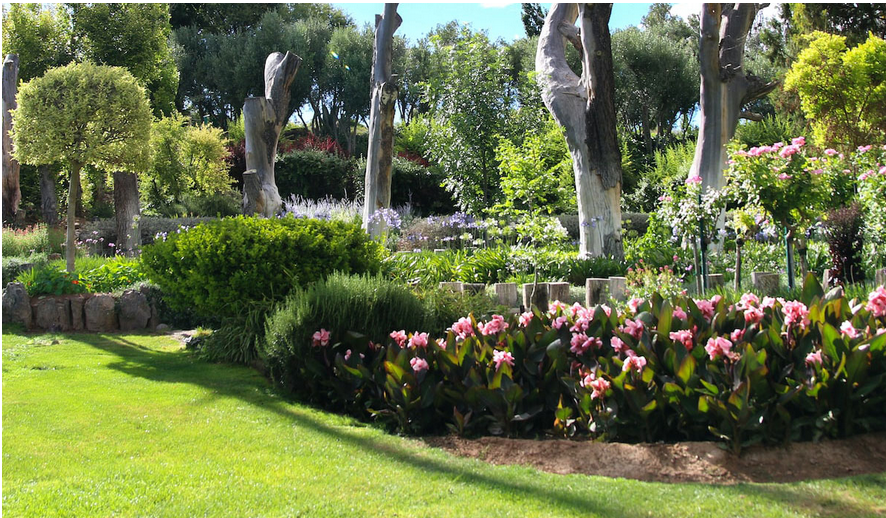
The traditional Chinese garden design conveys many philosophical ideas regarding the interior layout of a house.
If you choose the paint color for a living room, there isn’t really a specific code to follow except the style of decor to adopt.
This is not the case with Chinese gardens such as the classic Suzhou gardens. Many elements must be respected to avoid making a mistake.
As we mentioned in the previous paragraph, the creation of a Chinese garden is inspired by several religious and philosophical systems including Taoism.
The symbol of Yin as well as Yang comes from this doctrine. These two forces are contradictory but complementary. If water represents Yin, stone evokes Yang. As we all know, they are part of the fundamental elements of Chinese gardens.
Indeed, the art of the Chinese garden is difficult to observe as a whole. Moreover, symmetry and order have no place there. However, you can notice remarkable contrasts established by Chinese gardener artists.
The Chinese garden does not create disorder, but it appears as such. Instead of emphasizing harmony, it favors the aesthetics of all decorative elements.
Are there any famous Chinese gardens I should know about or visit in France?
Of course, you can find several Chinese gardens that are remarkably beautiful in France. The Yili Garden in Yvelines is among the most popular, welcoming many foreign tourists.
Yes, but on a small scale. You just need to play with contrasts (rocks/water, shadow/light), incorporate some symbolic plants, and if possible, a water element or a small bridge to capture the spirit of the Chinese garden.
Publications similaires :
 How to dig a hole in your garden with an electric auger?
 How to trim a thuja hedge that is too wide?
 Effective stump removal: Everything you need to know about the stump grinder
 Rainwater harvesting: our opinion on these three storage methods
 Jardipedia: connected garden tips and ideas
 Fruits starting with Z: complete list of rare and exotic fruits