Even if your outdoor space is equipped with a large garden gazebo, plants always need to be well maintained. Just like the importance of watering and weeding, hedge trimming is also very useful.
Belonging to the cypress family, thujas are among the shrubs that grow very quickly. To optimize their growth and preserve the beauty of your garden, they must be pruned correctly and regularly.
This article provides you with the best advice for trimming a thuja hedge using the right techniques. But before addressing this topic, it is appropriate to explain the importance of this operation.
Why trim a thuja hedge?
In the city as well as in the garden, a hedge can serve as an excellent means to block the view. It ensures the privacy of the occupants. Many also cultivate it to delimit spaces.
Otherwise, it helps to hide unsightly elements. Squirrels and hedgehogs choose it as their refuge. Whatever its role, it is important to take care of it periodically.
It should be noted that the law requires hedge trimming when it disturbs the neighbors. It must not exceed 2 meters in height.
Moreover, it grows very quickly and becomes wider in a short time. Thujas can reach a height of up to 20 meters.
Thus, they occupy a large part of the garden and block the view. To avoid reaching this stage, it is wise to trim them regularly.
How to trim a thuja hedge?
| Step | Description |
|---|---|
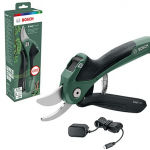
| Preparation | Check the condition of your hedge and make sure the tools are clean and sharp. Manual or electric shears and hedge trimmers are the most suitable. Wear gloves, goggles, and protective clothing. |
| Ideal timing | Preferably trim in spring (March-April) or at the end of summer (August-September). Avoid periods of frost and intense heat. |
| Cleaning the area | Clear the base of the hedge and remove dead or diseased branches. Collect debris to prevent the spread of diseases. |
| Shape of the cut | For a dense and uniform hedge, slightly trim the sides in a trapezoid shape (wider at the base and narrower at the top) so that light reaches all branches. Cut the top horizontally. |
| Cutting technique | Cut gradually, in small sections. Avoid cutting too deeply into old wood, as thuja can take time to regrow. |
| Finishing touches | Check the uniformity of the hedge, even out irregular areas, and remove remaining cut branches. Water lightly if the weather is dry to promote regrowth. |
| Post-trimming care | Fertilize the hedge with suitable fertilizer to stimulate growth. Trim regularly to maintain optimal shape and density. |
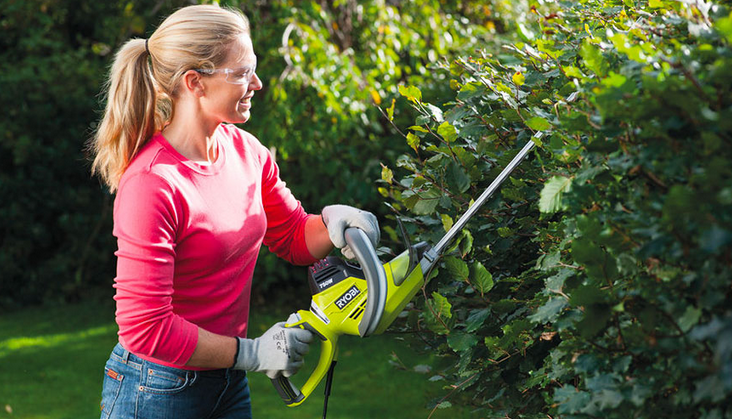
To carry this out successfully, it is essential to equip yourself well. a battery-powered hedge trimmer is practical for pruning freely.
For a large garden with a significant hedge area, it is preferable to use high-performance equipment such as a pneumatic pruner or a gas-powered hedge trimmer.
Also, do not forget to equip yourself with protective gloves to limit injuries. They also allow you to easily collect the cut plants. You can place a tarpaulin on the ground to collect debris.
After this preparation, start pruning from the bottom. Always stay parallel to the plant and do not change the area. Once the lower part is well trimmed, gradually move up until you reach the top of the hedge.
If its height is tall, it is necessary to use a ladder or a step stool. This equipment not only helps you have good visibility but especially to easily reach the upper part.
When to prune a thuja hedge that is too wide?
Pruning a hedge is nothing more than a simple and accessible operation. However, it is important to do it at the right time.
A rather late cut will likely affect the plants. When they become too wide, it becomes difficult to prune their branches. It is therefore imperative to act as soon as they reach a proper size. This way, you will maintain their aesthetic side and the appeal of your garden.
Generally, thuja pruning is done twice a year. You can do the first time during spring. The end of April or early May is the most recommended time.
As for the second time, choose the end of summer, more precisely between the end of August and the end of September.
It should be noted that not all thujas can be pruned along the spring. Only small plants are concerned. This maintenance is favorable to their growth.
Pruning a hedge that is too wide: what is the best solution?
When you do not regularly prune thujas, they grow to disproportionate sizes and end up becoming too wide.
Despite this situation, avoid severe pruning as it severely affects them. The branches appear dry and the plants gradually wither.
There is nothing safer than cutting them down and planting other hedges in their place. This is the best solution, because if you plan to prune them too deeply, know that old wood can no longer develop. That is why you notice bare and dense areas in a single hedge.
However, even if you completely uproot the thujas, you are not obliged to entirely remove the stumps.
Some people prefer to keep their hedge wide. To take care of it, it is possible to deeply prune some branches but cut back the rest.
Then, you need to tie them to the trunk with a string. To avoid facing this kind of situation, think about pruning thujas twice a year.
Hedge too tall: how to proceed?
To work safely, it is essential to be well equipped. A thuja hedge is considered quite tall when it is about 5 m high.
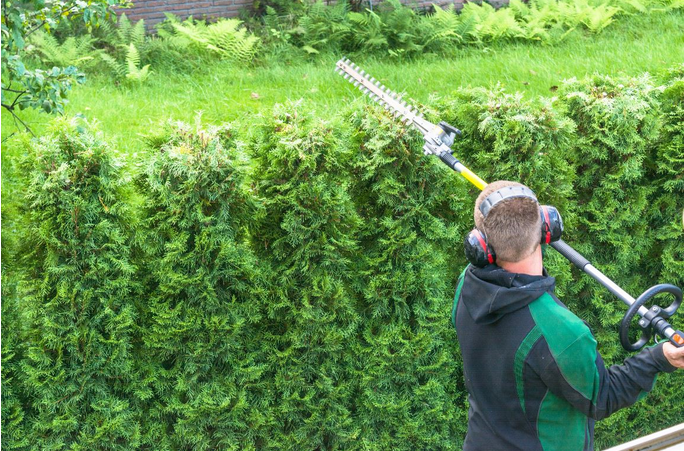
To access it, use a pole hedge trimmer with a long handle. It can reach 2 to 2.20 m high. Beyond this level, it is advisable to use a step stool. If the areas appear flat, the use of scaffolding is recommended.
In any case, this work at height is only for people in good health. If you sometimes suffer from vertigo, it is better to call a professional.
Our 3 tips for trimming a thuja hedge
- Start by trimming the sides: The best way to do this is with a slight slant technique. You leave more thickness at the bottom of the plant than at its top. Thanks to this method, the foliage grows under good conditions and receives more light at the same time.
- To ensure symmetry, don’t hesitate to trim from the bottom up. For precise cutting, the use of pruning shears is highly recommended.
- Straight hedges: The string method provides good results for trimming straight. To do this, simply plant stakes on each side of the hedge. Then attach the strings so that they are taut and straight. The strings can serve as a guide to achieve a perfectly straight cut.
- Trim the top: Start by defining a cutting height by planting 2 stakes and stretching a garden string between them. This string will serve as a guide to help you cut correctly. You have two options for trimming the top of the hedge. Whether it is a horizontal cut or a rounded one, it is important to always remain cautious since this is work at height.
Thuja trimming: gardener pricing
If you go through a professional, the cost of hedge trimming is sometimes determined by a price per linear meter of hedge or by an hourly rate. The professional also takes into account the time required for the work.
The average price for a day ranges between 190 and 240 euros including tax. This amount includes collection, equipment, and disposal.
For a hedge 1 to 1.5 meters high, the average trimming rate per linear meter varies between 5 to 6 euros including tax with disposal and 3 to 4 euros including tax without disposal.
How to reduce a thuja hedge?
For a hedge that is too wide, it is complicated to trim it because it affects its health and growth. Fortunately, it is still possible to reduce its width. For this, it is advised to use a hedge trimmer.
It is imperative to be very cautious because the hedge appears thick in the middle, but with dead branches inside. Therefore, avoid thinning it excessively. This could permanently weaken it.
There are several suitable software options, free or paid. For simple use, Kozikaza or ArchiFacile are practical and easy to use. For more advanced projects, Blender, SketchUp, or Sweet Home 3D offer full 3D features and a professional interface.
No, but some practice is necessary. The software is designed to be intuitive, but it is recommended to start with simple plans and experiment with 2D and 3D drawing functions to better master the tool.
Yes, most software allows you to modify plans at will. You can adjust dimensions, reposition elements, and test different configurations until you achieve a result that exactly matches your expectations.