The installation of a drywall partition is a popular solution for separating spaces or creating new rooms within a building. Easy to implement and versatile, the plasterboard offers many possibilities both in terms of thermal and acoustic insulation. This article will guide you to understand the essential elements to consider before starting the installation of your partition.
📋 The essentials at a glance: Personally, I consider that building a partition is accessible if the 60 cm spacing between studs is respected. It is a quick solution that allows creating a room in less than 48 hours. It is crucial to choose your boards well according to the room to ensure the durability of the work.
What is a drywall partition?
The drywall partition is made up of plasterboards, commonly called Placo®, fixed on a metal frame. These partitions are ideal for fitting out your interiors without major masonry work. They allow you to modulate the space according to your needs.
If you are considering a renovation or new construction, using plasterboards can greatly facilitate the work. Their lightness compared to a masonry partition prevents overloading the existing structure, while offering a particularly aesthetic finish after painting or wall covering.
🌟 Advantages
- Quick to install
- Perfectly smooth finish
- Excellent value for money
🔍 Drawbacks
- Significant dust during sanding
- Fragile against direct impacts
The metal frame
A good drywall partition relies on a solid metal frame composed of tracks and studs. The tracks serve as horizontal guides installed on the floor and ceiling, while the vertical studs ensure the rigidity of the partition. The standard spacing between two studs is generally 60 cm, but can be adjusted depending on specific requirements regarding stature and stability.
To guarantee the solidity of your partition, it is crucial to choose a frame adapted to the desired thickness and the constraints of your building. Depending on the height of the partition and its features (integrated door, angle), the choice of the type of track and stud may vary.
Acoustic and thermal insulation
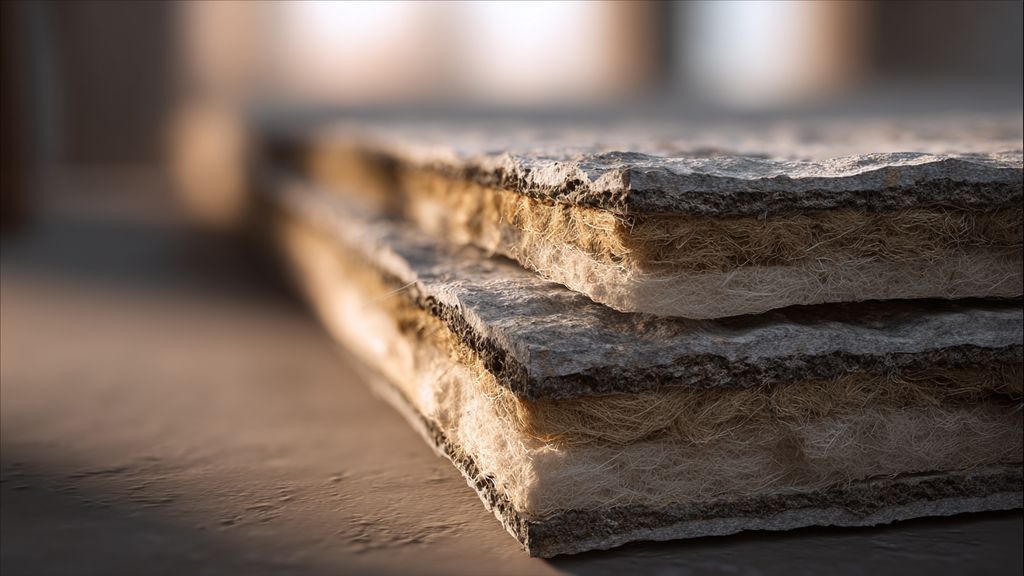
Beyond its main function of separating spaces, a drywall partition can play a significant role in the acoustic and thermal insulation of your home. Integrating mineral wool or an insulating panel between the boards greatly improves these properties.
To optimize acoustic insulation, it is recommended to choose plasterboards specifically designed to absorb noise. These boards generally have a higher density and are combined with efficient insulating materials that reduce sound transmission between two adjacent rooms.
🌍 Did you know?
The name “Placo” is a registered trademark, but it has become a generic term. In France, more than 300 million m2 of plasterboard sheets are installed each year, making it the number one partitioning material.
Choice of insulating materials
Several options are available for the internal insulation of your plasterboard partition. Here are some commonly used materials:
- Glass wool: Cheap and easy to install, it offers a good compromise between thermal and acoustic insulation.
- Rock wool: It offers slightly better performance than glass wool, notably better fire resistance.
- Extruded polystyrene panels: These panels provide excellent thermal performance, well suited for energy renovations.
The choice of material will thus depend on your priorities between acoustic and thermal insulation, as well as your budget allocated to this part of the project.
To go deeper, I recommend consulting my guide to mastering the installation of rails which complements this topic well. Using a suitable plasterboard screwdriver also provides useful tips for major time savings. And to go further, knowing how to choose your molly anchor offers interesting insight for your future wall fixings.
Thickness and installation of the plasterboard partition
The thickness of a plasterboard partition will vary according to several factors such as the available space, insulation needs, and the type of final covering planned. The usual standard for partition thickness is around 72 mm, including 13 mm for the plasterboard sheet and about thirty millimeters for the framework and insulation if integrated.
Before starting the installation of the partition, be sure to measure your space precisely. Make sure that the support where the metal framework will be fixed is sound and even. Irregular walls may require additional preparation with a leveling compound.
⏱️ Timing
Let the filler dry for at least 12 to 24 hours before starting sanding. If the filler is still wet at the core, you will clog your sandpaper and tear off the fiberglass tape.
Key installation steps
To successfully install a plasterboard partition, certain steps are essential:
- Determine the layout: Use a laser level to precisely mark the location of your partition.
- Install the rails: Fix them to the floor and ceiling, checking their alignment and horizontality.
- Add the studs: Position them vertically at regular intervals. Be sure to use appropriate screws designed to securely hold your studs to the rails.
- Install the insulation and boards: Insert your pre-cut insulation between the studs then fix the plasterboard sheets. Respect the orientation, often indicated on the board, to ensure a flat surface once the joints are finished.
- Complete the finishing: Coat the joints between the panels and sand to obtain a smooth surface, ready to be painted or wallpapered.
⚠️ Common mistake
Screwing the panels too close to the edge or driving the screw head too deep. If the cardboard is pierced by the screw, the panel holds nothing anymore, which will weaken the entire partition during the natural movements of the building.
Cost and average price of a plasterboard partition
Estimating the price of a plasterboard partition requires taking into account various elements such as the total area to cover, the choice of materials for the framework, the type of insulation, and even the planned finishes. Thus, the overall cost can vary slightly.
On average, the price ranges between 25 and 50 euros per square meter. This amount generally includes the metal framework, plasterboard panels, and standard insulation. Additional costs may apply for specific panels, enhanced insulation, or professional services if you do not install it yourself.
| Type of element | Average price (€/m²) |
|---|---|
| Standard framework | 5 to 10 |
| Basic plasterboard panels | 4 to 8 |
| Standard insulation | 6 to 12 |
| Labor (optional) | 20 to 40 |
Finding suitable solutions
Whatever your project, always choose products that comply with current standards; this guarantees not only a safe installation but also a durable one. If any technical aspect seems uncertain, do not hesitate to seek advice from a professional or specialist.
Many craftsmen offer services tailored to every need, ranging from simple one-time intervention for installation to full project management. You thus have the option to completely delegate the work to an expert while benefiting from their know-how and informed advice. Consider consulting quotes to compare offers and select the one that will meet both your budgetary and quality expectations.
📍 My experience: During my first renovation project in 2022, I wanted to save 15 euros on a crimping tool. I ended up screwing my rails crookedly, which made installing the panels a nightmare. The lesson is clear: without the right measuring and fastening tools, plasterboard allows no approximation.
Frequently asked questions about plasterboard partitions

Frequently Asked Questions
What is the distance between two drywall tracks?
For a standard structure, the center-to-center distance between two vertical studs should be 60 cm. If you plan to install heavy tiles, it is better to reduce this spacing to 40 cm for increased rigidity.
How to ensure the acoustic insulation of a partition?
It is essential to insert mineral wool or rock wool between the two panels. Using resilient strips under the horizontal tracks also helps limit the transmission of vibrations.
Which plaster should be used for joint tapes?
A specific jointing plaster, either powder or ready-to-use, is generally used. It is applied in two or three successive coats with drying time respected between each layer.