
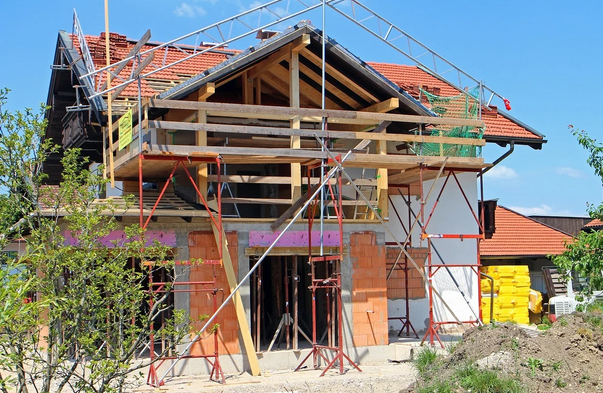
There are many profitable works to carry out before selling. It may also be that you simply want to renovate the house to restore it.
Whatever your reason, remember that this project requires a significant budget. Of course, you have already saved money, but your savings are not enough to carry out the work. Fortunately, there are several financing solutions to meet all needs.
📋 The essentials at a glance: Personally, I consider that anticipating your budget well is crucial, as 35% of homeowners exceed their initial budget during a renovation. I advise you to systematically compare state aids like MaPrimeRénov’ with bank loan offers. A good financing strategy allows you to realize your projects without jeopardizing your daily financial balance.
How to finance renovation work in my house?
- Cost of the work: Whether it is interior or exterior renovation, this type of work is generally expensive. It must be admitted that rehabilitating a home requires an astronomical amount.
- Use of a renovation loan: So that financial issues do not hinder the realization of your project, do not hesitate to use a renovation loan.
- Loan amount: The loan allows you to borrow up to €30,000 to help you improve your home. However, know that the loan amount may vary depending on the borrower’s profile and the type of work to be done.
- Credit consolidation: If this solution does not interest you, you can opt for credit consolidation. Many lending institutions handle credit buybacks and simulate a credit consolidation.
- Simplified management: Even if you already have multiple loans, it is possible to manage them easily thanks to this method. Better yet, it allows you to pay them off in a single monthly payment.
🗣️ My experience: During my last roof renovation in May 2024, I almost missed out on the Eco-PTZ thinking my file would be too complex. By taking 2 hours to prepare the file with my banker, I finally obtained a zero-interest loan for €15,000 worth of work. The lesson is simple: never assume your ineligibility without consulting a specialized advisor.
What financing options are available for renovation work?
| Type of financing | Average amount | Interest rate | Conditions |
|---|---|---|---|
| Eco-PTZ | Up to €50,000 | 0% | Energy renovation work |
| Classic renovation loan | €5,000 to €75,000 | 3% to 6% | No performance condition |
| MaPrimeRénov’ | Varies according to income | Grant | Mandatory RGE craftsmen |
| Mortgage loan | > €75,000 | 2.5% to 4.5% | Included in the overall purchase |
There are several aids to insulate your home, repair your roof, or renovate the house facade. The Anah subsidies are part of state financing. They cover electrical work, heating, insulation, and domestic hot water.
🌍 Did you know?
In France, nearly 80% of households are eligible for at least one public aid for energy renovation, but about 1 in 4 applications is abandoned due to administrative complexity.
Like Anah, the zero-interest eco-loan is among the State aids. This scheme offers a loan of €30,000 at zero interest, for a duration between 3 to 10 years. It particularly supports the energy renovation of your main residence.
Besides that, there are many other schemes such as VAT at 5.5%, the energy voucher, energy savings certificates or CEE and many more.

How to obtain a loan to finance renovation work?
To achieve this, it is important to convince financial institutions of the relevance of your project. If you plan to expand your property, consider presenting them with a valuation certificate. Call on a notary or a real estate agency to estimate the property.
For an energy renovation project, carry out an energy performance check. This helps you determine the usual consumption amount of the house.
A file must be complete including proof of residence, identity, the work to be done, income, and current loans. You must also provide a valuation certificate of the property, a tax notice, the latest bank statements, and much more.
⚠️ Common misconception
Many believe that a bank’s preliminary agreement is a final validation. This is false: as long as the loan offer is not issued and the 10-day reflection period has not passed, the financing is not secured.
What is the average interest rate for a renovation loan?
💡 Tip
Always plan a safety margin of 10% to 15% in your loan to cover unforeseen site costs, which are very common in renovating old buildings.
Several types of renovation loans can be distinguished. There is the allocated loan, the unallocated loan, the revolving credit, and the mortgage loan. Compared to its peers, the latter has the lowest interest rate.
If you want to know the best rate for a renovation loan, know that it depends on many parameters such as the repayment duration, the type of loan, the loan amount to consider, and especially the borrower’s profile.
In any case, the ideal borrowing rate for a renovation loan is around 2.30% for a budget under €5,000. This can rise to an average of 2.94%.
What are the advantages and disadvantages of using a credit card to finance renovation work?
| Aspect | Advantages | Disadvantages |
|---|---|---|
| Accessibility | Easy to obtain and use for immediate expenses | Credit limit often insufficient for major work |
| Payment flexibility | Allows purchases to be paid in installments according to offered options | Can lead to debt accumulation if poorly managed |
| Availability delay | No waiting period to unlock funds | No structured financing plan like a renovation loan |
| Fees and interest | Possibility to benefit from promotions or interest-free payments | Interest rates often high in case of deferred or partial payment |
| Budget management | Useful for financing occasional or unexpected purchases | Risk of budget overruns without strict monitoring |
With revolving credit, it remains possible to use the money reserve via a credit card. This type of funding is classified among the most flexible options.
The lending institution makes a sum of money available to you. You can spend it according to your needs without having to justify yourself to the institution.
Easy to use, revolving credit is a great help in emergency situations. It gives you access to the money reserve via the credit card.
As for its drawback, its interest rate may seem high. If you have difficulty controlling it, you risk over-indebtedness. Before adopting it, it is crucial to seek advice from a professional.
When comparing classic credit and self-financing, refer to this section:
✅ Strengths
- Preservation of precautionary savings
- Possibility to carry out larger works
- Often low interest rates for energy
🔍 Reservations
- Debt over several years
- Application and insurance fees
Frequently Asked Questions
The most common solutions are the renovation loan, revolving credit, personal loan, and credit consolidation. The renovation loan is often offered by banks with conditions adapted to the type of renovation. Credit consolidation simplifies the management of monthly payments if you already have several loans ongoing.
Yes, several aids exist depending on the nature of the work. For energy renovations, you can benefit from MaPrimeRénov’, the zero-interest eco-loan (éco-PTZ), or local subsidies. These aids are generally subject to income conditions, type of housing, and work carried out by certified professionals.
It depends on the amount of the work and your ability to repay quickly. The credit card can be practical for occasional purchases, but it carries high interest rates if the balance is not paid off quickly. For major work, it is better to favor a dedicated loan with fixed monthly payments and a more advantageous rate.
Publications similaires :
 Floating floor maintenance
 Understanding vehicle geolocation in a few steps
 Clogged gutter, what to do?
 Schüco and Kömmerling PVC frames: Innovation, durability, and superior quality
 Kinedo reviews: what are these showers and whirlpools really worth?
 Review of hand-wash toilet: the verdict on this space-saving combo