The polymer sand material was first marketed by the brand Techniseal in 1999. Since then, it has continuously enjoyed great success in landscaping and paving projects. It is a jointing element favored by experts due to its multiple advantages.
The polymer sand surface installation helps prevent the growth of unwanted weeds. This product also serves to avoid infestations of small parasitic insects.
Even better, it ensures the stabilization of joints, extending the lifespan of paving stones and slabs. To better understand, it is important to know the different characteristics of polymer sand joint.
📋 The essentials at a glance: Personally, I consider polymer sand the ultimate solution for durable paving joints, as it combines the flexibility of sand with the strength of mortar. Did you know that a well-laid joint reduces weed growth by 95%? I recommend paying particular attention to the final sweeping step, as any residue on the slabs will become permanent once activated by water.
What are the main characteristics of polymer sand?
🍀 Polymer Advantages
- Radical stop to weeds
- Resistance to ants
- Does not wash out with high-pressure cleaners
🔻 Limitations
- Significantly higher price
- Weather-dependent installation
With the aim of enhancing your property, you plan to proceed with front yard landscaping. To ensure the durability of the flooring of your driveway or terrace, the use of polymer sand joint is essential.
You may have heard about it, but you do not know exactly what it is. Polymer sand material is a mixture of ultra-fine sand and polymer additives. Once mixed with water, it transforms into a binding product that is both flexible and much stronger than mortar.
Unlike regular sand, polymer sand material allows the creation of strong and solid joints during the installation of concrete slabs or pavers. It is used to fill the space between each paver to rigidly hold the entire set of concrete pavers uniformly.
📍 My experience: In 2024, I wanted to joint my terrace just before a forecasted shower. Big mistake: premature activation by rain created a whitish film on my anthracite pavers that took me three days to strip. The lesson learned is that a 24-hour rain-free weather window is absolutely necessary to guarantee perfect polymerization and a flawless aesthetic finish.
In most cases, many professionals opt for polymer sand surface during the installation of low-traffic paths such as public parks, parking lots, pedestrian zones, and more. When it comes to heavy traffic roads, it is better to look for other options rather than using it.
Besides that, this material is used as joint filler for slabs on garage entrances, driveways, and most flexible floors. If you are considering setting up a nice terrace, you can use it for joints.
🌍 Did you know?
Polymer sand is not “set” like cement. It has a self-healing property: if it slightly cracks due to ground movement, it naturally reseals during the next rain thanks to its active additives.
How to prepare the ground before laying polymer sand?
Unlike other materials, there is no complicated preparation before applying polymer sand for paved joints or slabs on flexible ground. However, it is necessary to work on a clean and dry surface. Therefore, make sure to clean it properly. If there is worn sand, use a broom or a blower to get rid of it.
Please wear protective clothing to avoid staining your outfit. To prevent water stagnation, it is useful to block the edges of the work, for example by using a plastic border.
The polymer sand installation steps should only be done during dry weather. In case of rain, know that moisture prevents the material from hardening. Generally, the minimum and maximum temperatures are displayed on the back of the packaging or product bag.
Also, try not to make the polymer sand joints when it is windy. It should be noted that this material can seem very volatile. So if you do not want the grains to be blown away, it is necessary to follow this instruction.
What elements to compare before choosing your polymer sand?
Not all polymer sands are the same. To make the right choice depending on your project (terrace, driveway, garage entrance…), here is a comparative table of essential criteria:
| Criterion to compare | Importance | Practical advice |
|---|---|---|
| Sand grain size | The finer it is, the better it fills narrow joints. | Choose sand suitable for the spacing of the pavers. |
| Available color | Directly impacts the final aesthetics of the paving. | Select a shade matching the pavers (gray, beige, black, natural, etc.). |
| Weather resistance | Must withstand rain, frost, heat, and UV without degrading. | Prefer sand certified water-repellent and frost-resistant. |
| Paving compatibility | Some products are more suitable for interlocking pavers, others for natural stones or outdoor tiles. | Always check the manufacturer’s instructions. |
| Price per bag | Generally between €50 and €100, depending on quality and packaging. | Do not choose solely based on price, but on quality/durability ratio. |
| Ease of installation | Some sands are more volatile or require specific tools. | Read the instructions carefully before use. |
Which types of paving are best suited for the use of polymer sand?
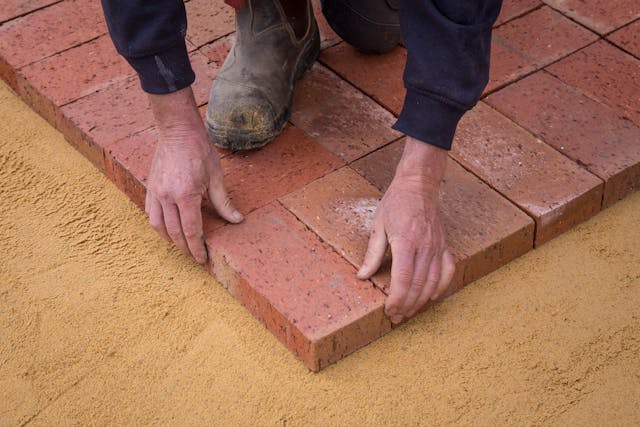
Before answering this question, it is important to emphasize that there are four categories of joints to fill the empty space between each slab or paver. While the classic sand joint easily weakens over time, the mortar joint lacks flexibility.
There is also the epoxy resin joint which is particularly robust. However, its application is reserved for professionals and it is normal that its cost is extremely high.
There is nothing like opting for polymer sand material installation. Despite its somewhat high price, it combines aesthetics, strength, and above all durability over time. This product is mainly used for joints of interlocking pavers.
Unlike other pavers, the latter stands out for its elegance and nobility. It is also classified as eco-friendly due to its composition of natural aggregates, cement, sand, and no petroleum derivatives. With its sometimes sober colors, the interlocking paver perfectly matches the outdoor space.
Besides this type of paver, the use of polymer sand joint is recommended to create a drivable driveway often in interlocking pavers. It is also found when making a garden path in slate slabs.
When setting up a pool terrace, many opt for polymer sand to complete the joints between each tile slab.
What are the advantages of polymer sand for jointing pavers?
Compared to most joints on the market, the polymer sand joint has a number of interesting advantages.
Due to the presence of a polymer resin in the mixture, it hardens effectively upon contact with water, which guarantees the stability and durability of paved or slab joints.
It should be noted that the polymer sand material is also water-repellent. It therefore repels water, preventing infiltration between the slabs.
As harmful insects cause their premature aging, polymer sand installation helps avoid their invasion. When it fills the joints, it creates a barrier against the growth of weeds.
In terms of aesthetics, polymer sand for joints comes in a wide range of colors. You can easily and beautifully match it with concrete slate paving, natural stone, and more.
Its other major advantage lies in its ease of application. Applying polymer sand does not require a professional. You can do it yourself without difficulty.
Many also choose polymer sand because of its high resistance to weather. Although it is expensive, its price is worth it. Its multiple advantages convince buyers to prefer it.
What are the key points to respect to successfully install polymer sand?
To achieve a solid, aesthetic, and durable result, certain rules must absolutely be followed during application:
- Check the weather: only apply the sand in dry weather, without rain or wind.
- Work on a clean surface: remove dust, old sand, or joint residues before laying.
- Fill the gaps well: insist with a soft-bristle broom or a jointing iron to compact the product.
- Compact carefully: use a vibrating plate or a compactor to ensure the density of the joint.
- Remove the excess : brush or blow the surface to avoid marks after drying.
- Respect the drying time : wait at least 24 hours before any exposure to moisture or traffic.
How to correctly apply polymeric sand between joints?
As we just mentioned above, polymeric sand installation steps are not only for professionals. Everyone can do it by following a few steps and equipping themselves with the right tools.
Among the most used, you will need a blower, a vibrating plate roller compactor, a jointing iron, a rubber mallet, a soft-bristle broom, a hose, and of course, polymeric sand powder for paving slab joints.
💡 Practical tip
Be sure to use a vibrating plate with a rubber protective sole after sweeping the sand. This helps to compact the product at the bottom of the joints and eliminate air pockets that could weaken the structure.
The first phase of the installation consists of cleaning the surface. You can then spread polymeric sand over the surface until you obtain an even layer.
Then use the soft-bristle broom to fill the joints between the paving slabs to their full depth. In case of irregular walls, make sure to press the polymeric sand powder firmly into the joints using a jointing iron.
The next step is compaction. As the name suggests, this involves compacting the joint strength by eliminating voids and creating contact between the polymers and the aggregates. To do this, simply pass a vibrating plate roller compactor to compact the polymeric sand surface.
To remove excess product, use a blower or a fine-bristle broom. Once done, you can water the surface.
⚠️ Common pitfall
The mistake is to water the joints with a direct and powerful jet. This dislodges the sand and creates hollows. Always use a “fine rain” setting and water in 20 m² sections, avoiding puddles on the surface.
Respect the drying time of at least 24 hours. The polymeric sand material must dry completely before being exposed to moisture or rain. This is to preserve its cohesion and especially its long-term resistance.
What is the expected lifespan of polymeric sand jointing?
Thanks to polymer resin or additive particles, the polymeric sand joint is capable of firmly holding the paving slabs. Unlike conventional joints, it is both more durable and more resistant. It can therefore increase the lifespan of the paving installation.
Despite its strength, it is subject to the test of time. Remember that polymers are small molecules that eventually dissolve in water. This characteristic thus limits the lifespan of polymeric sand joints.
With frost followed by spring thaw, intense winter cold, and long periods of rain, this material eventually cracks. It is therefore strongly advised to inspect the polymer sand installation every 7 years or more depending on the condition of the surface.
To benefit from it for many years, try to prioritize high-quality products. Although they usually cost more, they offer better longevity.
Does polymer sand resist extreme weather conditions?
Compared to other joints in the same category, surface polymer sand has the advantage of being waterproof. It does not allow moisture to penetrate, which often causes the degradation of a substrate. This is why it is widely used for paving slabs to extend their lifespan.
That said, more and more professionals recommend it for terrace joints or garage access, thanks to its resistance to water or rain.
This product is also appreciated for its tolerance to frost, erosion, wind, and intense cleaning. So if you are looking for a robust and durable joint, choosing polymer sand installation material is a good idea.
No matter its strong resistance to bad weather, it eventually gets damaged by harsh conditions over the years. Even if you take care of it frequently, it remains necessary to inspect it after 7 years of use.
Can polymer sand be used on sloped surfaces or only on flat surfaces?
As a general rule, polymer sand installation is done on surfaces free of unevenness. This greatly simplifies the installation, as it is enough to spread polymer sand powder.
In any case, some products on the market are capable of providing better results even if applied on sloped terrain. In this situation, it is recommended to entrust the polymer sand installation to a team of professionals to avoid mistakes.
If you work with good equipment, you can take matters into your own hands and do the work yourself. Compaction is one of the essential steps to level the surface.
The vibrating plate roller compactor is among the necessary tools to level the layer of paving slabs. The goal is to obtain a smooth and even substrate.
If it is necessary to cut the edges of certain pavers, use a concrete saw. Don’t forget to mark the cutting line beforehand to avoid inaccuracies. This correction allows for a uniform surface.
What are the average costs associated with purchasing and applying polymer sand?
Even though polymer sand application steps can be a delicate job, it is still possible to handle it yourself without resorting to a specialist. This helps you save money on your outdoor landscaping project.
When managing your budget, your main expense is the purchase price of the material for polymer sand installation. A bag of polymer sand costs between 50 to 100 euros. This value varies depending on multiple factors such as its weight, qualities, and brand reputation.
If you don’t have good tools, you can consider renting since many sites like AlloVoisins can help you. Since you only use them for polymer sand installation, you don’t have to spend a lot of money to acquire them.
If you do not have time to proceed with the assembly, you can always go through a professional.
The price for installing pavers is often between 50 to 150 euros per square meter. This includes the creation of the screed, the laying of the paver slabs, and the joints. Be sure to request several quotes to find the best value for money.
Where can you find detailed tutorials for applying polymeric sand?
More and more websites or platforms are detailing the polymeric sand installation on the internet. They offer tutorials and videos explaining each step of polymeric sand application.
If you are still a beginner, they are a valuable help guiding you through each phase. And even if you have some knowledge, these guides allow you to improve in handling polymeric sand joints professionally.
Major manufacturers like Techniseal provide you with many articles about the use and different types of their products. This brand is the world leader in the production of polymeric sand material.
Some building material distributors like Samse and Leroy Merlin also increasingly offer tutorials for polymeric sand installation. You have a wide choice of articles and videos giving you the best advice to carry out this work.
Frequently Asked Questions
It is not recommended, as cold and humidity prevent proper hardening. It is better to work in dry and mild weather.
On average, between 7 and 10 years, depending on the quality of the product, the climate, and maintenance.
Yes, provided the joints are well filled and properly compacted. However, some regular maintenance is still recommended.