
Plunge Saw: How to Choose the Best Model? Top 8
The plunge saw is increasingly in demand for its safer aspect compared to the classic version. And even though there aren’t many on the market, its high price slows down consumer enthusiasm.
Fortunately, brands and distribution chains offer discounts that significantly lower the price in favor of amateur DIYers.
Among this handful of carefully selected products, you might find yours. Also take advantage of our advice to choose it well.
Essential to remember: From my point of view, the plunge saw is the only machine capable of turning an amateur DIYer into a precision carpenter. What strikes me every time I use it is this feeling of total safety: the blade remains protected in its housing and only descends when I decide. In my opinion, trying it with its guide rail is to definitively give up approximate cuts with a classic circular saw. It is the editorial investment I recommend without hesitation for anyone wishing to carry out custom fittings with a finish worthy of a professional.
Makita SP6000J1 Systainer + Guide Rail
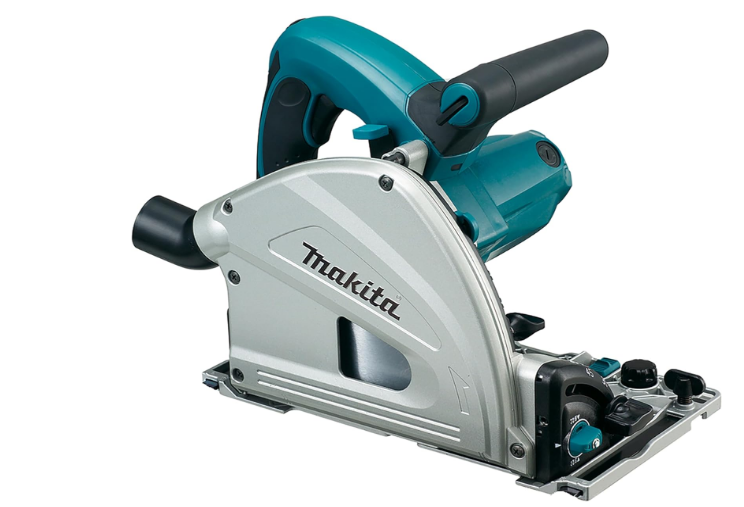
The Makita SP6000J1 is a 1300 W plunge circular saw designed for precise straight cuts with a 1400 mm guide rail. It uses a Ø165 mm blade, offers a variable speed from 2,000 to 5,800 rpm, and a cutting depth up to 56 mm at 90° (40 mm at 45°). Its soft start, electronic speed control, and tilt up to 48° ensure clean and controlled cuts on wood, panels, or laminates.
Delivered in a Systainer/Makpac case with rail, it allows for perfectly guided long cuts. It also features tool-free adjustments, anti-tilt safety, compatibility with standard rails, and a weight of about 4.4 kg for good stability. This complete setup is ideal for fittings, panel cutting, and precision work on site.
Advantages
- High precision included rail
- Effective 1300 W power
- Safe soft start
- Precise plunge cut
Disadvantages
- Restrictive wired cable
- Weight 4.4 kg

Einhell TE-PS 165
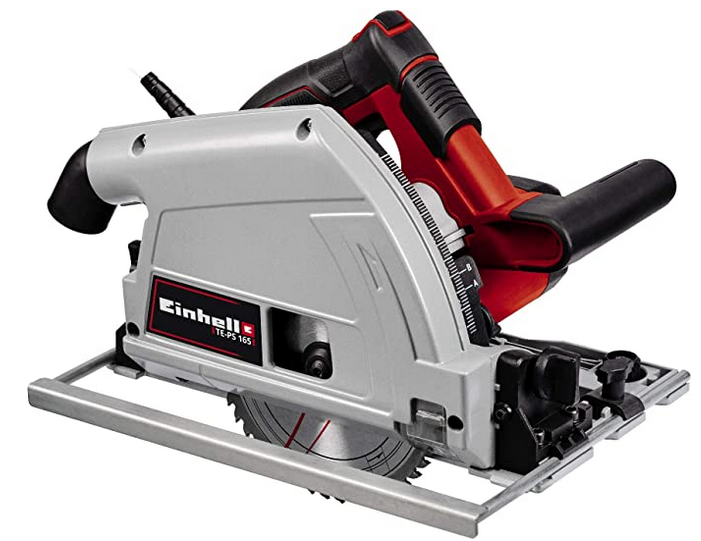
Compared to other plunge saws, the price of the Einhell TE-PS 165 is four times less than its competitors on the market. And yet, it is well sold with a parallel guide and an efficient dust extraction system.
This is therefore an inexpensive series, but more than decent. It is easy to handle with its weight of 4.75 kg and its small diameter handle. At 90°, it cuts up to 6.6 cm.
Its 1200 W are not far from the most powerful machines in this comparison. They allow it to make cuts on hard materials without overheating. Added to this is the quality of the blade, said to be high-end. Its 48 teeth provide smooth and precise cutting results.
This model is also easy to adjust. No tools are needed to set the cutting depth or the tilt angle. It is possible to lock the blade in place to replace it in the blink of an eye.
The 4 m power cord enhances user comfort and reduces constraints related to spacing.
The product’s solidity is reflected in the 2-year warranty granted by Einhell.
Advantages
- Inexpensive
- Good quality blade for clean cuts
- Featherweight
- Ergonomic
Disadvantages
- Tends to jam at the end of the cut in the lowered position.

DeWalt DWS520KT-QS
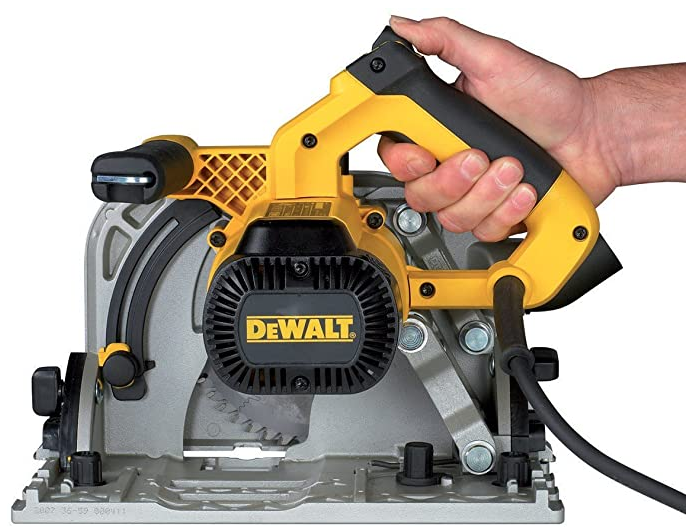
The DeWalt DWS520KT-QS plunge saw is available in one of the sturdiest cases and equipped with a comfortable carrying handle. It delivers a power of 1300 W for intense work and rigid materials, justifying its price of over 300 euros. Its speed ranges from 1750 to 4000 rpm, making it compatible with various materials.
However, the model is outdated compared to its weight, which is well above average, almost 8 kg.
The machine has a decent cutting depth of 5.5 cm. It easily splits wood or PVC with its 48-tooth blade. You get clean and neat cuts.
The manufacturer also claims that the suction system removes 90 % of wood dust and other materials, thus saving time after each use.
The handle, being flatter in shape than those of other models, fits perfectly in the hand. This provides a better grip on the tool.
Advantages
- Storage case included
- High performance and deep cutting capacity
- Suitable for different materials
- Robust
Disadvantages
- Heavy
- Moderately expensive

Scheppach PL75
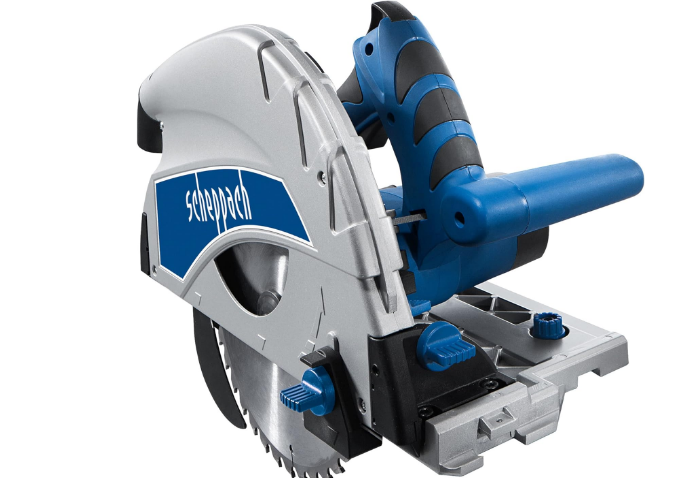
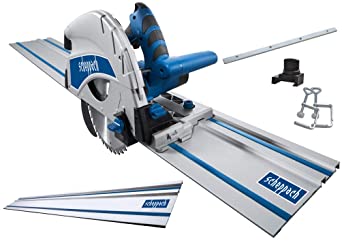
The Scheppach PL75 is a powerful 1600 W plunge circular saw designed for precise straight cuts in panels, solid wood, or countertops. It uses a Ø 210 mm blade, reaches a speed of about 4,500 rpm, and offers a cutting depth up to 75 mm at 90° (55 mm at 45°). Its 0 to 45° tilt, aluminum base, and spring-loaded riving knife allow for clean and safe plunge cuts.
Designed for precision, it offers guide rail compatibility, efficient dust extraction, an anti-tilt lock, and a cable of about 3 m for good working freedom. Its robust design makes it suitable for fitting work, cutting doors, and thick panels, while providing good control for clean cuts.
Advantages
- High 1600 W power
- Large 75 mm cutting depth
- Guide rail compatible
- Good cutting precision
Disadvantages
- Quite heavy to use
- Guide rail sometimes optional

Bosch Professional GKT 55 GCE
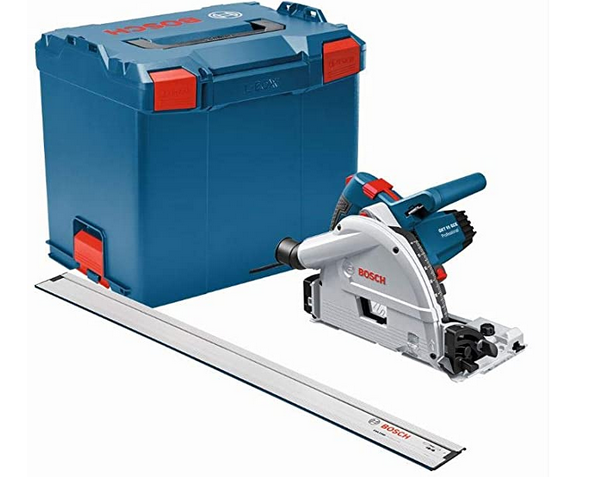
The Bosch Professional GKT 55 GCE plunge saw is one of the most powerful with its 1400 W. It will easily cut through solid wood and the hardest materials such as aluminum, glass, or acrylic. It also tackles less rigid materials thanks to its variable speed control and is highly recommended for professionals.
The motor lasts longer compared to other tools of the same type because it is protected against overloads and starts gradually each time.
It runs for hours without weakening thanks to its efficient motor. It is also one of the most expensive tools in this category, but quality has a price for professionals.
The model weighs 4.7 kg, which suits most users, men or women. With this reference, even accessories such as the blade or the guide rail are guaranteed.
Comfort is also present in a small workshop, as the machine operates without bursting eardrums. Dust does not have time to spread in the air thanks to the functional Bosch Click & Clean dust extraction system.
A case comes with the product so you can easily carry the GKT 55 GCE around.
Advantages
- Very high power
- Great versatility
- Average price for a professional tool
- Handy and lightweight
Disadvantages
- It is clearly stated on the packaging that a guide rail is included, but many did not find it in their package.

HYCHIKA 500W 4500RPM
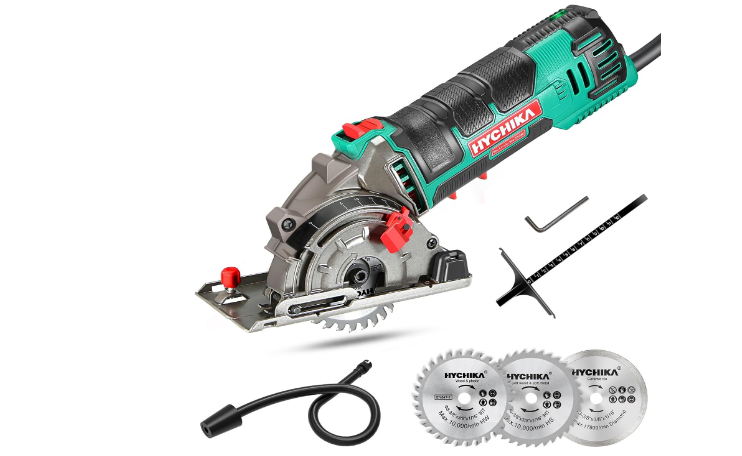
The HYCHIKA 500W Mini Circular Saw is a compact 500 W corded saw designed for precise cuts in wood, plastic, soft metal, or tile. It develops a speed of 4,500 rpm, uses a Ø 85 mm blade, and offers an adjustable cutting depth from 0 to 25 mm to suit finishing work. It comes with 3 blades (wood, metal, diamond), a parallel guide, and a dust extraction adapter to improve precision and limit dust.
Designed for maneuverability, it features an ergonomic non-slip handle, a double safety switch, a sturdy metal base, and a cord of about 3 m for more freedom. Its compact design makes it ideal for baseboards, thin panels, and small cuts, while providing a clean cut for household tasks.
Advantages
- Compact and easy to handle
- Three blades included
- Adjustable cutting depth
- Good precision for small cuts
Disadvantages
- Cutting depth 25 mm
- Average stability for long cuts
No products found.
Makita DSS501Z
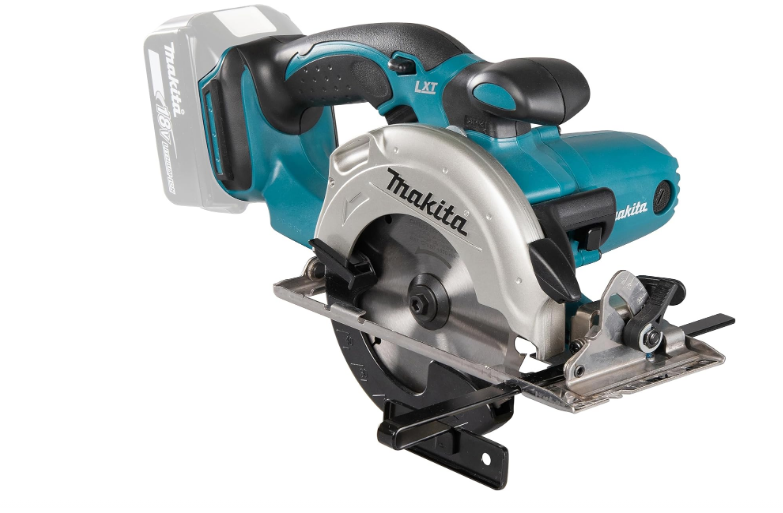
The Makita DSS501Z is a compact 18 V cordless circular saw designed for fast and precise cuts on wood and panels. It uses a Ø 136 mm blade, reaches a no-load speed of 3,600 rpm, and offers a cutting depth up to 51 mm at 90° (35 mm at 45°). Its aluminum base, electric brake, and dual LED lighting improve precision and safety during cuts. Its weight of about 2.7 kg ensures good maneuverability for job site or workshop tasks.
Designed for comfort, it features an ergonomic Soft Grip handle, chip blowing, tilt up to 45°, and a parallel guide included for straight cuts. Compatible with the Makita LXT 18 V platform (battery not included), it offers a practical solution for mobile cuts and light carpentry work.
Advantages
- Very maneuverable cordless
- Lightweight and balanced
- Good cutting precision
- Integrated LED lighting
Disadvantages
- Battery not included
- Limited blade diameter

Bosch 06016C1003
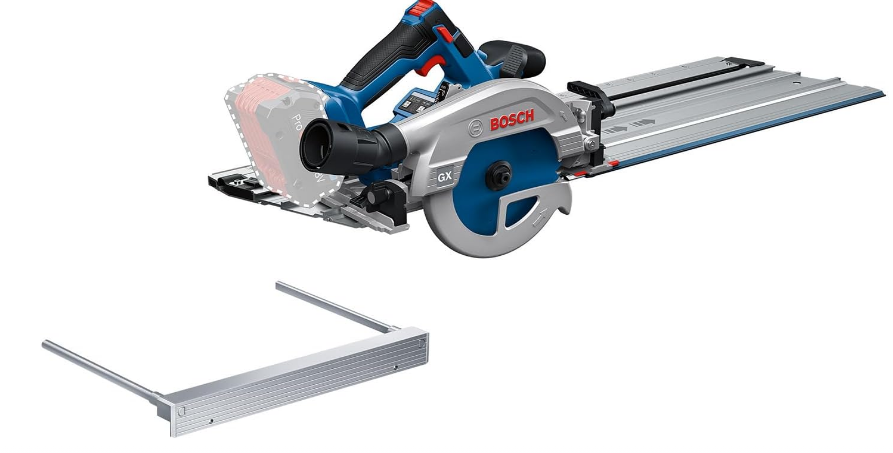
The Bosch 06016C1003 corresponds to the Bosch Professional GKS 18V‑57‑2 GX cordless circular saw designed for carpentry, framing, and precise cutting on wood or wood-based materials. Powered by an 18 V battery (not included), it features a robust brushless motor for a no-load speed of about 5,000 rpm, a Ø 165 mm blade with a 20 mm arbor, and a cutting depth up to 57 mm at 90° (about 41–42 mm at 45°). This model also supports bevel cuts up to 50°, making it versatile for various cutting applications.
Designed for precision, this saw is compatible with Bosch FSN and FSN X guide rail systems for perfectly straight or cross cuts, and includes safety features such as KickBack Control, Stop Control, and an ECO mode to optimize battery life. It also has a Click & Clean adapter for dust extraction and LED lighting for better visibility of the cutting line. Its weight of about 3.4 kg without battery ensures good maneuverability on site or in the workshop.
Advantages
- Compatible with guide rails
- Powerful brushless motor
- Cutting depth of 57 mm
- LED + integrated safety
Disadvantages
- Blade Ø165 mm only
- High weight with battery

I still remember the day I had to cut out the space for a cooktop in an expensive solid oak countertop. With a trembling hand, I positioned my plunge saw on its rail. It was at that exact moment that I truly realized the importance of surgical precision: the blade penetrated the wood right in the middle of the panel with startling sharpness. No splinters, no deviation, I accomplished in a few seconds what had previously terrified me. This experience changed my perspective on woodworking: stress gave way to the pure pleasure of mastered geometry.
What is a plunge saw?
A plunge saw is a tool that is not really far from a circular saw. It allows you to cut wood and its derivatives. It consists of a motor, a housing meant to hold the blade, several clearly visible adjustments, and an opening to connect a vacuum cleaner.
With this type of saw, you can also easily create expansion joints, make sheets of materials including plaster, or level doors.
Many DIYers cut aluminum profiles, PVC paneling, and cable ducts using this device.
Before starting your precision cuts, make sure to work on a folding workbench that is perfectly stable to ensure your safety. For finer adjustments or cutting small battens in series, using a miter saw will be an ideal complement to your equipment. If you are working on large panels, don’t forget to establish a cutting plan to minimize waste and optimize your wood throughput.
Which plunge saw brand to choose?
Many brands have started manufacturing plunge saws, making the choice between them a real dilemma. By getting to know them better along with their product ranges, you will decide more easily.
We also browsed the DIY aisles of major retail chains to help you find what you need without any hassle.
Makita
Makita offers several models of plunge saws in its collection. With or without guide rail, with or without accessories, or just the bare tool, the brand meets all general public needs. For power ratings up to 1300 W, prices range from 354 to 650 euros.
Parkside
The Parkside plunge saws are among the most affordable. Indeed, they cost less than 100 euros, sometimes even less than 90 euros.
They have a modest power of 710 W, which is relatively high for a mini model. On the other hand, they prioritize user comfort with their 4 m cord and ergonomic handle.
Festool
Festool is a high-end brand if we refer to its plunge saws, which cost twice as much as the average.
For 675 to 950 euros, it offers buyers a storage case, a rail, sometimes even two, a support to fix the tool on the workbench, in addition to the blade.
The cheapest models are sold for just under 500 euros. Power ranges from 1000 to 1200 W for corded versions with speeds up to 5800 rpm.
Bosch
The Bosch brand caters to all user profiles, from weekend DIYers to professionals with its range of plunge saws.
It opts for high power levels around 1400 W for its tools and equips them with speed variators. They are available with or without storage cases for a price around 400 euros.
Dewalt
Dewalt has released several models of plunge saws with or without storage cases and guide rails. The bare tool from the brand costs a little over 500 euros. Its models run at 4200 rpm and are rather quiet. As for cutting depth, they also have a good cutting capacity, up to 5.9 cm at 90°.
Scheppach
Scheppach is a brand accessible for small budgets. Its plunge saws range from about 140 euros to 242 euros. They come with guide rails and with their power of 1200 W to 1600 W and blade diameters from 16 to 21 cm, they are capable of cutting materials of various textures.
Scheppach products also include safety and table mounting systems.
Mafell
Mafell, the specialist in sawing since 1899, presents us with a wide range of plunge saws for different needs. The inventor of the world’s portable carpentry machine still has more than one trick up his sleeve after all these years.
Admittedly, its prices do not go below 575 euros, but this is explained by the quality of its products. Just its guide rails are over a meter long, whereas most stop at 75 cm. Its models are lightweight and its motors powerful.
Leroy Merlin
As with many retailers, the plunge saw is not as common as the classic circular saw. This is explained by its much higher price. This is also evident in Leroy Merlin stores where only the brands Dewalt, Feider, Worx are available. However, there is a wide price range from 99 euros for a mini plunge saw to 509 euros for a complete product.
Lidl
Several plunge saw manufacturers collaborate with Lidl, including Parkside. Thanks to promotions applied in stores, it is possible to get one for less than 60 euros. There are guide rails, and consumers speak well of them.
How to use a plunge saw?
It is true that at first glance the use of the plunge saw seems difficult to understand, but with these few tips, you will be able to handle it easily. These recommendations are therefore particularly aimed at DIY enthusiasts whom the manual could not help.
Creating joints along a wall
To do this, you need a plunge saw with a completely flat housing that allows it to align with the wall of the terrace, for example. Adjust the cutting depth by aligning the dial to the exact value. Rest the plunge saw against the wall which will also serve as a guide rail. Plug in the device and turn it on.
Adjusting the blade tilt angle
Generally, the blade pivots up to 45 to 60° so that you can make angled cuts, but this depends on each model. Look on the sides of the plunge saw. You should have a small protractor with graduations on it, locking screws, and a dial in a very visible color. Loosen the screw that locks the dial. Place the dial at the desired position, and simply tighten it again.
Using the splitter knife
The splitter knife is not just for looks. It helps you position yourself relative to the cutting line if you do not have, for example, a guide rail. Before cutting along a 4 m beam, we recommend marking the cutting line. Take a tape measure or a square and mark every 5 cm. Then connect the points until the whole forms a straight line.
You position your plunge saw so that the blade of the splitter knife and the saw is exactly on the line. Start the machine and cut about one to two meters. Then, to continue, see if the splitter knife slides into the newly created slot. If so, you have cut straight and are on the right track. You need to proceed little by little to the other end.
Connecting the plunge saw to a vacuum cleaner
It’s not very difficult. All you have to do is insert the vacuum cleaner’s head without a nozzle into the dedicated opening and start both machines at the same time, and that’s it. Just be careful that the hose does not get in your way during your task.
If you sand a plasterboard, in order to promote suction, place a cover (usually provided for this purpose and supplied with the product) in front of the saw blade. This way, the dust will not spread on the table.
Replacing the blade
On a plunge saw, you often need to change the blade as often as the materials. To start, undo the springs holding the plate. You will need a screwdriver. Take the opportunity to check the position of the depth stop. It should be at the maximum cutting depth. Replace the blade and put everything back in order.
Fixing a misalignment of the saw blade angle
If you notice that your tool cuts off to the side, locate the screws near the relevant knobs and using a screwdriver, turn them clockwise by a quarter turn. Do not do it all at once. If it doesn’t work, repeat the operation in the opposite direction until everything returns to normal.
Cleaning the plunge saw
After taking a look at the manual, proceed to the daily maintenance of your plunge saw. When putting it away, for example, if your purchase does not come with a case, keep the blade away from the metal plates. Place the machine against the wall, vertically.
After each use, remove the blade and wipe it with a clean, dry cloth. Once the dust has disappeared, if any remains, dip a piece of cloth in oil and polish the element with it. Take care not to cut yourself.
Then, take another piece of cloth and moisten it with denatured alcohol which you then use to cover the entire blade. Dry and apply the specific lubricating oil for your model. If not available, petroleum jelly will do.
If after several months of use, the teeth of your plunge saw blade wear out and you do not have the means to buy a new one, proceed to level them.
Place two wooden boards fairly high on a workbench and the blade flat on top. Then, take a flat file and rub each tooth with this tool to sharpen them. You will save money by taking this trouble regularly.
Cutting capacity guide
| Type of material | Recommended thickness | Type of blade (teeth) |
| Melamine panels | 18 mm to 22 mm | 48 to 60 teeth (finishing) |
| Worktop (hardwood) | 38 mm to 50 mm | 24 to 42 teeth (universal) |
| Solid wood cutting | Up to 55 mm | 12 to 18 teeth (ripping) |
| Aluminum / Plastic | 2 mm to 10 mm | Special trapezoidal blade |
| Thin plywood | 3 mm to 10 mm | Minimum 56 teeth |
Plunge saw and circular saw: what is the difference?
The plunge saw is much safer than the circular saw. Both are designed in the same way with the same number of components except that on the latter, the blade protrudes a few centimeters beyond the guard when the machine is off.
On the plunge version, a spring system holds the cutting element inside the guard so that no centimeter is exposed.
When starting the machine, these same springs push the blade down (hence its name “plunge” since the blade plunges into the material when cutting) for cutting by simply pressing a button. It is therefore easier to start cutting from the middle and not from the edges.
Another safety aspect of the plunge saw is its automatic stop function in case the blade gets stuck. This feature is not necessarily found on traditional circular saws.
These two types of saws differ from each other in their ease of use. Experts consider it easier to make full panel cuts with the plunge model.
They do not need to pre-drill the surface before starting the machine. This saves several minutes.
Plunge saw with or without rail?
The presence of a guide rail offers more usage possibilities for the plunge circular saw. For example, it is easier to cut wood and other materials in batches to the same dimensions.
The device cuts quite straight to create expansion joints along walls or a terrace.
The precision of a plunge saw with rail also facilitates cutting plasterboard sheets. And you don’t need to remove a door to level it. A model sold with a rail also allows cutting profiles and ducts as well as PVC paneling.
How to choose a plunge saw? Criteria before buying
Safety is not the only important factor when selecting a plunge saw. Several other elements such as power, battery life, and ease of use weigh in this tricky choice. Thus, to find your ideal model, keep these few explanations in mind.
Power
The power of the plunge saw ranges between 1000 to 1500 W. Models of 1000 W and below are aimed at amateur DIYers who use their tool occasionally for light domestic tasks like cutting pipes in the bathroom or plasterboard sheets.
From 1200 to 1500 W, the frequency of use increases significantly along with the intensity of the work. Thus, it is possible to easily cut hardwood and other more substantial materials.
And with models over 1500 W, professionals have what they need to fulfill their daily orders. This type of device is often found on construction sites for major works.
Blade
The blade is of particular interest in terms of its dimensions and the number of its teeth. The blade diameter determines how deep it can cut. The second criterion already defines the quality of the cut.
With a small number of teeth, the tool provides a rough cut. Whereas with a large number of teeth, you get edges that are smooth to the touch and pleasant to look at.
Battery
Battery life is very important in portable power tools. The user expects to complete a good amount of work before the battery runs out. Likewise, a model that takes several hours to charge would cause delays.
Generally, half an hour of continuous operation is not enough for professional use. For small domestic jobs, however, it may suffice.
Handling
To be able to saw straight with a plunge saw, it must be equipped with comfortable handles that fit well in the hands. The first is located at the front. A medium diameter is desired for this one in order to guide the tool effortlessly.
The other is placed at the back near the power cable in general. Often, the trigger is located on the inner part of the handle, making speed adjustment easier. The start is done via a switch.
Besides handling, the blade change, maintenance, adjustment of the cutting height and the blade tilt angle should be within everyone’s reach, weekend DIYers and not just professionals.
If you find yourself studying the manual for hours to understand how it works, opt for a more accessible model.
Safety
The automatic stop in case of blade blockage is typical of all plunge saws. Additionally, some machines include an anti-tilt safety feature when making bevel cuts.
The length of the cable also matters in terms of plunge saw safety. Indeed, using extension cords always carries some risk of electrocution and incidents, even though DIYers cannot do without them. For greater comfort, a cord of at least 4 m would be welcome.
Mastering your plunge saw: the guide for perfect cuts
The major difference lies in the movement of the blade: on a classic model, the blade is fixed relative to the base plate. Then: on the plunge version, the motor block is mounted on springs, allowing the blade to gradually descend into the material at any point on the panel. This allows for safe internal cuts (sinks, vents), where a classic saw would require a risky maneuver to manually lift the guard.
The guide rail is not just an accessory, it is the extension of the machine that guarantees absolute straightness. Then: it is equipped with a rubber splinter guard that presses the wood fibers as close as possible to the blade during rotation. The result is a clean cut, without any tearing, even on the most fragile materials such as laminate or melamine, which avoids long subsequent sanding steps.
To achieve a perfect finish and preserve the longevity of your blade, you should not set the depth to the maximum. Then: the golden rule is to have the blade protrude only 2 to 5 mm below the material to be cut. This adjustment limits the heating of the disc, reduces the risk of kickback from the machine, and ensures better evacuation of sawdust through the dust extraction hood, while protecting your work surface.


